
Training Outcomes Within Your Budget!
We ensure quality, budget-alignment, and timely delivery by our expert instructors.
Table of Content
- Difference between CCNA and CCNP Salary and Career Path
- Difference between CCNA and CCNP: Understanding the Basics
- CCNA and CCNP: Key Differences and Similarities
- Who Should Choose CCNA or CCNP?
- Exam Details, Requirements, and Difficulty
- Skills You Gain and Benefits of Each Certification
- Salary, Career Opportunities, and Current Market Demand
- Choosing Between CCNA and CCNP: Study Strategy and Career Roadmap
- Conclusion
- Recommended Reads
Recent Blogs
Cloud Computing Salary Guide 2026: AWS, Azure & GCP
August 18th, 2026
CompTIA Cloud+ Certification: Complete Guide
August 18th, 2026
AWS DevOps Engineer Certification: Complete Guide
August 18th, 2026
AWS Developer Certification: Study Guide & Exam Tips
August 18th, 2026
ISO 22000 Documentation Requirements
August 18th, 2026
ISO 31000 vs ISO 27001
August 18th, 2026
ISO 22000 vs HACCP
August 17th, 2026
PMP Exam July 2026: What's Changed and How to Prepare
August 17th, 2026
CISSP Book Insights to Keep Your Exam Preparation on Track
August 14th, 2026
Benefits of ISO 14001 Certification
August 14th, 2026
CISM Certification Cost and Roadmap for Career Success
August 12th, 2026
ISO 20000 IT Service Management
August 10th, 2026
What is ISO Lead Auditor Certification?
August 10th, 2026
ISO Auditor Roles and Responsibilities
August 10th, 2026
Why Choosing PMI RMP Certification Can Benefit Your Career
August 10th, 2026
CCNA vs CCNP: Which Certification Should You Choose?
Last updated on August 10th, 2026
- Share
-

-

-

-

-

 Sachin Kumar
This guide explains what each certification covers, who should take it, the skills you gain, salary expectations, exam details, and the career opportunities available after earning either certification.
Difference between CCNA and CCNP Salary and Career Path
Introduction
If you are planning a career in networking, you have probably come across Cisco certifications. Two of the most popular options are CCNA and CCNP. Choosing between them can feel confusing, especially if you are starting in IT. Understanding CCNA Certification helps you build a strong foundation before comparing certifications, such as the Difference Between CCNA and CCNP, to decide which path best matches your skills, career goals, and experience level. This guide explains what each certification covers, who should take it, the skills you gain, salary expectations, exam details, and the career opportunities available after earning either certification.

Difference between CCNA and CCNP: Understanding the Basics
Before comparing these certifications, it is important to understand what they are and why they matter in the networking industry. While both certifications come from Cisco, they target different levels of professional experience and expertise.
What is CCNA?
What is CCNA? CCNA (Cisco Certified Network Associate) is an entry-level certification focused on building foundational networking skills. networking certification that teaches the basics of designing, managing, and troubleshooting computer networks. It builds a strong foundation in networking concepts that many employers expect from junior IT professionals.
With CCNA, you learn topics such as:
- Network fundamentals
- IP addressing and subnetting
- Routing and switching
- Wireless networking
- Network security basics
- Automation and programmability
CCNA is suitabel for:
- Students interested in networking
- IT support professionals
- Help desk technicians
- Beginners starting a networking career
- Anyone moving into infrastructure or network administration
What is CCNP?
What is CCNP? Cisco Certified Network Professional (CCNP) is a professional-level certification designed for people who already understand networking fundamentals and want to develop advanced technical skills.
The certification focuses on:
- Enterprise networking
- Advanced routing protocols
- Network security
- Automation
- Troubleshooting complex enterprise networks
- High availability and network optimization
CCNP is best suited for:
- Network engineers
- System administrators
- Infrastructure engineers
- Experienced IT professionals
- Professionals aiming for senior networking roles
Both certifications are based on Cisco technologies, but CCNP goes deeper and covers more advanced networking topics than CCNA.
CCNA and CCNP: Key Differences and Similarities
CCNA and CCNP are different in how advanced they are. CCNA teaches the basics of networking, like how networks work and how devices connect. CCNP goes a step further and focuses on more advanced skills, helping you learn how to manage and fix bigger, more complex business networks.
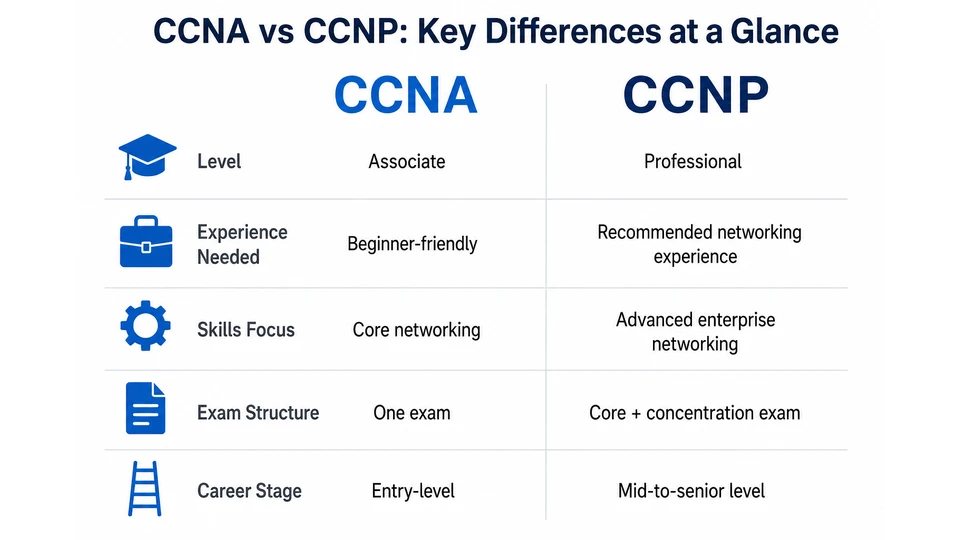
Similarities Between Both Certifications
Although they target different experience levels, both certifications share several important features.
Both certifications:
- Are offered by Cisco
- Validate networking knowledge
- Improve career prospects
- Focus on practical networking skills
- Require continuous learning to stay current
Many learners also compare CCNA and CCNP when deciding whether to start with CCNA or move directly toward a professional certification. Understanding these similarities helps you see how the certifications complement each other rather than compete.
Another common CCNA vs CCNP comparison is that both certifications include networking fundamentals such as routing, switching, security, and automation, but the depth of learning is significantly different.
Who Should Choose CCNA or CCNP?
Selecting the right certification depends on your experience, current job role, and career goals. There is no single answer because different professionals have different starting points.
Choose CCNA if you:
- You are new to networking
- You have little or no Cisco experience
- You want your first networking certification
- You want to build a strong basic understanding of networking
- You are aiming for entry-level IT or networking jobs
This is why CCNA vs CCNP for beginners usually favors CCNA. It introduces networking concepts step by step without expecting prior enterprise networking experience.
Choose CCNP if you:
- Already understand networking basics
- Work with enterprise networks
- Want to move into senior technical roles
- Need advanced troubleshooting skills
- Plan to specialize in Cisco technologies
One question many learners ask is Can I do CCNP without CCNA? The answer is yes. Cisco no longer requires you to earn CCNA before taking CCNP exams. However, having equivalent networking knowledge is highly recommended because CCNP assumes you already understand the topics covered in CCNA.
If you are trying to decide between CCNA and CCNP, it depends on your experience. CCNA is better for beginners because it teaches the basics of networking. CCNP is for people who already know networking and want to learn more advanced skills for bigger and more complex networks.
Exam Details, Requirements, and Difficulty
Once you understand the basics of both certifications, the next step is to compare their exam structure, requirements, and how difficult they are to learn. This helps you understand how much time and effort you will need before booking your exam.
CCNA Exam Details
CCNA requires you to pass one exam that checks your basic networking knowledge. It covers topics like:
- Network fundamentals
- IP connectivity
- Network access
- Security fundamentals
- Automation and programmability
- IP services
It verifies that you can set up, manage, and troubleshoot small to medium-sized network environments.
CCNP Exam Details
CCNP follows a different format. You need to pass:
- 1. One core exam
- 2. One concentration exam based on your chosen specialization
Popular specializations include Enterprise, Security, Data Center, Service Provider, and Collaboration. This flexible approach lets you build expertise in the area that matches your career goals.
CCNP Certification Requirements
Many learners research the CCNP certification requirements before deciding to pursue it. Cisco does not require a CCNA certification to attempt CCNP. However, you should already have a solid understanding of networking fundamentals because the exams cover advanced enterprise networking topics.
How Difficult Are the Exams?
A common concern is how difficult CCNA and CCNP are. CCNA is easier because it focuses on basic networking skills and is designed for beginners. CCNP is harder because it requires deeper knowledge and the ability to handle complex networking issues in large business networks.
When discussing CCNA vs. CCNP difficulty, think of CCNA as learning to drive a car and CCNP as learning to manage traffic across an entire city. Both require practice, but the scope and complexity are very different.
This also answers another frequently asked question: is ccnp harder than ccna? Yes. CCNP is generally harder because it covers more advanced concepts, larger network environments, and deeper troubleshooting techniques.
Skills You Gain and Benefits of Each Certification
Both certifications help you build valuable networking skills, but the level of expertise you develop depends on which path you choose.
Skills You Learn with CCNA
CCNA helps you build a strong technical foundation by teaching you how networks operate in real-world environments.
You will learn how to:
- Configure routers and switches
- Understand IP addressing and subnetting
- Troubleshoot basic network issues
- Secure network devices
- Work with wireless networks
- Understand network automation basics
These practical skills help you get entry-level networking jobs and also make it easier to understand more advanced technologies in the future.
Skills You Learn with CCNP
CCNP goes beyond the basics. Instead of just setting up devices, you learn how to design, improve, secure, and fix large business networks.
You'll gain experience in:
- Advanced routing protocols
- Enterprise network design
- High availability
- Network automation
- Security implementation
- Performance optimization
These skills are valuable for professionals responsible for maintaining business-critical networks.
Benefits of CCNA
Some main benefits include:
- Builds a strong foundation in networking
- Helps you get entry-level IT jobs
- Improves your confidence with Cisco tools and technologies
- Helps you learn advanced certifications more easily later
- Is well recognized by employers worldwide
Benefits of CCNP
Professionals often choose CCNP because it:
- Demonstrates advanced technical expertise
- Opens doors to senior networking roles
- Supports specialization in different Cisco technologies
- Improves troubleshooting and design skills
- Strengthens long-term career growth
CCNA vs CCNP Pros and Cons Comparison
|
Certification |
Pros |
Cons |
|---|---|---|
|
CCNA |
|
|
|
CCNP |
|
|
If you compare CCNA and CCNP, CCNA is easier and best for beginners who are new to networking. CCNP is more advanced and is better for people with experience who want to learn deeper skills and grow in their careers.
Salary, Career Opportunities, and Current Market Demand
Cisco certifications are still highly valued because companies depend on safe and reliable networks. With the rapid expansion of cloud computing, cybersecurity, and automation, there is a constant need for skilled networking professionals.
CCNA vs CCNP Career Opportunities
When comparing CCNA vs CCNP career opportunities, the biggest difference is the level of responsibility.
After earning CCNA, you may qualify for roles such as:
- Network Technician
- IT Support Engineer
- NOC Technician
- Junior Network Administrator
- Field Support Engineer
These positions focus on installing, maintaining, and troubleshooting network infrastructure. To understand how salary and career growth typically progress after CCNA, it is useful to examine CCNA Salary and Career Growth to see how roles and experience levels affect earning potential over time.
Professionals with CCNP often move into roles such as:
- Network Engineer
- Senior Network Engineer
- Network Consultant
- Enterprise Infrastructure Engineer
- Network Architect (with additional experience)
These jobs involve designing, optimizing, and managing large enterprise networks.
Another benefit of CCNA vs CCNP career paths is that both offer a clear learning path. Most professionals start with CCNA, gain experience, and then move on to CCNP for advanced roles.
CCNA vs CCNP Salary
One of the biggest deciding factors is salary. When comparing CCNA vs. CCNP salaries, CCNP-certified professionals generally earn more because they handle more complex projects and assume greater technical responsibility.
Several factors influence earnings, including:
- Years of experience
- Job role
- Industry
- Location
- Additional certifications
Looking at CCNA vs. CCNP salaries, CCNA can help you secure a solid entry-level income. At the same time, CCNP often leads to higher-paying mid-level and senior networking positions as your experience grows.
Current Market Demand
Companies are using more computers, cloud tools, and secure internet systems than ever before. Because of this, they need people who understand Cisco networking to help set up and manage these systems, so these skills are needed in many different jobs and industries such as:
- Information Technology
- Banking and Finance
- Healthcare
- Telecommunications
- Government
- Manufacturing
These certifications can help you find stable job opportunities in many industries, as networking skills are needed in almost every modern business.
Choosing Between CCNA and CCNP: Study Strategy and Career Roadmap
If you are starting your networking career or want to move into advanced jobs later, having a clear study plan helps a lot. CCNA teaches you the basic networking skills, while CCNP takes you to a more advanced level used in larger companies. Instead of choosing one over the other, think of them as steps you take one after another in your career. What you choose depends on how much you already know and what job you want in the future. A step-by-step plan like the CCNA Course Certification Path can help beginners learn easily and grow toward CCNP over time.
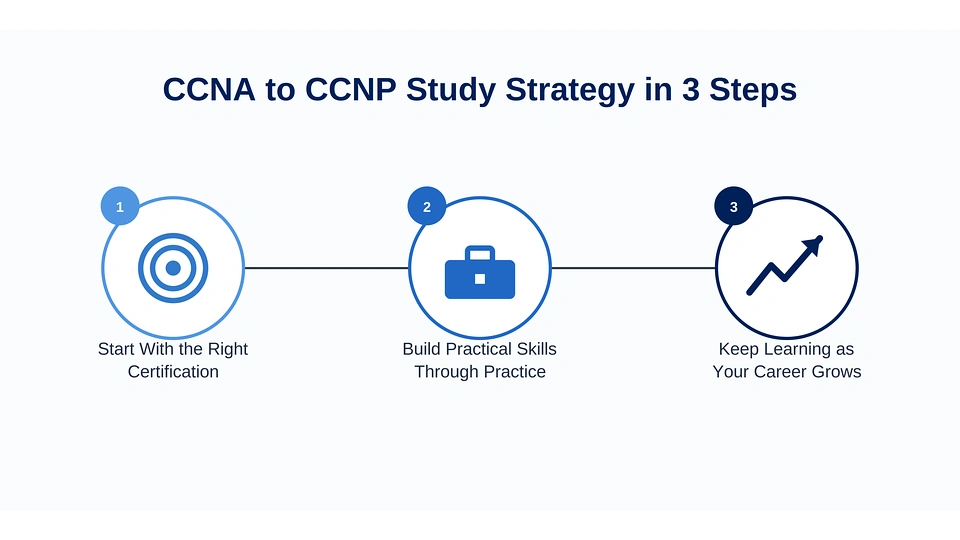
Step 1: Start with the Right Certification for Your Experience
If you are new to networking, it is best to start with CCNA. It teaches you the basic ideas like how devices get IP addresses, how data moves through networks, how networks stay secure, and how wireless connections work. It also introduces simple automation concepts. Learning these basics first makes it much easier to understand advanced topics later.
CCNA is a good choice if you want to:
- Learn networking from the basics
- Build strong technical skills step by step
- Get ready for entry-level IT and networking jobs
- Prepare for advanced Cisco certifications in the future
If you already have equivalent networking knowledge or practical experience, you can prepare directly for CCNP by selecting a specialization that matches your career goals. Popular options include:
- CCNP Enterprise focuses on how big company networks work, including routing and switching.
- CCNP Security teaches how to protect networks using tools like firewalls and VPNs.
- CCNP Data Center is about managing and organizing powerful systems used by large organizations.
- CCNP Collaboration covers communication tools like calls, video meetings, and messaging systems.
- CCNP Service Provider is about managing very large networks used by internet companies (ISPs).
Choosing the right starting point helps you learn at a comfortable pace and build skills that are relevant to your future role.
Step 2: Build Practical Skills Through Consistent Practice
No matter which certification you choose, practicing is just as important as learning theory. Try using home labs, simulators, or virtual setups to work with network devices. Practice setting things up and fixing problems so you can better understand how networking works in real situations.
A balanced study plan should include:
- Reading official study materials
- Practicing configuration labs regularly
- Taking mock exams to measure progress
- Reviewing weak topics before the exam
- Applying concepts in real or virtual network environments
Many learners ask, how long does it take to go from CCNA to CCNP? There is no fixed timeline. Most professionals spend one to three years gaining practical networking experience after earning CCNA before moving on to CCNP. However, the pace depends on your learning schedule, work experience, and confidence with enterprise networking concepts.
Continue Learning as Your Career Progresses
As your knowledge grows, your certification path can grow with it. Understanding the differences between CCNA and CCNP helps you choose the right learning path at each stage of your career. CCNA develops broad networking knowledge, while CCNP focuses on advanced design, implementation, automation, and troubleshooting for enterprise environments.
Some people also compare CCNA, CCNP, and CCIE when planning their career growth. These certifications show different skill levels. CCNA is the starting level where you learn the basics, CCNP is the next level where you build stronger professional skills, and CCIE is the highest level for experts who work with very complex and large network systems.
A simple Cisco certification roadmap looks like this:
- 1. Start by learning the basics of networking with CCNA
- 2. Practice your skills using labs or real projects
- 3. Move on to CCNP in the area you want to specialize in
- 4. Go for CCIE if you want to reach expert-level networking jobs
If you are still wondering which is better, ccna or ccnp, the answer depends on your current experience. CCNA serves as the best entry-level certification for those new to networking, while CCNP is the better choice for professionals who already understand networking fundamentals and are equipped to step into more advanced job responsibilities in networking. For beginners seeking a clear, step-by-step learning path in networking, the SterlingNext CCNA Program can be a helpful starting point before moving on to advanced certifications like CCNP.
Conclusion
Choosing between CCNA and CCNP depends on your current knowledge, experience, and long-term career goals. Understanding the Difference between CCNA and CCNP makes it helps you choose the certification that best matches your skills and long-term goals. If you are new to networking, CCNA provides a strong foundation for understanding networking concepts and securing entry-level roles. If you already know some networking and want to work with bigger company networks, CCNP helps you learn more advanced skills and move into better job roles. Instead of thinking of CCNA and CCNP as choices against each other, think of them as steps in the same learning path. Start with the level that matches what you already know, keep practicing in real or lab environments, and slowly build your skills as you move toward your career goals.
Recommended Reads
Get Certified With Industry Level Projects & Fast Track Your Career
Checkout Top 10 Highest Paying Jobs
Frequently Asked Questions
CCNA teaches simple networking basics for beginners so you can understand how networks work. CCNP is more advanced and is for people with experience who want to manage bigger and more complex company networks.
For beginners, CCNA is the ideal first certification. It introduces networking fundamentals in an easy-to-follow format and doesn't require previous enterprise networking knowledge. The skills you gain also prepare you for advanced certifications such as CCNP.
No. Cisco no longer requires CCNA before attempting CCNP exams. However, you should have equivalent networking knowledge and a solid understanding of networking fundamentals, as CCNP covers more advanced enterprise technologies and concepts.
CCNP usually takes longer to prepare for because it covers advanced networking concepts, enterprise technologies, troubleshooting, and implementation. Most candidates also spend additional time gaining hands-on practice to master the exam objectives.
Both certifications can help you grow your career, however CCNP is often preferred for advanced networking roles because it prepares you for more complex tasks and greater responsibilities. It can also open the door to senior positions and support long-term career growth.
Yes. CCNA is a well-known certification for people starting a career in networking. It can help you apply for roles such as Network Technician, NOC Technician, Junior Network Administrator, or IT Support Engineer. Your skills, hands-on experience, and the employer's requirements will also influence the opportunities available to you.
Yes. CCNA and CCNP certifications need to be renewed from time to time to remain active. This helps confirm that your networking skills and knowledge stay up to date as technologies and industry practices continue to change.
Yes. You can study for CCNP without professional work experience, but practical networking knowledge makes advanced topics easier to understand. Hands-on practice also improves confidence and increases your chances of passing the certification exams.
It depends on your experience. CCNA is good if you are starting your networking career, while CCNP is better if you already have experience and want more advanced job roles.
Not necessarily. Many networking professionals keep learning through Cisco’s specialized certifications and some go on to pursue advanced expert-level certifications like CCIE to build stronger skills and grow their careers further.