
Training Outcomes Within Your Budget!
We ensure quality, budget-alignment, and timely delivery by our expert instructors.
Table of Content
- AWS DevOps Engineer Certification Guide for Professionals
- AWS DevOps Engineer Certification Guide at a Glance
- DOP-C02 Requirements and Candidate Profile
- AWS DOP-C02 Exam Syllabus and Domain Breakdown
- High-Priority AWS Services for DOP-C02 Preparation
- Core Skills for AWS DevOps Operations
- How Difficult Is AWS DevOps Engineer Professional?
- How to Prepare for AWS DevOps Engineer Professional
- DOP-C02 Scenario-Based Practice Examples
- AWS DevOps Engineer Professional Certification Cost
- AWS Developer Associate vs DevOps Engineer Professional
- Career Path, Job Demand, and Salary Outlook
- Is AWS DevOps Certification Worth It?
- AWS DevOps Engineer Professional Recertifications
- Conclusion
Recent Blogs
Cloud Computing Salary Guide 2026: AWS, Azure & GCP
August 18th, 2026
CompTIA Cloud+ Certification: Complete Guide
August 18th, 2026
AWS Developer Certification: Study Guide & Exam Tips
August 18th, 2026
ISO 22000 Documentation Requirements
August 18th, 2026
ISO 31000 vs ISO 27001
August 18th, 2026
ISO 22000 vs HACCP
August 17th, 2026
PMP Exam July 2026: What's Changed and How to Prepare
August 17th, 2026
CISSP Book Insights to Keep Your Exam Preparation on Track
August 14th, 2026
Benefits of ISO 14001 Certification
August 14th, 2026
CISM Certification Cost and Roadmap for Career Success
August 12th, 2026
ISO 20000 IT Service Management
August 10th, 2026
What is ISO Lead Auditor Certification?
August 10th, 2026
ISO Auditor Roles and Responsibilities
August 10th, 2026
Why Choosing PMI RMP Certification Can Benefit Your Career
August 10th, 2026
What to Know Before the Lean Six Sigma Green Belt Exam
August 10th, 2026
AWS DevOps Engineer Certification: Complete Guide
Last updated on August 18th, 2026
- Share
-

-

-

-

-

 Sachin Kumar
This AWS DevOps Engineer Certification Guide explains what the DOP-C02 exam covers, who it suits, how difficult it can be, which services deserve attention, and how to prepare with practical work instead of memorizing service names, it also covers cost, career options, salary considerations, renewal, Infrastructure as Code, CI/CD, governance, DevSecOps, and modern operational tools.
AWS DevOps Engineer Certification Guide for Professionals
AWS Certified DevOps Engineer Professional is designed for people who work across cloud operations, automation, software delivery, reliability, monitoring, and security on AWS. Knowing the AWS Developer Exam can also help explain how developer-focused AWS skills differ from the broader automation and operations work covered at the DevOps Professional level. It is not an entry-level credential. This AWS DevOps Engineer Certification Guide explains what the DOP-C02 exam covers, who it suits, how difficult it can be, which services deserve attention, and how to prepare with practical work instead of memorizing service names, it also covers cost, career options, salary considerations, renewal, Infrastructure as Code, CI/CD, governance, DevSecOps, and modern operational tools.\
AWS DevOps Engineer Certification Guide at a Glance
AWS Certified DevOps Engineer Professional credential before going deeper into the exam, it covers the certification level, exam code, duration, question format, cost, recommended experience, validity period, testing options, and the score candidates need to pass.
What is AWS DevOps Engineer Certification
AWS Certified DevOps Engineer Professional shows advanced knowledge of managing applications and systems on AWS. The exam covers setting up and managing systems, security, monitoring, automation, and handling problems. It also tests how tools such as deployment pipelines, infrastructure, monitoring systems, security controls, and reliable system designs work together.
|
Exam detail |
Information |
|---|---|
|
Certification |
AWS Certified DevOps Engineer Professional |
|
Exam code |
DOP-C02 |
|
Level |
Professional |
|
Duration |
180 minutes |
|
Questions |
75 |
|
Question types |
Multiple choice and multiple response |
|
Exam fee |
USD 300 |
|
Passing score |
750 out of 1,000 |
|
Recommended experience |
2+ years |
|
Standard validity |
3 years |
|
Testing options |
Pearson VUE test center or online proctored exam |
|
Languages |
English, Japanese, Korean, and Simplified Chinese |
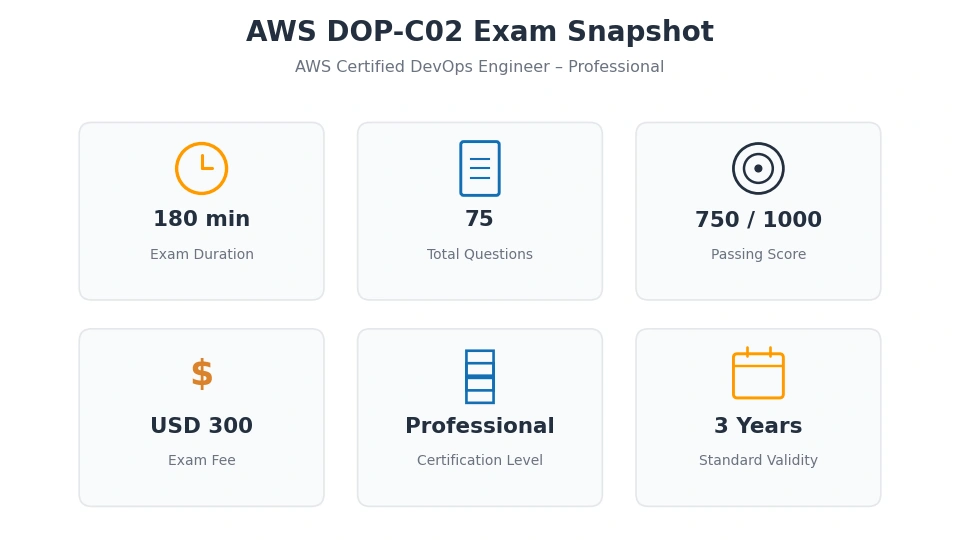
AWS states that 65 questions are scored and 10 are unscored. The unscored questions are not identified during the exam. The reported score ranges from 100 to 1,000, and 750 is the minimum passing score.
DOP-C02 Requirements and Candidate Profile
The AWS DevOps certification requirements are mainly based on work experience rather than other certifications. AWS recommends at least two years of practical experience managing AWS systems, basic understanding of software development, programming, or scripting can also be useful.
Recommended Experience Before DOP-C02
A useful background includes experience with:
- Automated cloud infrastructure
- Operating-system administration
- Development and operations practices
- AWS security and access controls
- Monitoring and troubleshooting
- Scripting for repetitive tasks
- Infrastructure as Code
- CI/CD workflows
There is no mandatory Associate-level AWS certification that must be completed first. However, the AWS DevOps certification requirements make it clear that practical AWS experience matters more than simply collecting earlier credentials.
Do you need coding experience for AWS DevOps certification
Basic programming or scripting skills are helpful, but advanced application development is not required, familiarity with Bash, Python, JSON, YAML, AWS CLI commands, and Infrastructure as Code helps with automation tasks. AWS recommends programming or scripting experience, while full-stack development is not a main part of the exam.
Topics You Do Not Need to Study Too Deeply
DOP-C02 focuses mainly on DevOps tasks and AWS operations, it does not require deep knowledge of full-stack development, database design, advanced networking, or specialized application security. Basic knowledge of these areas can help, but study should focus on automation, system management, monitoring, security, reliability, and software delivery.
AWS DOP-C02 Exam Syllabus and Domain Breakdown
The AWS DOP-C02 exam syllabus has six domains; each domain has a percentage that shows its share of the exam.
|
Domain |
Weight |
|---|---|
|
SDLC Automation |
22% |
|
Configuration Management and IaC |
17% |
|
Resilient Cloud Solutions |
15% |
|
Monitoring and Logging |
15% |
|
Incident and Event Response |
14% |
|
Security and Compliance |
17% |
Domain 1 SDLC Automation: 22%
This is the largest domain. It focuses on how code moves from the source code system to testing and deployment. Key topics include build processes, testing, storing application files, deployment methods, permissions, cross-account deployments, security, and recovery when something fails. Practical study can include creating a simple pipeline, causing a planned failure, and checking how the system rolls back or returns to normal.
Domain 2 Configuration Management and IaC: 17%
This domain focuses on setting up and managing infrastructure in a consistent way, key topics include templates, stacks, managing changes, reusable setups, setting up resources across multiple accounts, automatic configuration, and rules for managing resources.
AWS CloudFormation and AWS CDK are important because they allow infrastructure to be defined and managed through code. Candidates should also understand how StackSets, Systems Manager, AWS Organizations, and Control Tower can support standardized environments.
Domain 3 Resilient Cloud Solutions: 15%
This domain focuses on building systems that keep working when something fails, key topics include keeping systems available, handling more users or workloads, backups, recovery, separating failures, using multiple Availability Zones, checking system health, directing traffic, and setting recovery goals.
Do not study resilience only as architecture theory. Practice deciding which recovery approach fits a given business requirement, cost limit, and recovery target.
Domain 4 Monitoring and Logging: 15%
This domain focuses on finding and understanding system problems. Key topics include metrics, logs, traces, dashboards, alerts, and events. Common services include CloudWatch, CloudTrail, and AWS X-Ray. Centralized logs, alerts, data storage periods, and system visibility are also important.
Exam questions may ask which monitoring method or information is most useful for finding a specific problem, rather than simply asking for the name of a monitoring service.
Domain 5 Incident and Event Response: 14%
This domain focuses on handling system problems, finding their causes, fixing issues automatically, and restoring normal operation, it also covers event-based actions and investigating incidents across different AWS services.
Important topics include EventBridge, Lambda, Systems Manager automation, alarms, and notification processes, practice should include finding a problem, identifying its cause, and deciding whether the fix should happen automatically or require human action.
Domain 6 Security and Compliance: 17%
Security questions focus on IAM, secrets, encryption, logging, account controls, compliance, and fixing security issues, key topics include, giving only the required access, using temporary credentials, protecting encryption keys, storing secrets securely, setting account controls, applying security policies, and keeping audit records.
AWS DevSecOps automation places security checks and responses inside delivery and operational workflows instead of treating security as a final manual step.
This syllabus is best used as a decision-making map. Knowing service names is useful, but candidates also need to understand which design is more secure, resilient, automated, maintainable, or cost-aware in a specific scenario.
High-Priority AWS Services for DOP-C02 Preparation
The exam is not built around memorizing a fixed list, but certain services repeatedly support the skills tested across its domains. This is a practical priority list rather than the complete list of AWS services that may appear within the DOP-C02 exam scope.
|
Exam area |
Services and tools to understand |
|---|---|
|
CI/CD |
CodePipeline, CodeBuild, CodeDeploy, CodeArtifact |
|
Infrastructure as Code |
CloudFormation, AWS CDK, AWS SAM |
|
Monitoring |
CloudWatch, CloudTrail, AWS X-Ray |
|
Governance |
Organizations, Control Tower, AWS Config |
|
Operations |
Systems Manager, Lambda, Step Functions, EventBridge |
|
Security |
IAM, KMS, Secrets Manager, Security Hub, GuardDuty |
|
Containers |
ECS, EKS, ECR, Fargate |
|
Reliability |
Route 53, Elastic Load Balancing, Auto Scaling, AWS Backup |
Candidates do not need to treat every service equally. A better approach is to learn what problem a service solves, how it integrates with other services, what permissions it needs, and when another option would be more appropriate.
Core Skills for AWS DevOps Operations
The main AWS DevOps engineer skills include automation, software delivery, infrastructure management, monitoring, security, governance, and troubleshooting. Exam questions may combine several of these areas in one situation, requiring the right approach to solve the problem.
CI/CD and Deployment Automation
AWS CI/CD pipeline automation helps move code through building, testing, storing files, deploying, checking, and monitoring with less manual work, important topics include deployment methods, pipeline permissions, testing steps, cross-account deployments, secret handling, and recovering from failed releases.
Infrastructure as Code and Configuration
Infrastructure as Code helps create and manage systems in a consistent way, topics include planning changes, keeping versions, getting approval, applying changes, and rolling them back when needed. It also covers detecting differences between the planned setup and the actual setup, reusing templates, keeping configurations consistent, and avoiding unplanned manual changes.
Security and Multi-Account Governance
AWS multi-account governance for DevOps helps manage multiple AWS accounts for different teams, applications, or environments, topics include AWS Organizations, Control Tower, service control policies, central logging, standard account settings, and automatic account setup. These tools help apply the same rules and security controls across many accounts.
Amazon Q Developer in Modern DevOps Work
Amazon Q Developer is a helpful tool for AWS and programming work, it can help with coding, testing, security checks, AWS questions, and finding problems in systems. It can also save time by handling some repeated tasks. However, for the DOP-C02 exam, candidates still need to understand AWS architecture, permissions, monitoring, and how to handle problems when they occur.
Together, these areas reflect the AWS DevOps engineer skills needed to connect software delivery with dependable cloud operations.
Amazon Q Developer for DevOps can also support everyday tasks such as understanding code, troubleshooting issues, reviewing AWS resources, and working with development workflows.
Note: Amazon Q Developer reflects current AWS development and operations workflows, but it is not specifically listed as a DOP-C02 exam objective in the current AWS exam guide.
How Difficult Is AWS DevOps Engineer Professional?
The AWS DevOps Engineer Professional exam difficulty comes mainly from long, scenario-based decisions rather than basic definitions. A single question may combine deployment, IAM, monitoring, resilience, automation, governance, and troubleshooting while presenting several technically possible answers.
Candidates need to identify the requirement that matters most. One answer may be cheaper, another easier to operate, another more secure, and another more automated. The correct choice depends on the wording of the scenario.
Time management also matters because 75 questions must be handled within 180 minutes. The AWS DevOps Engineer Professional exam difficulty is usually more manageable for people who have already built and operated AWS workloads instead of learning every concept only from study notes.
How to Prepare for AWS DevOps Engineer Professional
A useful AWS DevOps Engineer Professional exam preparation plan should include the official exam guide, hands-on practice, scenario-based questions, and timed tests, the study schedule matters less than understanding each domain and knowing why one solution is better than another.
Candidates who prefer a structured approach can use AWS DevOps Certification Training alongside hands-on labs and scenario-based practice to study the main DOP-C02 topics in a clear and organized way.
Eight-Week DOP-C02 Study Roadmap
|
Week |
Main focus |
Practical work |
|---|---|---|
|
1 |
SDLC Automation |
Build a basic pipeline |
|
2 |
IaC and configuration |
Deploy and update infrastructure through code |
|
3 |
Resilient solutions |
Test scaling, backup, and recovery choices |
|
4 |
Monitoring and logging |
Build alarms, dashboards, and log queries |
|
5 |
Incident response |
Automate a simple event response |
|
6 |
Security and compliance |
Review IAM, KMS, secrets, and governance |
|
7 |
Mixed scenarios |
Solve cross-domain questions |
|
8 |
Final revision |
Take timed mocks and review mistakes |
Hands-On Projects That Build Exam Judgment
Useful projects include creating a CI/CD pipeline with rollback, setting up infrastructure with templates, collecting logs in one place, creating CloudWatch alarms, automating fixes, setting up cross-account permissions, and testing backup or recovery.
Large production systems are not needed, small hands-on labs are enough when they involve making decisions and seeing how the system responds when something goes wrong.
Common Preparation Mistakes
Common problems include:
- Learning service names without knowing when to use them.
- Skipping practical lab work.
- Giving less attention to IAM and security.
- Not practicing failure, recovery, and rollback situations.
- Practicing only easy single-service questions.
- Taking mock exams without reviewing why answers were wrong.
DOP-C02 Scenario-Based Practice Examples
The following examples are original practice scenarios designed to build decision-making skills. They are not real AWS exam questions.
|
Scenario |
What to Look For |
Best Approach |
|---|---|---|
|
Deployment failure |
Health checks fail after a production release |
Use automated deployment validation and rollback to return to a stable version |
|
Multi-account governance |
Several AWS accounts need common security controls |
Use organization-level controls, standardized account setup, centralized logging, and automated provisioning |
|
Monitoring and incident response |
An application has intermittent latency across several services |
Combine metrics, logs, tracing, alarms, and request correlation to locate the issue |
|
Secret management |
Database credentials are stored in configuration files |
Use centralized secret storage, IAM-based access, rotation where needed, and runtime retrieval |
AWS DevOps Engineer Professional Certification Cost
The DOP-C02 exam fee is USD 300. The total budget may be higher when optional training, labs, practice tests, taxes, or a retake are included.
|
Cost area |
What to consider |
|---|---|
|
Exam |
USD 300 |
|
Training |
Optional |
|
Labs |
Free or paid |
|
Practice exams |
Optional |
|
Retake |
Additional exam fee if needed |
Candidates should check the official AWS Certification page before booking because fees, taxes, and local currency amounts can change.
AWS Developer Associate vs DevOps Engineer Professional
These certifications overlap in some AWS services, but they test different job responsibilities.
|
Factor |
Developer Associate |
DevOps Engineer Professional |
|---|---|---|
|
Level |
Associate |
Professional |
|
Main focus |
Building AWS applications |
Operating and automating AWS environments |
|
CI/CD depth |
Important |
Major focus |
|
Monitoring |
Moderate |
Strong focus |
|
Infrastructure as Code |
Important |
Strong focus |
|
Governance |
Limited depth |
Greater depth |
|
Incident response |
Less central |
Major exam area |
|
Recommended experience |
Lower |
Advanced |
Developer Associate is usually better aligned with application development. DevOps Engineer Professional fits people working with delivery automation, operations, reliability, governance, and platform engineering.
DOP-C02 Retake Policy
Candidates who do not pass the DOP-C02 exam must wait 14 calendar days before trying again. There is no limit on attempts, but the full exam fee applies each time. Use the waiting period to review weak topics, go through incorrect answers, and get more practice with AWS services.
Career Path, Job Demand, and Salary Outlook
AWS DevOps careers can follow different paths based on experience, skills, and the type of cloud work involved, key areas include career growth, job demand, and salary factors that affect opportunities for AWS DevOps professionals.
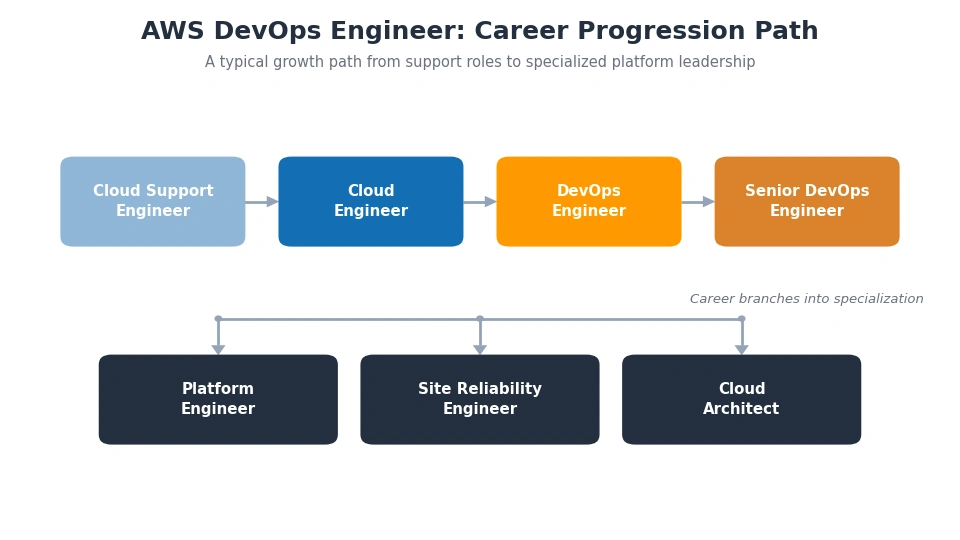
Career Progression for AWS DevOps Engineers
Certification can help with career growth, but employers also value practical skills in automation, troubleshooting, security, scripting, containers, monitoring, and cloud architecture.
Job Market Outlook for AWS DevOps Engineers
AWS DevOps Engineer job demand differs by employer, industry, and location. Jobs may be listed under titles such as DevOps, cloud, platform, automation, or site reliability, since U.S. employment reports do not track DevOps as a standalone category, their figures cover the broader technology sector rather than AWS DevOps jobs specifically.
When looking at AWS DevOps Engineer job market demand, it is also useful to check related roles such as platform engineer, cloud engineer, automation engineer, and site reliability engineer.
Salary Outlook for AWS DevOps Engineers
The AWS DevOps engineer salary depends on location, experience, employer, and skills, pay can also vary based on experience with AWS, automation, cloud platforms, and related tools. Salary figures change over time, so current salary data should be checked before making comparisons.
When comparing an AWS DevOps engineer salary, check the date, location, job level, and source rather than relying on one national average. A senior platform engineer in a major technology market may have a very different compensation range from an early-career cloud engineer.
Is AWS DevOps Certification Worth It?
Is AWS DevOps certification worth it for someone already working with AWS infrastructure, CI/CD, cloud operations, platform engineering, or automation? In many cases, yes. The certification validates advanced operational knowledge and gives experienced professionals a structured way to review delivery, monitoring, security, resilience, governance, and incident response.
|
May be a good fit for |
May not be the first choice for |
|---|---|
|
DevOps engineers |
Complete AWS beginners |
|
Cloud engineers |
People seeking only basic cloud knowledge |
|
Platform engineers |
Roles focused mainly on application coding |
|
Site reliability engineers |
Candidates without practical AWS exposure |
|
Automation professionals |
People who do not work with cloud operations |
When deciding whether the certification is worth pursuing, the target role matters more than the credential alone. It is most useful when certification study is supported by hands-on AWS work, labs, troubleshooting, automation projects, and practical system design.
AWS DevOps Engineer Professional Recertifications
AWS offers two ways to keep the AWS Certified DevOps Engineer Professional credential active. Candidates can pass the latest Professional-level exam to extend the certification for three years. Another option is AWS Skill Builder maintenance, which can extend the certification for one year.
The AWS DevOps engineer salary depends on location, experience, employer, and skills, pay can also vary based on experience with AWS, automation, cloud platforms, and related tools. Salary figures change over time, so current salary data should be checked before making comparisons.
Professionals considering other cloud and IT credentials can also look at SterlingNext Technology Certification Training to understand the different certification paths available across technology roles.
Conclusion
This AWS DevOps Engineer Certification Guide is useful for professionals who already have some AWS experience and want to learn more about automation, Infrastructure as Code, monitoring, security, resilience, governance, and incident response. Good preparation should include the official exam topics, small hands-on projects, practice questions, and review of mistakes. Practical experience also helps build a better understanding of how AWS services work together during changes, failures, recovery, scaling, and security tasks.
Get Certified With Industry Level Projects & Fast Track Your Career
Checkout Top 10 Highest Paying Jobs
Frequently Asked Questions
A useful guide puts the exam format, domain weightings, required experience, key AWS services, study tips, and career details in one place, it works best as a study reference along with the official AWS exam guide, hands-on labs, practice questions, and timed tests.
Yes. DOP-C02 is a Professional-level exam and expects real AWS experience, knowing individual services is not always enough because many questions involve automation, security, monitoring, resilience, and operational decisions. Hands-on AWS work can make these questions easier to understand.
The DOP-C02 exam fee is USD 300, the total study cost can be higher when paid courses, labs, practice tests, or a retake are included. Taxes and currency conversion may also change the final amount paid.
Candidates need at least 750 out of 1,000 to pass, AWS uses the overall exam score rather than requiring a separate passing score for each domain. The exam also includes unscored questions, which are not marked for candidates.
There are 75 questions to complete within 180 minutes. AWS states that 65 questions are scored and 10 are unscored, since the unscored questions are not identified, every question should be treated as important.
No. An Associate-level AWS certification is not required before taking DOP-C02, AWS recommends practical experience with AWS environments, software delivery, operations, automation, and scripting. Earlier certifications can help with preparation but are optional.
SDLC Automation has the highest weighting at 22% of the scored content, this area includes CI/CD pipelines, automated testing, artifact management, deployment methods, and release processes. Extra study time should be given to this domain because it carries the largest share.
Study time varies with AWS experience and hands-on skills, strong AWS experience may require only a few weeks, while limited practice can mean more preparation time. A useful readiness check is answering mixed questions and understanding why the other choices are wrong.
Key services include CodePipeline, CodeBuild, CodeDeploy, CloudFormation, CloudWatch, CloudTrail, Systems Manager, IAM, KMS, Organizations, Control Tower, Lambda, EventBridge, and AWS Config. The main focus should be on how these services work together in real AWS environments.
Job options include DevOps Engineer, Cloud Engineer, Platform Engineer, Site Reliability Engineer, Automation Engineer, Senior DevOps Engineer, and Cloud Architect. Certification can support career growth, but hands-on skills in scripting, troubleshooting, security, automation, and system design remain important to employers.