
Training Outcomes Within Your Budget!
We ensure quality, budget-alignment, and timely delivery by our expert instructors.
Table of Content
- AWS Developer Exam Guide: A Practical Learning Path
- What Is the AWS Certified Developer Associate DVA-C02 Exam?
- AWS Certified Developer Associate DVA-C02 at a Glance
- AWS DVA-C02 Exam Domains and Weightings
- AWS DVA-C02 High Yield Topics to Prioritize
- Technical Topics That Commonly Challenge DVA-C02 Candidates
- AWS DVA-C02 Study Roadmap and Scenario Practice
- DVA-C02 Final Week Study Checklist
- AWS DVA-C02 Scenario Based Practice Questions
- AWS Developer Exam Guide Tips and Mistakes to Avoid
- Conclusion
Recent Blogs
Cloud Computing Salary Guide 2026: AWS, Azure & GCP
August 18th, 2026
CompTIA Cloud+ Certification: Complete Guide
August 18th, 2026
AWS DevOps Engineer Certification: Complete Guide
August 18th, 2026
ISO 22000 Documentation Requirements
August 18th, 2026
ISO 31000 vs ISO 27001
August 18th, 2026
ISO 22000 vs HACCP
August 17th, 2026
PMP Exam July 2026: What's Changed and How to Prepare
August 17th, 2026
CISSP Book Insights to Keep Your Exam Preparation on Track
August 14th, 2026
Benefits of ISO 14001 Certification
August 14th, 2026
CISM Certification Cost and Roadmap for Career Success
August 12th, 2026
ISO 20000 IT Service Management
August 10th, 2026
What is ISO Lead Auditor Certification?
August 10th, 2026
ISO Auditor Roles and Responsibilities
August 10th, 2026
Why Choosing PMI RMP Certification Can Benefit Your Career
August 10th, 2026
What to Know Before the Lean Six Sigma Green Belt Exam
August 10th, 2026
AWS Developer Certification: Study Guide & Exam Tips
Last updated on August 18th, 2026
- Share
-

-

-

-

-

 Sachin Kumar
The sections below explain the exam format, main exam areas, important topics, study plan, practice scenarios, and common mistakes.
AWS Developer Exam Guide: A Practical Learning Path
AWS Certified Developer Associate certification covers how to build, secure, deploy, and troubleshoot applications on AWS. Candidates can also learn how AWS services work together in different cloud situations by using Preparing for AWS Architect Exam. This AWS Developer exam guide is useful for beginners, developers moving to cloud technology, and professionals preparing for the DVA-C02 exam.
Good preparation is not only about memorizing AWS services. It also requires understanding what each service does, when to use it, how different services work together, and how security and deployment choices affect applications. The sections below explain the exam format, main exam areas, important topics, study plan, practice scenarios, and common mistakes.
What Is the AWS Certified Developer Associate DVA-C02 Exam?
The AWS Certified Developer Associate DVA-C02 is an associate-level AWS certification exam for developers. It tests skills in developing, testing, deploying, securing, debugging, and optimizing AWS cloud applications. The exam contains 65 questions, lasts 130 minutes, and requires a minimum scaled score of 720 to pass.
AWS Certified Developer Associate DVA-C02 at a Glance
The exam is aimed at a developer role. AWS currently lists 65 multiple-choice or multiple-response questions, 130 minutes of testing time, and a fee of $150 USD. Of the 65 questions, 50 affect the score and 15 are unscored. The minimum passing score is 720 on a 100–1,000 scale. AWS does not identify the unscored questions during the exam.
DVA-C02 Exam Format
|
Exam Detail |
DVA-C02 Information |
|---|---|
|
Exam code |
DVA-C02 |
|
Level |
Associate |
|
Questions |
65 |
|
Time |
130 minutes |
|
Question types |
Multiple choice and multiple response |
|
Scored questions |
50 |
|
Unscored questions |
15 |
|
Passing score |
720 |
|
Exam fee |
$150 USD |
These figures provide a simple view of the AWS DVA-C02 exam cost and passing score. AWS also states that unanswered questions are marked incorrect and there is no penalty for guessing.
There is no required AWS certification before taking this exam. However, AWS recommends some practical experience. The target candidate typically has at least one year of experience developing and maintaining applications using AWS services.
Basic knowledge of a high-level programming language, application development, development tools, AWS APIs, SDKs, AWS CLI, and CI/CD is also recommended. These are recommended skills, not mandatory requirements for taking the exam.
These AWS Certified Developer Associate exam requirements help candidates understand the knowledge and practical skills recommended before preparing for DVA-C02.
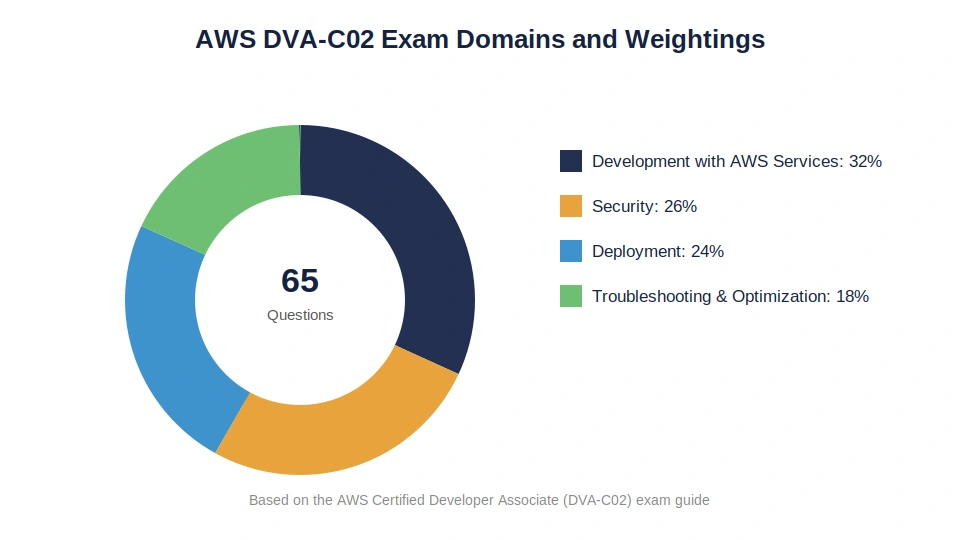
AWS DVA-C02 Exam Domains and Weightings
The AWS DVA-C02 exam is divided into different domains that cover the main skills required for an AWS developer, each domain focuses on a specific area of AWS development and has a different weight in the exam. Understanding these domains helps candidates know what topics to study.
Domain 1 Development with AWS Services
This domain covers developing code for AWS-hosted applications, working with Lambda, and using data stores. Candidates should understand event-driven and microservice patterns, stateful versus stateless design, synchronous versus asynchronous communication, APIs, messaging, SDKs, Lambda configuration, DynamoDB keys and indexes, Query versus Scan, consistency, and caching.
Domain 2 Security
This section focuses on how AWS applications are kept secure, it covers user authentication, access permissions, encryption, and data protection. Key areas include Amazon Cognito, IAM roles, bearer tokens, secure communication between services, key management, environment variables, and ways to protect sensitive information.
Domain 3 Deployment
Deployment questions cover application packages, testing, infrastructure as code, CI/CD, version control, rollbacks, and release methods, they test how code is tested, moved to AWS, and released safely while reducing the chance of errors or service issues.
Domain 4 Troubleshooting and Optimization
This area focuses on finding and fixing application problems, topics include logs, metrics, traces, debugging, monitoring, health checks, concurrency, caching, and resource usage. Questions may describe a problem and ask which AWS tool or feature can help identify the cause and fix it.
AWS DVA-C02 High Yield Topics to Prioritize
The following AWS DVA-C02 high yield topics are practical study priorities based on the current exam domains and in-scope services, AWS does not publish guaranteed question counts for individual services, so these topics should be used as study guidance rather than a prediction of the exam.
|
Topic |
What to Understand |
Typical Decision |
|---|---|---|
|
Lambda |
Invocation, permissions, concurrency, errors |
How should serverless code run? |
|
DynamoDB |
Keys, indexes, capacity, consistency |
How should application data be accessed? |
|
IAM |
Policies, roles, explicit deny |
Is an AWS request allowed? |
|
Cognito |
Application user identity and AWS access |
How should users sign in or receive credentials? |
|
SQS |
Queues and decoupling |
How can components process work independently? |
|
SNS |
Pub/sub messaging |
How can one message reach several subscribers? |
|
EventBridge |
Event routing |
How should events be sent by rules? |
|
API Gateway |
API access |
How should clients reach backend services? |
|
CodeDeploy |
Controlled releases |
How should a new version be deployed? |
|
X-Ray |
Distributed tracing |
Where is a request slowing or failing? |
|
Amazon Q Developer |
AI-assisted development and testing |
How can AI support coding, testing, and development tasks? |
Choosing the Right Service From Scenario Clues
A useful study habit is to connect a requirement with a service. “Decouple components” should suggest SQS. “Fan out a message” should bring SNS to mind. “Route events by rules” suggests EventBridge. “Trace a request across services” points toward X-Ray. “Store a secret” suggests Secrets Manager, while application-user authentication can point toward Cognito.
This approach is more useful than memorizing simple definitions because exam questions may include several possible services, instead of only asking, “What does this service do?” consider, “Which service best matches the given requirement?”
AI-Assisted Development Topics
The DVA-C02 exam guide includes Amazon Q Developer as a topic candidates may need to understand. It can help with coding and automated testing, AWS may also include unscored pretest questions on AI-assisted development, including code generation, testing, troubleshooting, security, CI/CD, and application improvement.
SQS vs SNS vs EventBridge for DVA-C02
SQS is used to hold messages and separate application tasks, SNS sends messages to multiple subscribers, and EventBridge sends events to different targets based on rules, DVA-C02 questions may ask which service is the best choice for a specific messaging or event-based need.
|
Service |
Main Use |
Common Exam Clue |
|---|---|---|
|
Amazon SQS |
Message queues and decoupling |
Process work independently |
|
Amazon SNS |
Pub/sub messaging |
Send one message to many subscribers |
|
Amazon EventBridge |
Event routing |
Route events using rules |
|
SQS + SNS |
Fan-out with queues |
Multiple systems need independent processing |
Technical Topics That Commonly Challenge DVA-C02 Candidates
Several technical areas become easier when they are reduced to a rule, a comparison, or a short calculation.
AWS Lambda Cold Starts and SnapStart
A Lambda cold start happens when AWS needs to set up a new execution environment before running a function, AWS Lambda cold starts and SnapStart are related because SnapStart can reduce startup time by using a saved snapshot of an initialized environment.
DynamoDB RCU and WCU Capacity Calculation
With provisioned capacity, 1 RCU handles one strongly consistent read per second for data up to 4 KB, it can handle two eventually consistent reads. 1 WCU handles one write per second for data up to 1 KB.
RCU Example
For a 6 KB item, DynamoDB rounds the size up to 8 KB for read calculations, strongly consistent read then uses 2 RCUs. An eventually consistent read uses half of that capacity.
WCU Example
If an item is 1.5 KB, it is rounded to 2 KB for writing, so one write per second needs 2 WCUs.
AWS Cognito User Pools vs Identity Pools
|
Feature |
User Pools |
Identity Pools |
|---|---|---|
|
Main purpose |
User directory and authentication |
Temporary AWS credentials |
|
Typical question |
Who is the application user? |
What AWS resources can the user access? |
|
Output |
Tokens |
Temporary AWS credentials |
|
Common use |
Sign-up and sign-in |
Access to services such as S3 or DynamoDB |
A simple memory rule is: User Pool identifies and authenticates the application user; Identity Pool can exchange identity information for temporary AWS credentials.
AWS IAM Policy Evaluation
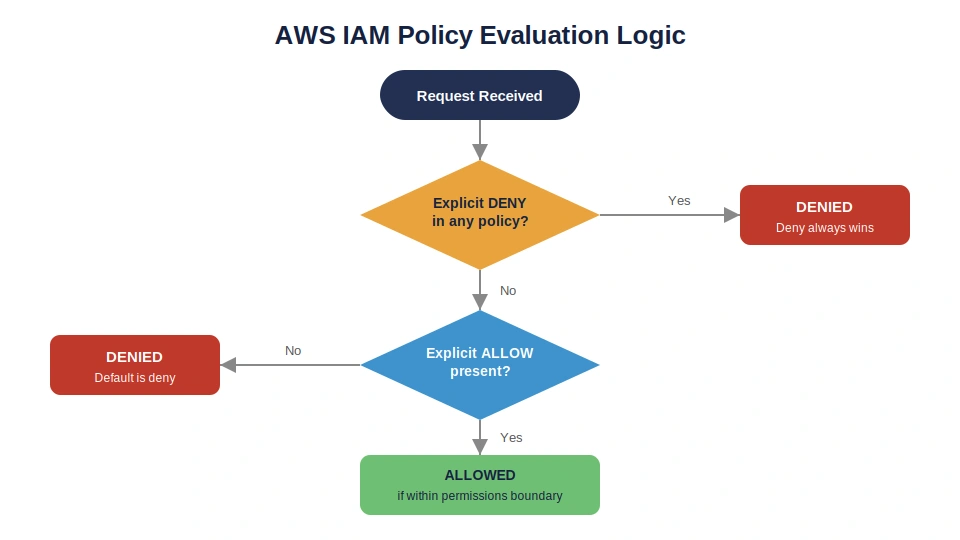
AWS IAM policy evaluation follows a deny-by-default approach. AWS checks the policies linked to a request, and an explicit deny always overrides an allow, permissions boundaries can also restrict the permissions given by identity-based policies. For exam questions, check for an explicit denial first, then confirm that the action is allowed.
AWS CodeDeploy Deployment Strategies
CodeDeploy supports several ways to release an application. In-place deployment updates existing EC2 or on-premises instances, Blue/green deployment moves traffic from an old environment to a new one and is used with Lambda and ECS, traffic can move in canary, linear, or all-at-once patterns. Questions may ask which option suits limited downtime, gradual releases, or fast rollbacks.
AWS X-Ray Tracing
AWS X-Ray tracing helps follow requests through distributed applications. A trace contains information about a request as it moves through services, while segments and subsegments add detail about work and downstream calls. It is especially relevant when a scenario asks where latency, an error, or a downstream dependency problem occurs.
AWS SAM and CDK
AWS SAM and CDK are both used for infrastructure as code, but they work in different ways, SAM uses a simpler template-based approach for serverless applications and works with CloudFormation, AWS CDK lets developers define AWS resources using programming languages, then converts the code into CloudFormation templates.
|
Area |
AWS SAM |
AWS CDK |
|---|---|---|
|
Style |
Declarative |
Programmatic |
|
Strong fit |
Serverless applications |
Broader code-defined infrastructure |
|
Local serverless testing |
SAM CLI |
SAM CLI can test Lambda functions from synthesized CDK apps |
AWS DVA-C02 Study Roadmap and Scenario Practice
A six-week plan gives time to study the exam topics. Study time can vary based on experience, each week can include AWS topics, hands-on practice, and exam questions.
|
Week |
Main Focus |
Hands-On Task |
Practice Goal |
|---|---|---|---|
|
1 |
Exam structure, IAM, architecture basics |
Create roles and test permissions |
Explain allow and deny outcomes |
|
2 |
Lambda, API Gateway, SQS, SNS, EventBridge |
Build a small event-driven flow |
Choose messaging services correctly |
|
3 |
DynamoDB, S3, caching |
Create a table and test reads/writes |
Practice keys, consistency, capacity |
|
4 |
Cognito, KMS, secrets |
Review authentication and secure configuration |
Separate identity from authorization |
|
5 |
CI/CD, CodeDeploy, SAM, CDK, observability |
Deploy and inspect logs/traces |
Recognize deployment and tracing clues |
|
6 |
Mixed review |
Repeat weak labs |
Complete timed mixed questions |
This AWS DVA-C02 study roadmap follows the main skills found across development, security, deployment, and troubleshooting while adding hands-on tasks that turn reading into practical review. For candidates who prefer a guided study plan, AWS Developer Certification Training can be a useful option alongside hands-on practice and self-study.
DVA-C02 Final Week Study Checklist
During the final week, spend more time on weak topics rather than trying to revise every AWS service. Review service differences, IAM permissions, DynamoDB calculations, deployment methods, Lambda, Cognito, messaging, and troubleshooting, take timed practice tests and check the reason behind every incorrect answer.
Then:
- Read the latest AWS exam guide.
- Study all four exam areas.
- Learn the differences between SQS, SNS, and EventBridge.
- Practice IAM permission questions.
- Practice DynamoDB RCU and WCU calculations.
- Review Lambda, API Gateway, and Cognito.
- Study deployment and rollback.
- Take timed practice tests.
AWS DVA-C02 Scenario Based Practice Questions
Practice AWS DVA-C02 scenario questions help candidates understand how AWS services are used in real development situations. These questions can cover deployment, security, troubleshooting, monitoring, APIs, permissions, and application performance, making it easier to choose the right service for different exam situations.
|
Scenario |
Question |
Answer |
|
|---|---|---|---|
|
1 |
Lambda Cold Starts |
Lambda connects to RDS and times out under sudden traffic spikes. What should you implement? |
RDS Proxy: pools and reuses connections, preventing exhaustion during concurrent Lambda invocations. |
|
2 |
DynamoDB Throttling |
Table throttles during a flash sale despite on-demand capacity. Likely cause? |
Hot partition key: traffic is skewed toward one key value, not overall capacity. |
|
3 |
S3 Event-Driven Processing |
Trigger image resizing on S3 upload, with retry on failure. Best approach? |
S3 Event → SQS → Lambda, with a Dead Letter Queue (DLQ) for failed attempts. |
|
4 |
API Gateway Throttling |
Users get 429 Too Many Requests. Fix without harming legitimate traffic? |
Configure usage plans + API keys, adjust throttling/burst limits per client. |
|
5 |
CI/CD Rollback |
CodeDeploy deployment causes production errors. Minimize downtime? |
Use blue/green deployment with automatic rollback via CloudWatch alarms. |
|
6 |
Secrets Management |
App hardcodes DB credentials. Secure fix? |
Store credentials in AWS Secrets Manager, retrieve at runtime via SDK. |
AWS Developer Exam Guide Tips and Mistakes to Avoid
Good preparation depends on understanding how AWS services solve developer problems. The following AWS Developer Associate exam tips are more useful than memorizing hundreds of isolated facts.
How to Pass AWS Developer Associate Exam
- 1. Read the official exam guide before building a study schedule.
- 2. Divide study time by domain while still reviewing all four areas.
- 3. Compare similar services such as SQS, SNS, and EventBridge.
- 4. Practice AWS IAM policy evaluation instead of only reading policy definitions.
- 5. Build small applications that use Lambda, APIs, data stores, and messaging.
- 6. Review every wrong practice answer and record the reason.
- 7. Revisit weak topics before taking full timed practice exams.
AWS recommends checking the official exam guide, reviewing important topics, practicing exam-style questions, gaining hands-on experience, and using an official practice exam to check readiness.
A practical AWS Developer exam guide should also train candidates to notice requirement words. Phrases such as “least operational effort,” “decoupled,” “temporary credentials,” “trace a request,” or “minimize interruption” can narrow the possible answer.
AWS DVA-C02 Exam Mistakes
Common mistakes are studying service definitions without seeing how the services work together, missing IAM permissions, mixing up messaging services, avoiding DynamoDB calculations, and spending too much time on Lambda while neglecting deployment topics, mock tests are less useful when wrong answers are not reviewed. Older notes should also be checked with the latest AWS exam guide.
Another useful AWS Developer Associate exam tip is to learn how to pick the right service for a given situation, know what each service does, compare it with similar services, and look for the requirement that points to the best option.
Candidates comparing different learning paths can also refer to SterlingNext Technology Training Programs when considering certification-focused training across cloud and IT areas.
Conclusion
The AWS Developer exam guide is a good starting point for DVA-C02 preparation. It explains the main topics covered in the exam and helps organize study time. Focus on Lambda, DynamoDB, IAM, Cognito, messaging services, deployment, and monitoring. Hands-on practice can make these topics easier to understand and show how AWS services work together. Practice tests are also useful, but reviewing incorrect answers is important. Instead of memorizing service definitions, learn what each service does, when it should be used, and why it may be better than another option in a given situation.
Get Certified With Industry Level Projects & Fast Track Your Career
Checkout Top 10 Highest Paying Jobs
Frequently Asked Questions
The DVA-C02 exam can feel difficult for beginners because many questions are based on real AWS situations rather than simple definitions, preparation should include IAM, Lambda, DynamoDB, deployment methods, messaging services, and troubleshooting.
Coding experience is not listed as a formal requirement for the exam. Still, AWS expects candidates to understand a high-level programming language, APIs, SDKs, testing, development tools, and error handling. Some coding knowledge can make preparation much easier.
The certification can be useful for cloud developers, application developers, and engineers who work with AWS services. It becomes more valuable when exam preparation is combined with practical experience building and managing applications on AWS.
Development with AWS Services carries the largest share of the DVA-C02 exam at 32%. Security makes up 26%, Deployment accounts for 24%, and Troubleshooting and Optimization covers the remaining 18%.
Services such as Lambda, DynamoDB, IAM, Cognito, API Gateway, SQS, SNS, EventBridge, CloudWatch, and X-Ray are worth studying closely. These are useful AWS DVA-C02 high yield topics, although the exact number of questions from each service is not fixed.
The exam does not currently have a live coding lab, questions are presented in multiple-choice and multiple-response formats, even so, candidates still need to understand APIs, SDKs, Lambda functions, testing, security, development workflows, and error handling.
Candidates receive 130 minutes to complete 65 questions, which works out to roughly two minutes for each question, finishing shorter questions quickly can leave additional time for longer scenarios and final review.
No. AWS states that 50 questions contribute to the final score, while 15 are unscored. Candidates are not told which questions are scored and which are being used for evaluation purposes.
Practice questions are most useful when the reasoning is reviewed after each attempt. Instead of rootlearning the correct option, focus on why one AWS service fits the scenario better than the other available choices.
A good AWS Developer exam guide should help candidates understand what the exam covers, which AWS services matter most, how the domains are weighted, and where hands-on practice is needed, it should also include service comparisons, scenario questions, common study mistakes, and a simple revision plan.