
Training Outcomes Within Your Budget!
We ensure quality, budget-alignment, and timely delivery by our expert instructors.
Table of Content
- ISO 22000 vs HACCP Comparison Guide for Beginners
- ISO 22000 vs HACCP Comparison What Is the Main Difference?
- What Is HACCP and How Does It Work?
- What Is the ISO 22000 Food Safety Management System?
- How HACCP Fits Inside ISO 22000
- Key Differences, Compliance, Certification, and Implementation
- Practical Example and Which Approach Fits the Need?
- Conclusion
Recent Blogs
Cloud Computing Salary Guide 2026: AWS, Azure & GCP
August 18th, 2026
CompTIA Cloud+ Certification: Complete Guide
August 18th, 2026
AWS DevOps Engineer Certification: Complete Guide
August 18th, 2026
AWS Developer Certification: Study Guide & Exam Tips
August 18th, 2026
ISO 22000 Documentation Requirements
August 18th, 2026
ISO 31000 vs ISO 27001
August 18th, 2026
PMP Exam July 2026: What's Changed and How to Prepare
August 17th, 2026
CISSP Book Insights to Keep Your Exam Preparation on Track
August 14th, 2026
Benefits of ISO 14001 Certification
August 14th, 2026
CISM Certification Cost and Roadmap for Career Success
August 12th, 2026
ISO 20000 IT Service Management
August 10th, 2026
What is ISO Lead Auditor Certification?
August 10th, 2026
ISO Auditor Roles and Responsibilities
August 10th, 2026
Why Choosing PMI RMP Certification Can Benefit Your Career
August 10th, 2026
What to Know Before the Lean Six Sigma Green Belt Exam
August 10th, 2026
ISO 22000 vs HACCP
Last updated on August 17th, 2026
- Share
-

-

-

-

-

 Sachin Kumar
The ISO 22000 vs HACCP Comparison shows how these two approaches are connected but not identical. This guide compares their purpose, scope, requirements, certification, implementation, and practical use.
ISO 22000 vs HACCP Comparison Guide for Beginners
Food safety can be affected at many stages, including sourcing, preparation, processing, packaging, storage, transport, and serving. Businesses need clear systems to identify possible hazards and keep them under control before food reaches consumers. Understanding ISO 22000 Food Safety helps explain how food safety risks can be managed through a structured system, while HACCP focuses more closely on identifying and controlling significant hazards. The ISO 22000 vs HACCP Comparison shows how these two approaches are connected but not identical. This guide compares their purpose, scope, requirements, certification, implementation, and practical use.

ISO 22000 vs HACCP Comparison What Is the Main Difference?
HACCP is a preventive method used to identify, evaluate, and control significant food safety hazards. ISO 22000 is a wider food safety management system standard. It incorporates HACCP principles while also covering areas such as leadership, communication, prerequisite programs, documentation, performance evaluation, and continual improvement. The ISO 22000 standard incorporates HACCP principles and the related steps defined by the Codex Alimentarius Commission.
Key Differences Between ISO 22000 and HACCP
A Food safety management standards comparison makes the distinction easier to understand.
|
Factor |
HACCP |
ISO 22000 |
|---|---|---|
|
Main purpose |
Identify and control significant food hazards |
Manage a complete food safety system |
|
Scope |
Mainly hazard analysis and control |
Organization-wide food safety management |
|
HACCP principles |
Form the foundation |
Incorporated into the system |
|
Management involvement |
Focuses mainly on food safety controls |
Includes formal leadership responsibilities |
|
Communication |
Supports operational activities |
Includes structured internal and external communication |
|
Prerequisite programs |
Support the HACCP system |
Form part of the wider FSMS |
|
Documentation |
HACCP plans and related records |
Wider documented information |
|
Performance review |
Focused on effectiveness of hazard controls |
Reviews the complete management system |
|
Improvement |
Changes are made to maintain effective controls |
Continual improvement applies to the FSMS |
|
Certification |
Depends on the applicable scheme |
Organizations can be certified against ISO 22000 |
The Difference in Simple Terms
The easiest way to understand the ISO 22000 vs HACCP Standards difference is to think about the level at which each one works.
HACCP looks closely at the food production process. It asks where food safety hazards may occur, which hazards are significant, where strict control is required, and what action is needed if control is lost.
ISO 22000 looks at those hazards but also considers the wider organization. Responsibilities, communication, resources, supplier information, records, monitoring, review, and improvement all form part of the system.
This means HACCP is an important food safety method, while ISO 22000 provides a broader structure for managing food safety across an organization.
What Is HACCP and How Does It Work?
Hazard Analysis and Critical Control Point. It is a science-based and systematic approach that identifies specific food safety hazards and establishes measures to control them. The focus is mainly on prevention rather than depending only on inspection or testing after food has already been produced.
A HACCP study normally looks at hazards that could make food unsafe. These may include:
- Biological hazards, such as harmful bacteria, viruses, parasites, or other microorganisms.
- Chemical hazards, such as allergens, cleaning chemicals, pesticides, or unwanted chemical residues.
- Physical hazards, such as glass, metal fragments, stones, or other foreign materials.
After hazards have been identified, the business decides which ones are significant and where control is necessary.
What are the 7 principles of HACCP?
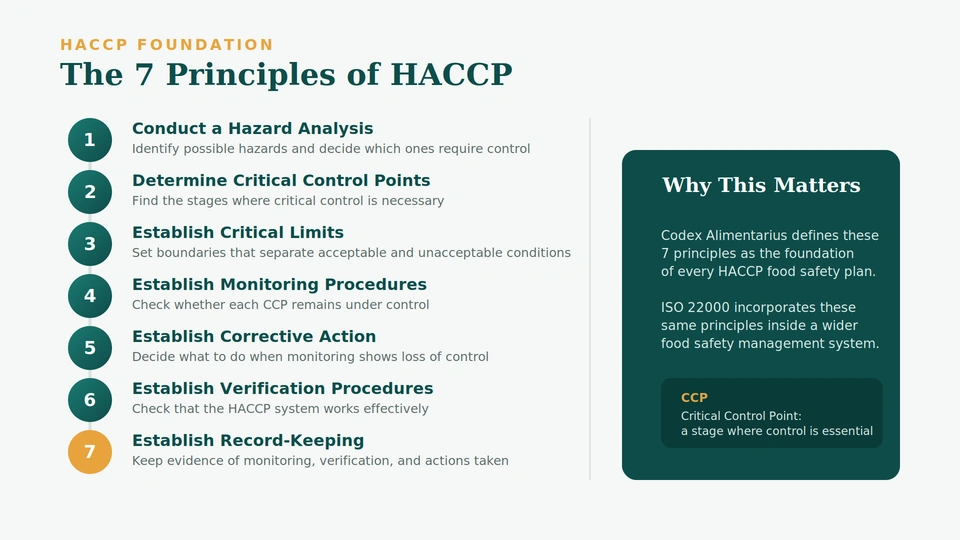
Codex identifies seven HACCP principles that form the foundation of the system.
|
Principle |
What It Means |
|---|---|
|
1. Conduct a hazard analysis |
Identify possible hazards and decide which ones require control |
|
2. Determine Critical Control Points |
Find stages where critical control is necessary |
|
3. Establish critical limits |
Set boundaries that separate acceptable and unacceptable conditions |
|
4. Establish monitoring |
Check whether each CCP remains under control |
|
5. Establish corrective action |
Decide what to do when monitoring shows loss of control |
|
6. Establish verification |
Check that the HACCP system works effectively |
|
7. Establish records |
Keep evidence of monitoring, verification, and actions taken |
Why Critical Control Points Matter
A Critical Control Point, usually shortened to CCP, is a stage where control is essential for dealing with a significant food safety hazard.
For example, heat treatment may be identified as a CCP when adequate heating is necessary to control harmful microorganisms. The business must establish suitable limits, monitor the process, record the results, and respond when those limits are not achieved.
Not every step in food production becomes a CCP. The purpose of HACCP is to identify the stages where critical control is genuinely needed.
Simple HACCP Example
Many HACCP food safety plan examples are easier to understand when a simple food process is used.
Consider cooked chicken production. Harmful bacteria may be identified as a biological hazard. The cooking stage may be selected as a CCP because proper heat treatment is necessary to control that hazard. The process is monitored, records are kept, and action is taken when the required conditions are not achieved.
HACCP risk assessment examples may also consider how likely a hazard is to occur and how serious its effect could be. This helps determine which hazards need stronger controls.
What Is the ISO 22000 Food Safety Management System?
The ISO 22000 food safety management system provides requirements for organizations that need to manage food safety hazards consistently. It can be used by organizations of different sizes and at different positions in the food chain. ISO states that the standard applies to organizations directly or indirectly involved in food-related activities.
Unlike a system that focuses only on individual hazards or control points, the ISO 22000 food safety management system connects operational food safety controls with wider management responsibilities. For professionals who want to build a basic understanding of these requirements, ISO 22000 Foundation Training can help introduce the main concepts, structure, and food safety management principles.
What does ISO 22000 stand for?
ISO 22000 is a global standard for managing food safety. It helps organizations manage food safety risks and maintain safe food production and handling processes.
ISO is defined as the International Organization for Standardization. However, ISO is not an acronym. The name comes from the Greek word isos, which means “equal.”
As of August 2026, ISO 22000:2018 remains the current published edition. In February 2024, Amendment 1:2024 introduced climate change considerations into Clauses 4.1 and 4.2. Organizations must now check if climate change affects their food safety system management system and consider related requirements from interested parties.
The amendment took effect immediately, so there is no separate transition period for new or recertification audits.
A full revision of ISO 22000 is also being developed. The revised standard is currently known as ISO/DIS 22000, with publication expected around 2027.
Main Elements of ISO 22000
ISO 22000 brings different food safety activities together instead of treating each one separately.
Leadership and Responsibilities
Management has a defined role in the system. Responsibilities need to be assigned, resources need to be available, and food safety objectives must be supported.
This helps prevent food safety from becoming the responsibility of only one department or one employee.
Communication
Food safety information often moves through several parts of the food chain. Suppliers may need to provide information about raw materials, employees may report process changes, and customers may have specific food safety requirements.
ISO 22000 places importance on maintaining appropriate communication so that information affecting food safety is understood and acted upon.
Prerequisite Programs
Prerequisite programs, or PRPs, establish the basic conditions required for a hygienic food environment.
Depending on the organization, these may cover areas such as:
- Cleaning and sanitation: Keep areas, surfaces, and equipment clean.
- Personal hygiene: Maintain good hygiene when handling food.
- Pest management: Prevent and control insects and other pests.
- Storage practices: Keep food in the proper place and at the right temperature and conditions.
- Equipment maintenance: Check equipment regularly and keep it clean and working properly.
- Waste handling: Clear waste regularly and dispose of it in a safe way.
- Facility conditions: Keep the building and work areas clean, safe, and suitable for food handling.
- Preventing contamination: Stop harmful substances from getting into food.
PRPs provide the basic operating environment in which more specific hazard controls can work effectively.
Monitoring, Review, and Improvement
Food safety controls cannot simply be created and then forgotten. Their performance needs to be checked.
ISO 22000 includes monitoring, verification, evaluation, corrective action, management review, and continual improvement. These activities help determine whether the system continues to achieve its intended food safety results.
How HACCP Fits Inside ISO 22000
One of the most important points in this topic is that HACCP and ISO 22000 should not always be viewed as competing choices.
ISO 22000 integrates Codex HACCP principles into a larger food safety management framework.
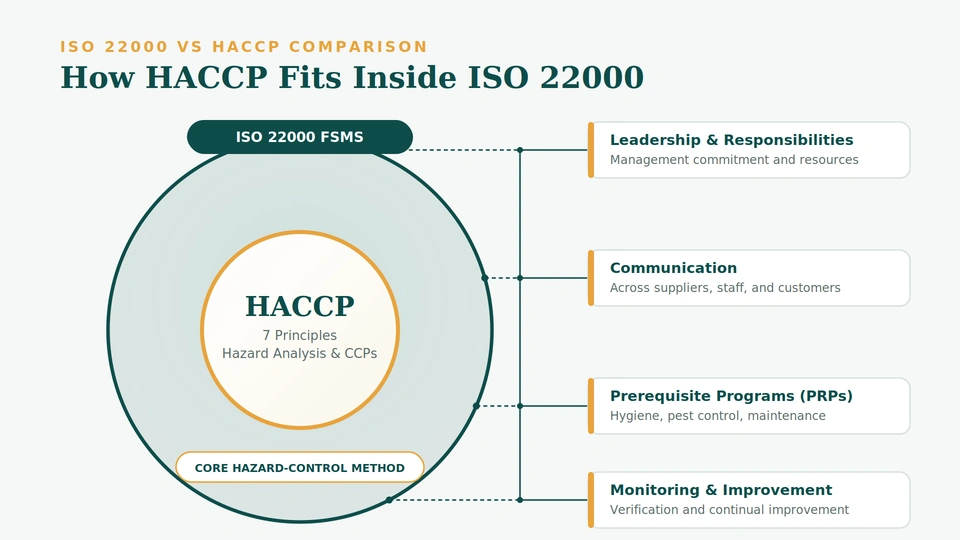
How to apply HACCP under ISO 22000
The process begins by understanding the food, ingredients, processes, intended use, and possible hazards. Significant hazards are identified and suitable control measures are selected.
Identify and Assess Hazards
The process looks at biological, chemical, and physical hazards that could affect food safety. Organization then identifies which hazards need to be controlled. This helps distinguish small concerns from hazards that could cause serious food safety problems.
Select Appropriate Controls
Not every significant hazard needs to be controlled in exactly the same way.
Under ISO 22000, control measures may be managed through CCPs or operational prerequisite programs, often called OPRPs. The choice depends on the nature of the hazard and how the control works within the process.
Monitor and Correct Problems
Monitoring helps show whether the selected controls are working as planned. If monitoring shows that a limit or action criterion has not been met, the organization must respond.
Affected products may need to be evaluated, processes may need adjustment, and the reason for the problem may need investigation.
Verify and Maintain Records
Verification provides evidence that the controls and the wider system work effectively.
Records are important because they show what was checked, when it was checked, the result, and what action was taken.
The connection between ISO 22000 and HACCP is simple: HACCP helps identify and control food safety hazards, while ISO 22000 includes HACCP as one part of the overall food safety system
Key Differences, Compliance, Certification, and Implementation
Several differences become clearer when both approaches are examined beyond hazard control alone.
Scope and Management Responsibility
HACCP mainly concentrates on food safety hazards, significant controls, monitoring, verification, corrective action, and records.
ISO 22000 includes these operational areas but also requires a broader management structure. Leadership, organizational context, communication, objectives, resources, performance evaluation, and continual improvement all have a place within the system.
Documentation and Communication
HACCP documentation commonly includes information such as:
- Hazard analysis: Identify possible food safety hazards.
- CCP identification: Find the points where hazards need to be controlled.
- Critical limits: Set safe limits that must be met.
- Monitoring results: Record what was checked and the results.
- Corrective actions: Take action when a limit is not met.
- Verification activities: Check that the controls are working properly.
ISO 22000 requires documented information for the wider FSMS as well as operational food safety controls.
The ISO 22000 vs HACCP compliance requirements therefore differ in scope. Having a working HACCP plan does not automatically demonstrate conformity with all ISO 22000 requirements.
ISO 22000 Certification vs HACCP
The HACCP certification meaning can vary depending on the country, certification program, market, customer, or scheme being followed. FAO material notes that there is no single international HACCP certification program, although local and national certification schemes exist.
The second point about HACCP certification meaning is that a HACCP certificate should not automatically be treated as equivalent to certification against ISO 22000.
ISO 22000 is a certifiable management-system standard. However, ISO itself does not audit organizations or issue certificates. Independent certification bodies perform certification.
ISO 22000 Certification Process Steps
Common ISO 22000 certification process steps begin with understanding the standard and reviewing the organization’s current food safety system.
Step 1: Conduct a Gap Analysis
An ISO 22000 gap analysis compares existing practices against applicable requirements in the standard.
It can identify missing documentation, unclear responsibilities, weak controls, incomplete monitoring, or other areas that need attention.
After changes have been made, another ISO 22000 gap analysis may help determine whether important weaknesses remain before the certification audit.
Step 2: Build and Implement the FSMS
The ISO 22000 implementation steps may involve assigning responsibilities, establishing or reviewing prerequisite programs, conducting hazard analysis, selecting control measures, creating monitoring methods, preparing documented information, and training relevant staff.
Step 3: Review the System
Before external certification, the organization needs evidence that the system has been implemented and reviewed. Internal auditing and management review help identify areas that still require correction or improvement.
Step 4: Complete the Certification Audit
A certification body assesses whether the management system conforms to ISO 22000 requirements. Any identified nonconformities need to be addressed according to the certification process. These ISO 22000 certification process steps are not a fixed timetable because organizations differ considerably in size, complexity, preparation, and existing controls.
How long does ISO 22000 certification take?
The answer to How long does ISO 22000 certification take? depends on the size of the organization, number of sites, process complexity, existing food safety controls, documentation, gaps identified, corrective work, and certification-body arrangements.
A business that already has a mature food safety system may require less preparation than an organization building an FSMS from the beginning.
Practical Example and Which Approach Fits the Need?
A practical example helps show why HACCP and ISO 22000 are related but work at different levels.
Consider a business that prepares packaged cooked chicken.
HACCP View of the Process
During hazard analysis, harmful bacteria may be identified as a significant biological hazard. The business then considers where the hazard can be effectively controlled. Cooking may be identified as a CCP when correct processing conditions are essential for food safety.
Hazard
Raw chicken can carry harmful microorganisms such as bacteria that may cause foodborne illness if they are not controlled properly. During HACCP analysis, these biological hazards are identified so the business can decide where control is most important in the production process.
Control Measure
Cooking is used to control harmful microorganisms, proper heating can reduce these microorganisms to a safe level. The cooking process must follow set time and temperature conditions to keep food safe.
Monitoring
The cooking stage is monitored to confirm that the required conditions are being met. Relevant factors, such as time and temperature, may be checked and recorded according to the HACCP plan. Regular monitoring helps identify a problem before the product moves to the next stage.
Corrective Action
If the required limit is not met, action must be taken immediately, affected food may be held, checked, reprocessed, or discarded, depending on the situation. The cause of the problem should also be identified to help prevent it from happening again.
This example shows the basic HACCP approach: identify the hazard, choose the right control, monitor it, and respond when control is lost.
ISO 22000 View of the Same Process
ISO 22000 includes this hazard-control work but looks beyond the cooking stage.
The organization may also need to manage:
- Supplier information: Keep basic details about suppliers, including their food safety requirements.
- Raw material controls: Check materials when they arrive to make sure they meet safety and quality requirements.
- Cleaning procedures: Set out simple steps for cleaning and sanitizing work areas and equipment.
- Employee hygiene: Follow good hygiene practices during food handling.
- Staff competence: Make sure employees know how to do their jobs safely and correctly.
- Communication: Pass food safety information to the people who need it.
- Document control: Keep records and documents up to date and easy to access.
- Equipment maintenance: Check and maintain equipment so it continues to work properly.
- Verification: Check whether the food safety controls are giving the expected results.
- Internal audits: Review the system to identify gaps, problems, and areas that need attention.
- Management review: Management looks at food safety results and decides what needs to be changed.
- Continual improvement: Look for practical ways to improve food safety over time.
Operational Controls
PRPs, CCPs, OPRPs, monitoring, verification, and corrective actions help keep individual food safety hazards under control.
Management Controls
Leadership, resources, communication, objectives, review, and improvement are all part of managing food safety effectively. HACCP focuses mainly on controlling food safety hazards, while ISO 22000 includes HACCP as part of a broader system for managing food safety across the organization.
Which is better ISO 22000 or HACCP
There is no single answer that applies to every organization.
|
Business Need |
Approach to Consider |
|---|---|
|
Need a structured method for significant food hazards |
HACCP |
|
Need a complete food safety management system |
ISO 22000 |
|
Need certification against ISO 22000 |
ISO 22000 |
|
Already operate a HACCP system |
Assess additional ISO 22000 requirements |
|
Customer specifies a particular scheme |
Follow the required scheme |
|
Need wider management-system controls |
ISO 22000 |
|
Need to meet a legal HACCP requirement |
Follow the applicable legal requirement |
The decision should be based on legal requirements, customer expectations, supply-chain requirements, certification goals, existing controls, and the type of food operation involved.
For broader information on professional standards and certification pathways, SterlingNext Certification Programs cover learning options across different management and industry areas.
Conclusion
The ISO 22000 vs HACCP Comparison is easier to understand by looking at what each one covers. HACCP focuses on finding important food safety hazards, identifying where they need to be controlled, checking those controls, and responding when something goes wrong. ISO 22000 includes HACCP principles but covers a wider range of food safety activities. It also addresses leadership, communication, prerequisite programs, records, system checks, and ongoing improvements. Neither approach is the right choice for every food business, the best option depends on legal requirements, customer needs, certification plans, current food safety practices, and the type of food activities involved.
Get Certified With Industry Level Projects & Fast Track Your Career
Checkout Top 10 Highest Paying Jobs
Frequently Asked Questions
No, ISO 22000 does not replace HACCP, it includes HACCP principles within a broader food safety management system, HACCP mainly focuses on identifying and controlling food safety hazards, while ISO 22000 also covers management responsibilities, communication, documentation, risk management, and continual improvement across the organization.
ISO 22000 incorporates the HACCP principles and application steps developed through Codex. An organization cannot simply leave out HACCP-based hazard analysis and still treat the resulting system as meeting the complete ISO 22000 approach.
It depends on the certification or regulatory requirement involved. HACCP certification schemes exist, but a HACCP system by itself does not automatically meet all requirements of ISO 22000 or another food safety certification scheme.
Yes. HACCP can be included within an ISO 22000 system. HACCP focuses on identifying food safety hazards and deciding how to control them. ISO 22000 covers these controls along with other parts of food safety management, such as communication, records, management responsibilities, monitoring, and improvement.
No. ISO states that ISO 22000 can be used by organizations regardless of their size or position in the food chain. This can include organizations involved in production, processing, distribution, food service, packaging, equipment, and related activities.
An Operational Prerequisite Program (OPRP) is a control used in ISO 22000 to manage significant food safety hazards. It helps prevent or reduce risks during food-related activities. OPRPs are part of the overall food safety system and work together with other controls, including Critical Control Points (CCPs).
PRPs are the basic practices that help keep food production safe. They cover everyday activities such as cleaning, personal hygiene, pest control, storage, equipment upkeep, and preventing contamination. These practices create a clean and suitable environment for producing and handling food safely.
HACCP can be implemented without certification against ISO 22000 when that approach meets the organization’s applicable legal, customer, and business requirements. ISO 22000 becomes relevant when a broader food safety management system is needed.
A CCP is a stage where control is essential for managing a significant food safety hazard. Monitoring and critical limits are established so that loss of control can be detected and addressed.
The simplest ISO 22000 vs HACCP comparison is that HACCP concentrates on identifying and controlling significant food safety hazards, while ISO 22000 places those controls within a broader food safety management system.