
Training Outcomes Within Your Budget!
We ensure quality, budget-alignment, and timely delivery by our expert instructors.
Table of Content
- ISO 31000 vs ISO 27001 Comparison Guide for Businesses
- What Is the Difference Between ISO 31000 and ISO 27001
- Current Status of the Standards in August 2026
- What ISO 31000 Covers and How Its Risk Approach Works
- What ISO 27001 Covers and Why an ISMS Matters
- ISO 31000 vs ISO 27001 Comparison of Scope Purpose and Risk Assessment
- Certification Benefits and Choosing Between the Standards
- How ISO 31000 and ISO 27001 Can Work Together
- Conclusion
Recent Blogs
Cloud Computing Salary Guide 2026: AWS, Azure & GCP
August 18th, 2026
CompTIA Cloud+ Certification: Complete Guide
August 18th, 2026
AWS DevOps Engineer Certification: Complete Guide
August 18th, 2026
AWS Developer Certification: Study Guide & Exam Tips
August 18th, 2026
ISO 22000 Documentation Requirements
August 18th, 2026
ISO 22000 vs HACCP
August 17th, 2026
PMP Exam July 2026: What's Changed and How to Prepare
August 17th, 2026
CISSP Book Insights to Keep Your Exam Preparation on Track
August 14th, 2026
Benefits of ISO 14001 Certification
August 14th, 2026
CISM Certification Cost and Roadmap for Career Success
August 12th, 2026
ISO 20000 IT Service Management
August 10th, 2026
What is ISO Lead Auditor Certification?
August 10th, 2026
ISO Auditor Roles and Responsibilities
August 10th, 2026
Why Choosing PMI RMP Certification Can Benefit Your Career
August 10th, 2026
What to Know Before the Lean Six Sigma Green Belt Exam
August 10th, 2026
ISO 31000 vs ISO 27001
Last updated on August 18th, 2026
- Share
-

-

-

-

-

 Sachin Kumar
The ISO 31000 vs ISO 27001 Comparison then makes the distinction clearer, as ISO 31000 provides broad guidance for managing risk, while ISO/IEC 27001 explains how an organization can establish and maintain an Information Security Management System.
ISO 31000 vs ISO 27001 Comparison Guide for Businesses
Organizations deal with many kinds of uncertainty, from financial and operational issues to cyber threats and data loss. Understanding ISO 31000 Risk Management provides useful context for seeing how organizations handle risk across different objectives and activities. The ISO 31000 vs ISO 27001 Comparison then makes the distinction clearer, as ISO 31000 provides broad guidance for managing risk, while ISO/IEC 27001 explains how an organization can establish and maintain an Information Security Management System. One supports wider risk-based decision-making, while the other focuses specifically on protecting information through a structured management system.
What Is the Difference Between ISO 31000 and ISO 27001
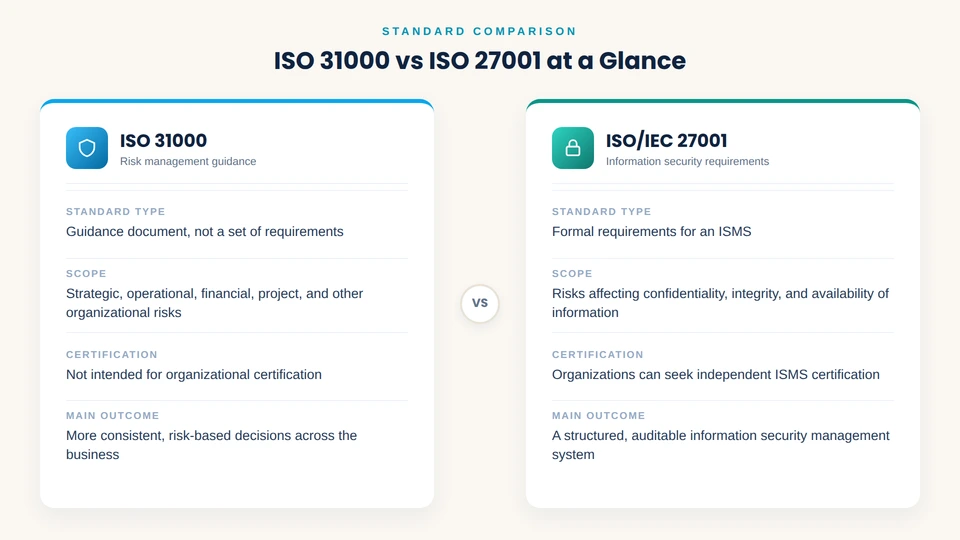
ISO 31000 provides guidance for identifying and managing risks in different parts of an organization, including daily work, projects, goals, and important decisions. ISO/IEC 27001 focuses on protecting information and sets requirements for building and maintaining an Information Security Management System (ISMS). In simple terms, ISO 31000 covers risk across the organization, while ISO/IEC 27001 focuses on risks related to information security and can be used for certification.
|
Comparison Area |
ISO 31000 |
ISO/IEC 27001 |
|---|---|---|
|
Main purpose |
Manage risk across organizational activities |
Manage information security through an ISMS |
|
Standard type |
Guidance |
Requirements |
|
Main scope |
Strategic, operational, financial, project, supplier, security, and other risks |
Risks affecting information security |
|
Management system required |
No |
Yes |
|
Certification |
Not intended for organizational certification |
Organizations can seek certification |
|
Main users |
Leaders, risk teams, project teams, and business functions |
Security, IT, compliance, governance, and ISMS teams |
|
Main outcome |
More consistent risk decisions |
A structured and auditable information security management system |
The first point in the scope and purpose comparison between ISO 31000 and ISO 27001 is breadth. ISO 31000 can be applied to almost any category of uncertainty. ISO 27001 works within the defined scope of the ISMS and concentrates on risks that can impact the information privacy, accuracy, or accessibility.
This distinction also explains the broader topic of risk management vs information security standards. The standards are connected by risk thinking, but they are not direct replacements for one another. An organization may use one or both for different parts of governance.
What ISO 31000 and ISO 27001 Do Not Do
|
Standard |
What It Does Not Do |
|---|---|
|
ISO 31000 |
It does not create a certifiable management system and does not require one fixed risk-scoring method |
|
ISO/IEC 27001 |
It does not manage every category of enterprise risk and does not prescribe one universal risk-assessment formula |
The difference matters because the two standards do not serve the same purpose. ISO 31000 gives general guidance for managing risks across an organization, while ISO/IEC 27001 provides specific requirements for managing information security. ISO 31000 allows more flexibility in how risk is managed. ISO/IEC 27001 follows a defined management system and can be used as a basis for certification.
Current Status of the Standards in August 2026
|
Standard |
Current Status |
|---|---|
|
ISO 31000 |
ISO 31000:2018 remains the current published edition, while a third edition is under development |
|
ISO/IEC 27001 |
ISO/IEC 27001:2022 remains the current published edition |
|
ISO/IEC 27001 Amendment |
Amendment 1:2024 on climate action changes has been published |
|
ISO/IEC 27005 |
ISO/IEC 27005:2022 remains the published information-security risk guidance standard |
For organizations using these standards, awareness of the current edition matters. The published ISO 31000 edition remains the 2018 version until a replacement is formally issued. ISO/IEC 27001:2022 also remains current, with Amendment 1:2024 requiring organizations to consider whether climate change is a relevant issue when evaluating organizational context.
What ISO 31000 Covers and How Its Risk Approach Works
ISO 31000 provides guidance for managing risks that could affect an organization’s goals. It can be used in projects, daily operations, business plans, and different areas of the organization. The standard gives a practical way to identify risks, understand their possible effects, decide what action is needed, monitor changes, and communicate important risk information.
What Is ISO 31000
ISO 31000:2018 provides guidance for managing risk in a structured and adaptable way. Organizations that want to understand how this approach is applied in practice can build deeper knowledge through ISO 31000 Risk Management Training. The standard is designed for organizations of both small and large and can be applied to decisions, projects, functions, strategies, and operations. It is suitable for both small and large organizations
ISO 31000 Risk Management Framework Overview
A useful overview of the ISO 31000 risk management framework starts with three interconnected elements: principles, a framework, and a process.
The principles describe what effective risk management should look like. Risk management should be integrated into normal work, structured, suitable for the organization, inclusive of relevant stakeholders, responsive to change, based on available information, aware of human and cultural factors, and continually improved.
The framework is about putting risk management into the organization itself. Leadership, responsibilities, resources, communication, and review all matter. Risk management works better when it is part of planning and decision-making rather than a separate exercise completed only for audits or reports. Integration into governance, strategy, planning, reporting, policies, values, and culture is an important part of the standard.
ISO 31000 Risk Management Process
The process gives organizations a practical sequence for handling risk:
- 1. Define the scope, context, and criteria.
- 2. Identify what could affect objectives.
- 3. Analyze the nature and level of risk.
- 4. Evaluate which risks need treatment or further attention.
- 5. Select and apply suitable risk treatment.
- 6. Monitor changes and review results.
- 7. Communicate, consult, and record information throughout the process.
ISO 31000 covers activities such as identifying, analyzing, evaluating, treating, monitoring, and communicating risks.
This structure shows why ISO 31000 can be useful beyond formal risk departments. A project manager can apply the same thinking to schedule risk, a procurement team can use it for suppliers, and senior leaders can use it when considering strategic uncertainty.
The main advantages of ISO 31000 risk management come from this flexibility. It can create a common language for risk, clarify priorities, connect risk decisions to objectives, and help different functions adopt a more consistent approach without forcing every department into the same technical method.
What ISO 27001 Covers and Why an ISMS Matters
ISO/IEC 27001:2022 sets requirements for an Information Security Management System (ISMS). An ISO 27001 information security management system provides organizations a clear way to protect important information. It helps identify what information needs protection, understand the risks, decide how to deal with those risks, assign responsibilities, check how well the system is working, and make improvements when needed.
Amendment 1:2024 adds a climate-action consideration to the management-system context. Organizations need to determine whether climate change is a relevant issue when considering internal and external matters that can affect the ISMS.
What Information Can an ISMS Protect
Information can exist in many forms. It may include:
- Customer and client records
- Employee information
- Financial data
- Intellectual property
- Business plans and internal documents
- Information stored in cloud systems
- Supplier or partner information
- Paper records and other non-digital information
An ISMS is therefore not limited to computers or cybersecurity tools. People, processes, suppliers, physical locations, technology, access decisions, and business practices can all affect information security.
Confidentiality, Integrity, and Availability
Three ideas are commonly used to understand information security:
- Confidentiality means only approved people or systems can view or use the information.
- Integrity means the information stays correct, complete, and free from unwanted changes.
- Availability means information and systems can be accessed when needed.
This helps explain why ISO 27001 is important for businesses. A single technical weakness rarely causes information security problems. A poorly defined responsibility, a weak supplier process, an incorrect access decision, a missing review, or an ineffective incident response can create serious exposure.
An ISMS brings information security activities together in one organized system. It covers policies, risk checks, actions to reduce risks, security goals, assigned responsibilities, monitoring, internal audits, management reviews, and regular improvements. This makes information security a shared management responsibility instead of leaving it as a set of separate IT tasks.
ISO 31000 vs ISO 27001 Comparison of Scope Purpose and Risk Assessment
The second use of ISO 31000 vs ISO 27001 scope and purpose becomes clearer when both standards are viewed through risk assessment. ISO 31000 starts from organizational objectives and can consider a wide range of effects. ISO 27001 operates within the scope of an ISMS and addresses risks related to information security.
Risk Assessment Under ISO 31000
ISO 31000 allows one event to be looked at from different parts of the business. For example, relying on one supplier could cause problems with daily operations, costs, contracts, product quality, reputation, and information security. Looking at all these effects together gives a clearer picture of the overall risk and helps the organization decide what action is needed.
The approach can be kept simple or made more detailed, depending on the organization. A small project may assess a risk by evaluating how likely it is to occur and how serious the consequences could be. A large company may use more detailed criteria and risk calculations. The main aim is to use a method that fits the situation and helps management make sensible decisions.
ISO 27001 Risk Assessment and Treatment Process
The ISO 27001 risk assessment process is more specific because it operates inside the ISMS. The organization needs risk criteria, a repeatable assessment approach, identified information security risks, analysis and evaluation of those risks, and decisions about treatment.
A practical sequence may include:
- 1. Define risk criteria.
- 2. Identify information security risks.
- 3. Identify risk owners.
- 4. Analyze likelihood and consequences.
- 5. Evaluate risks against the criteria.
- 6. Decide which risks require treatment.
- 7. Select treatment options and suitable controls.
- 8. Record results and review them when needed.
ISO/IEC 27001 requires organizations to use a risk approach that fits their context rather than treating information security as a fixed checklist. The ISO 27001 risk assessment process therefore does not require every organization to use the same scoring formula. The method should be consistent, repeatable, and suitable for the organization.
One Risk Viewed by Both Standards
Consider a cloud service outage. Under ISO 31000, the organization can look at the wider business impact, such as lost revenue, customer problems, dependence on the supplier, contract issues, work disruptions, damage to reputation, and information security concerns.
Under ISO/IEC 27001, the focus is on information security, the organization would check whether important information is still available, whether recovery plans are working, whether the cloud provider has suitable security controls, and whether any changes are needed to reduce the security risk.
|
Risk Area |
ISO 31000 View |
ISO/IEC 27001 View |
|---|---|---|
|
Supplier failure |
Operational and business risk |
Security and availability concerns |
|
Data exposure |
Legal, financial, and reputation impact |
Confidentiality risk |
|
Service outage |
Business interruption |
Availability risk |
|
Unauthorized access |
Wider organizational consequences |
Access and information security risk |
|
Contract weakness |
Commercial and supplier risk |
Supplier security requirements |
This is one of the clearest practical differences between the standards. ISO 31000 can place an event within the broader business risk picture, while ISO 27001 examines its information security implications through the ISMS.
Certification Benefits and Choosing Between the Standards
Certification is one of the clearest differences between ISO 31000 and ISO/IEC 27001, ISO 31000 provides risk management guidance and is not intended for organizational certification, while ISO 27001 contains formal ISMS requirements that organizations can be certified against. The better choice depends on business needs and objectives.
Certification Difference
ISO 31000 provides guidance for managing risk. It is not a certification standard, so an organization cannot receive an ISO 31000 certificate. The guidance can still be used to build and improve the way risks are identified, assessed, and managed.
ISO/IEC 27001 is different. It contains ISMS requirements against which organizations can seek independent certification. Certification is carried out by certification bodies, not by ISO itself.
This distinction matters because training certificates or personal credentials related to ISO 31000 should not be presented as organizational certification against ISO 31000.
Benefits of Each Approach
The benefits of ISO 31000 vs ISO 27001 depend on the business need.
ISO 31000 can help with:
- A common approach to risk across functions
- Better connection between risks and objectives
- More consistent prioritization
- Broader awareness of uncertainty
- Stronger risk-based decision-making
ISO 27001 can help with:
- Clear information security responsibilities
- Structured risk assessment and treatment
- Better control over security-related processes
- Defined monitoring and review
- Evidence for audits
- Continual improvement of the ISMS
- A recognized route to organizational certification
Comparing the benefits of ISO 31000 and ISO 27001 shows why the decision should not be treated as a contest. One standard supports broad risk governance, while the other provides formal requirements for information security management.
Which ISO Standard Is Best for Organizations
There is no single answer because the right starting point depends on the problem being addressed.
|
Business Need |
More Relevant Starting Point |
|---|---|
|
Enterprise-wide risk management |
ISO 31000 |
|
Strategic and operational risk decisions |
ISO 31000 |
|
Formal information security management |
ISO/IEC 27001 |
|
ISMS certification |
ISO/IEC 27001 |
|
Managing information security risks |
ISO/IEC 27001 |
|
Connecting information risk with wider enterprise risk |
Both may be useful |
An organization seeking general risk management guidance may use ISO 31000. Those needing a formal information security system, audit readiness, customer assurance, or certification may choose ISO/IEC 27001.
Large organizations often use both: ISO 31000 for overall business risk and ISO/IEC 27001 for information security risks, since the two are closely connected.
How ISO 31000 and ISO 27001 Can Work Together
ISO 31000 and ISO/IEC 27001 can be used together because they deal with risk from different angles. ISO 31000 supports risk management across the organization, while ISO/IEC 27001 focuses on information security risks through an ISMS, using both can help link information security decisions with wider business goals and risk priorities.
Can ISO 31000 and ISO 27001 Be Used Together
Yes. Both standards can be used together because they have different purposes. ISO 31000 helps manage risks across the organization, while ISO/IEC 27001 provides a structured way to manage information security risks through an ISMS. ISO/IEC 27005 can also help connect information security risk management with ISO/IEC 27001 and the broader risk management approach in ISO 31000.
Together, they show how global ISO standards for risk and security can address connected risks at different levels of an organization.
How the Standards Connect
A simple way to understand how ISO 31000 supports ISO 27001 is to place them at different levels:
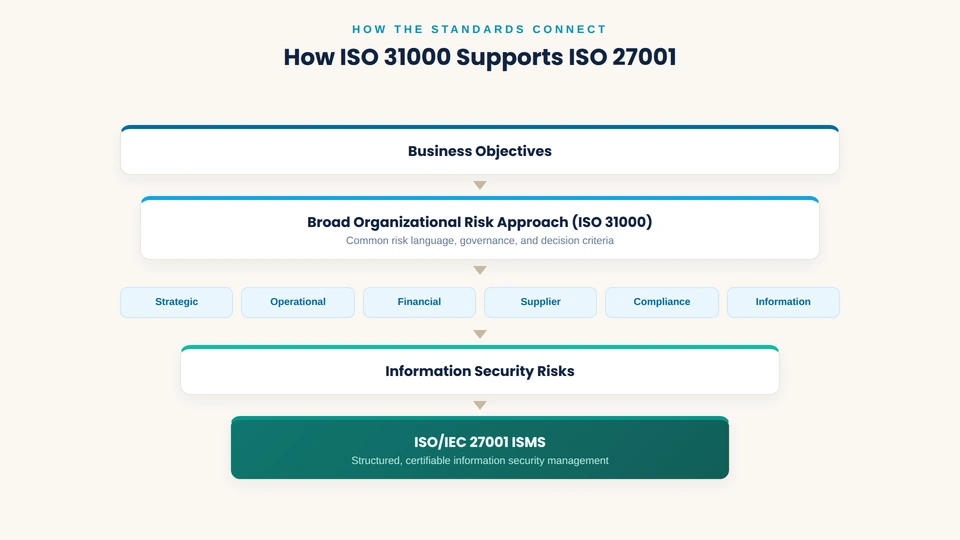
ISO 31000 may help an organization create common risk language, governance, responsibilities, escalation practices, and decision criteria across departments. Information security teams can then align their ISMS risk work with that wider environment.
However, ISO 31000 is not a prerequisite for ISO 27001. An organization can implement an ISMS and seek certification for it without formally adopting ISO 31000.
Where ISO IEC 27005 Fits
ISO/IEC 27005:2022 provides guidance specifically for information security risk management and supports an ISMS based on ISO/IEC 27001. It also applies broader risk-management principles to the information-security context.
|
Standard |
Main Role |
|---|---|
|
ISO 31000 |
General risk management guidance |
|
ISO/IEC 27001 |
ISMS requirements |
|
ISO/IEC 27005 |
Information security risk management guidance |
Practical Business Example
Consider a company planning to move customer information to a new cloud provider.
Using ISO 31000, leadership may consider financial costs, supplier dependence, service interruptions, legal obligations, reputation, project delays, and security exposure.
Using ISO/IEC 27001, the ISMS team may focus on access controls, data confidentiality, service availability, supplier security, incident response, backup arrangements, monitoring, and treatment of identified information security risks.
The two views can feed into the same business decision without becoming the same process. One provides a wider risk context; the other goes deeper into information security.
Organizations applying risk and information security standards often benefit from learning how different ISO frameworks connect in practice. SterlingNext Risk Management Learning can provide additional context for professionals building knowledge in risk management, governance, and related ISO standards.
Conclusion
ISO 31000 and ISO/IEC 27001 deal with different but related needs. The ISO 31000 vs ISO 27001 Comparison shows the main difference clearly. ISO 31000 gives general guidance for managing risks across business activities, projects, goals, and decisions. ISO/IEC 27001 sets requirements for managing information security with the help of an Information Security Management System (ISMS). One standard does not replace the other. An organization may use ISO 31000 for wider business risks and ISO/IEC 27001 for information security risks. ISO/IEC 27005 provides additional guidance for managing information security risks. Together, these global ISO standards for risk and security can help connect business risk management with the protection of important information.
Get Certified With Industry Level Projects & Fast Track Your Career
Checkout Top 10 Highest Paying Jobs
Frequently Asked Questions
The ISO 31000 vs ISO 27001 Comparison shows that ISO 31000 provides broad risk management guidance, while ISO/IEC 27001 provides requirements for managing information security through an ISMS. ISO 31000 is not an organizational certification standard, whereas ISO/IEC 27001 can support certification.
No. ISO 31000 is not required before implementing ISO/IEC 27001. ISO 31000 can be used for managing risks across the organization, but ISO/IEC 27001 already includes requirements for identifying, assessing, and treating information security risks.
Yes. An organization can use ISO 31000 to manage risks across the business and ISO/IEC 27001 to manage information security risks. Using both can help connect information security risks with wider business risk discussions and reporting.
No. ISO 31000 provides guidance on managing risk and is not intended for organizational certification, training courses and individual risk management credentials may be available, but these are different from an organization being certified to ISO 31000.
No. Organizations can use ISO/IEC 27001 of any size and from different industries. Banks, manufacturers, service providers, healthcare organizations, government bodies, educational institutions, and small businesses can use it to manage and protect important information.
ISO 31000 is not limited to a single category of risk, so its approach can be applied wherever cybersecurity uncertainty may affect organizational objectives. It provides broad risk guidance rather than a dedicated cybersecurity management system.
ISO/IEC 27005 guides the management of information security risks and supports an ISMS based on ISO/IEC 27001. It provides organizations with more focused risk guidance in the information-security context, while ISO 27001 remains the requirements standard.
Yes. ISO/IEC 27001 can be implemented without ISO 31000. Organizations may still use the ISO 31000 principles when they want information security risks to align more closely with a broader enterprise risk approach.
ISO 31000 is more suitable when an organization needs general guidance for managing risks across the business. It is not limited to information security and can be used for different types of risks based on the organization’s needs and situation.
The decision depends on what the organization wants to achieve, small organizations looking for general guidance on managing risks may start with ISO 31000. An organization that needs a clear system for protecting information, meeting customer requirements, or getting ISMS certification may choose ISO/IEC 27001.