
Training Outcomes Within Your Budget!
We ensure quality, budget-alignment, and timely delivery by our expert instructors.
Table of Content
- ISO 31000 Risk Management Guide
- What Is ISO 31000?
- What Does Risk Mean in ISO 31000?
- Purpose of ISO 31000
- The Principles Behind ISO 31000
- ISO 31000 Risk Management Framework
- The Risk Management Process Under ISO 31000
- Practical ISO 31000 Example
- Benefits of ISO 31000
- Who Can Use ISO 31000?
- How to Implement ISO 31000
- Common Challenges
- ISO 31000 and Other ISO Standards
- Is ISO 31000 Certifiable?
- Conclusion
Recent Blogs
Theories of Entrepreneurship
July 24th, 2026
ISO 22301 Business Continuity Management
July 24th, 2026
ISO Certification Process Step by Step
July 24th, 2026
Benefits of ISO 27001 Certification
July 24th, 2026
How to Stop pop up Ads on Android Phone
July 24th, 2026
Character AI Chat Error: Causes and Fixes
July 22nd, 2026
Microsoft Word Tools
July 22nd, 2026
Key Elements of Organisational Behaviour
July 22nd, 2026
Cybersecurity Webinars That Help Build Career Clarity
July 22nd, 2026
CISSP Exam Format & Domains
July 22nd, 2026
ISO 13485 Audit Questions and Answers
July 22nd, 2026
ISO 9001 Documentation Requirements
July 22nd, 2026
ISO 27001 Risk Assessment Process
July 22nd, 2026
How to Build Confidence for the PRINCE2 Practitioner Exam
July 22nd, 2026
Clear and Concise Approach to Mastering PRINCE2 Foundation
July 22nd, 2026
What is ISO 31000 Risk Management?
Last updated on July 24th, 2026
- Share
-

-

-

-

-

 Sachin Kumar
 This guide explains ISO 31000 principles, its framework and process, and how organizations can apply it in practice using simple examples and tables.
ISO 31000 Risk Management Guide
Introduction
Business uncertainty is unavoidable, and organizations need a clear way to handle it. Risks may come from changing markets, new technology, supply chain problems, regulatory updates, or internal issues. Key Steps for ISO 27001 Assessment focuses on information security risks, while ISO 31000 Risk Management covers risk management across the wider organization. By making risk management part of daily decisions, businesses can prepare for challenges, improve governance, and make better choices. This guide explains ISO 31000 principles, its framework and process, and how organizations can apply it in practice using simple examples and tables.
What Is ISO 31000?
The International Organization for Standardization developed ISO 31000 as an international standard for risk management. It lays out guidelines, principles, and a framework for managing risk in any organization, no matter the industry or size.
Unlike many other ISO standards, ISO 31000 isn't something a company gets certified against. Instead, it gives teams a shared vocabulary and a consistent way of thinking about risk that can be adapted to their own needs. It helps organizations shift away from reacting to problems after they've already happened and toward spotting them ahead of time.
Companies that use ISO 31000 Risk Management often find their decision-making becomes more consistent, simply because everyone is working from the same logic when they talk about uncertainty.
What Does Risk Mean in ISO 31000?
Typically, "risk" usually sounds like something bad. ISO 31000 takes a broader view: risk is the effect of uncertainty on objectives, and that effect can be either positive or negative.
A couple of examples make this clearer:
- Entering a new market comes with some risk, but it can also give a business a chance to grow.
- A delay in the supply chain can cause late deliveries and may affect customer trust.
This broader definition helps organizations treat risk not just as something to avoid, but as a factor to manage intelligently while they chase their goals.
Purpose of ISO 31000
At its core, ISO 31000 exists to help organizations create and protect value. It does this by giving teams a common structure for consistently identifying, assessing, and responding to risk.
Following the ISO 31000 Risk Management Guidelines helps teams avoid a common mistake: treating risk management as a one-time task. Instead, it should be part of regular planning and daily work. When done properly, it becomes part of how teams plan, run the business, and make important decisions, rather than something they only think about during an audit.
Small businesses and large enterprises both benefit from this shared language. It cuts down on the confusion that happens when different departments each talk about risk in their own way.
The Principles Behind ISO 31000
ISO 31000 is based on a few simple principles that guide how an organization should manage risk. These principles are not a list of technical steps to follow. Instead, they provide a way of thinking that helps businesses make sound decisions and address risks through their regular activities.
The 8 Principles of ISO 31000
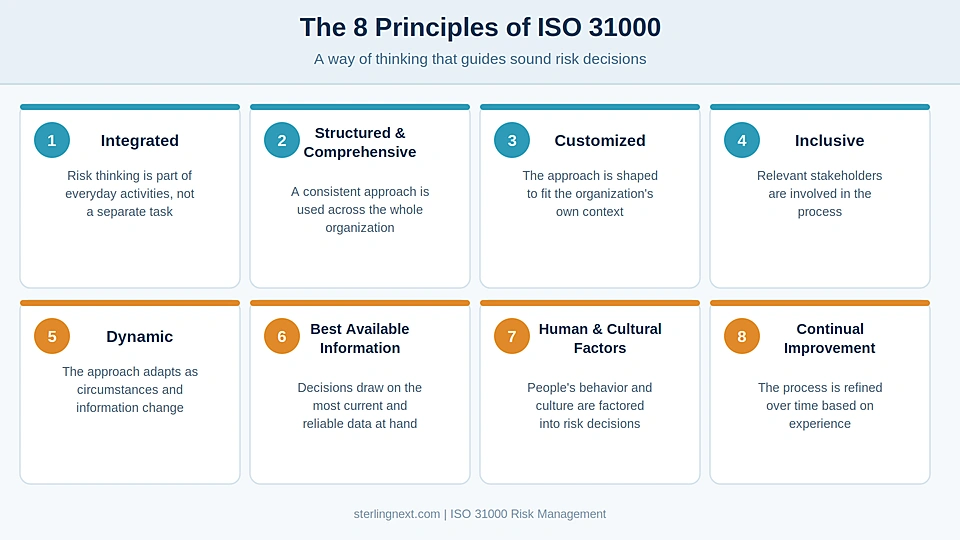
These principles show that risk management should be part of everyday business activities, not something an organization does only once a year or when an audit is coming up.
ISO 31000 Risk Management Framework
The ISO 31000 Risk Management Framework explains how leaders can set up, use, and maintain risk management throughout an organization. It acts as the basic structure that helps the organization manage risks in a clear and consistent way.
A solid framework typically includes:
- Leadership commitment and accountability: Leaders take responsibility for making sure risks are properly managed.
- Clearly defined roles and responsibilities: Everyone knows what they are responsible for when it comes to managing risks.
- Integration with existing business processes: Risk management becomes part of regular business activities and decisions.
- Regular cycles of review and improvement: The organization regularly checks its approach and makes changes when needed.
A strong version of this framework makes sure risk management doesn't sit with just one department. Leadership sets the tone and expectations, and every level of the organization plays some part in spotting and addressing uncertainty.
Using the ISO 31000 Risk Management Guidelines helps ensure that decisions about risk support the organization’s main goals and business plans, rather than being handled separately from other important decisions.
The Risk Management Process Under ISO 31000
Once the framework is in place, organizations follow a defined process to manage risk on a day-to-day basis. This is where the ISO 31000 Risk Management Process Steps come into play.
The Core Process Steps
|
Step |
Name |
Purpose |
|---|---|---|
|
1 |
Communication and consultation |
Keep stakeholders informed and involved throughout |
|
2 |
Scope, context, and criteria |
Define exactly what is being assessed and why |
|
3 |
Risk assessment |
Identify, analyze, and evaluate risks |
|
4 |
Risk treatment |
Decide how to respond to each risk |
|
5 |
Monitoring and review |
Check whether the chosen responses are actually working |
|
6 |
Recording and reporting |
Document decisions, actions, and outcomes |
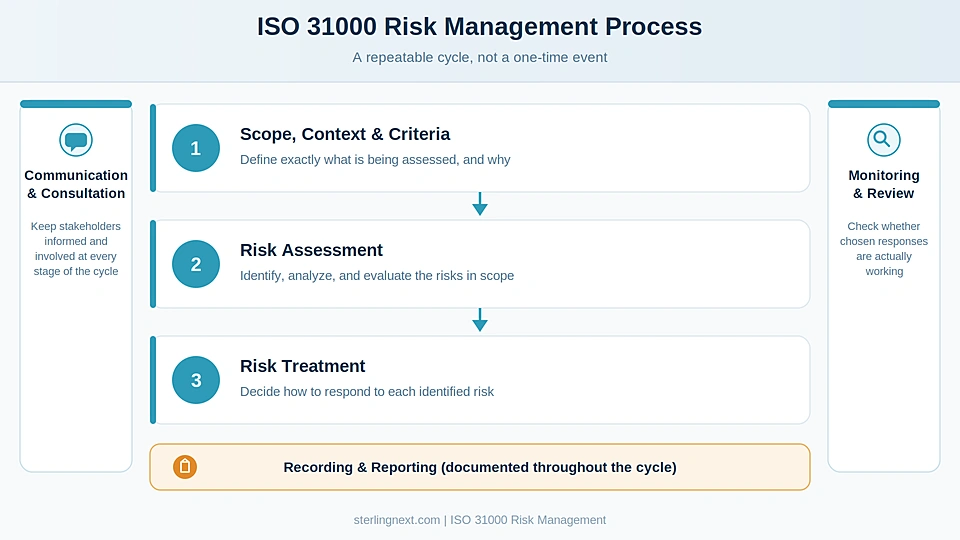
Together, these ISO 31000 Risk Management Process Steps give organizations a repeatable cycle to work through rather than a one-off event that gets filed away and forgotten.
Risk Assessment Techniques (IEC 31010)
Many organizations pair ISO 31000 with IEC 31010 for more hands-on guidance. Risk Assessment Techniques IEC 31010 lays out specific tools, checklists, scenario analysis, risk matrices, and similar methods that help teams carry out the assessment step in a more structured way.
Practical ISO 31000 Example
A logistics company is thinking about using a new delivery route that often gets flooded, before starting, the team checks how likely flooding is and whether it could delay deliveries. This example makes it easier to understand Inherent Risk vs Residual Risk.
- Inherent risk is the flooding threat as it exists before any precautions are put in place.
- Residual risk is what's left over after the company adds safeguards, such as alternate routes or more flexible scheduling.
By weighing inherent risk vs residual risk side by side, the company can judge whether its precautions are actually cutting down exposure to an acceptable level, instead of just assuming the problem has been solved.
Benefits of ISO 31000
Organizations that stick with ISO 31000 over time tend to notice improvements across several areas of the business.
Some of the clearest Benefits of implementing ISO 31000 include:
- Better-informed decisions: Helps teams make decisions after understanding the possible risks.
- Fewer unexpected problems: Helps organizations prepare for risks before they turn into bigger issues.
- Greater stakeholder confidence: Shows customers, partners, and other stakeholders that risks are being managed properly.
- Better alignment with business goals: Makes sure risk management supports the organization’s wider plans and objectives.
ISO 31000 for Operational Resilience
One growing use case involves applying ISO 31000 to build stronger operational resilience. As disruptions like cyberattacks and supply chain shocks become more common, organizations lean on the standard to build resilience plans that keep critical operations running even under pressure.
Who Can Use ISO 31000?
ISO 31000 is deliberately written to be flexible. It isn't limited to large corporations or any one specific industry.
It's used by:
- Small businesses manage everyday operational risk.
- Government agencies planning public projects.
- Nonprofits assessing funding and program risks.
- Manufacturing firms managing supply chain uncertainty.
Because it focuses on principles rather than rigid rules, teams can scale the approach up or down to match their own size and complexity.
A small shop may use a simple spreadsheet to keep track of risks involving money, stock, and employees. A large international company may have a team that focuses on risk, along with systems and software to manage risks in different locations. Both can follow ISO 31000 because it can be applied in ways that suit the size and needs of each business. The main goal is to spot problems early and deal with them before they cause trouble.
How to Implement ISO 31000
Getting started with risk management begins with support from business leaders. Without their involvement, risk management may not become a regular part of the organization’s work. An ISO 31000 Risk Management Training course can help professionals understand the standard, learn how to assess risks, and apply practical methods to manage risks in their daily business activities.
Practical steps typically include:
- Getting leadership support: Making sure leaders understand the value of managing risks and support the process.
- Understanding the organization's situation: Identifying the business environment, goals, and factors that may create risks.
- Training employees: Helping teams learn how to identify, assess, and manage risks.
- Adding risk checks to daily work: Making risk management part of existing tasks and business processes.
- Regularly reviewing the approach: Checking what is working and making changes when needed.
Using an ISO 31000 Risk Assessment Template
Many organizations use a simple ISO 31000 risk assessment template to record and manage risks in a consistent way. The template may include details such as the risk, how likely it is to happen, its possible impact, current controls, and actions planned to reduce it. This makes it easier for teams to record risks and keep track of how they are being managed. Here is a simple example of how the template might look in practice.
|
Risk Description |
Likelihood |
Impact |
Existing Controls |
Planned Action |
|---|---|---|---|---|
|
Flooding on delivery route |
Medium |
High |
Weather monitoring |
Add alternate route |
|
Key supplier delay |
Low |
Medium |
Backup supplier contract |
Review quarterly |
|
Data breach during system upgrade |
Medium |
High |
Access controls, encryption |
Schedule penetration test |
Using an ISO 31000 Risk Assessment Template early on helps teams stay consistent as they build experience with the process, rather than reinventing the format every time a new risk comes up.
Common Challenges
Even organizations with good intentions run into obstacles when applying ISO 31000.
Common Challenges and How to Address Them
- Limited staff training: Provide employees with basic training so they understand how to identify and manage risks.
- Inconsistent reporting: Use a common process or template so different departments record and report risks in the same way.
- Treating risk management as paperwork: Make risk management part of regular business activities instead of viewing it as a task that only needs to be completed for documentation.
- Lack of follow-up: After identifying risks, make sure teams take action and continue to monitor them.
- Regularly review risks: Hold monthly check-ins or include risk discussions in leadership meetings to keep track of changes and ensure important risks are not forgotten.
AI Risk Management with ISO 31000
As artificial intelligence becomes more common in businesses, companies also need to think about the risks that come with using it. ISO 31000 helps organizations identify and manage risks in a structured and effective manner. These risks may include unfair AI decisions, privacy concerns, data problems, and mistakes made by automated systems.
Integrating ESG into ISO 31000
ESG factors are also becoming an important part of risk management. Organizations are looking at environmental, social, and governance issues alongside financial and operational risks. For example, they may assess climate-related risks and social responsibility concerns using the same approach they use to manage other business risks.
ISO 31000 and Other ISO Standards
ISO 31000 can be used with other management standards, many organizations already follow different standards for areas such as quality, security, or business continuity. Using them together can help the organization understand its risks more clearly and manage them in a more organized way.
ISO 31000 Integration with ISO Management Standards
Bringing ISO 31000 together with other management systems such as ISO 9001 for quality or ISO 27001 for information security lets organizations avoid running duplicate processes. Instead of maintaining separate risk systems, teams fold ISO 31000 principles into the management structures they already have in place.
ISO 31000 vs COSO ERM
A common comparison professionals make is between ISO 31000 and COSO ERM. Both address organizational risk, but they come from different starting points. The table below breaks down some of the key differences.
|
Aspect |
ISO 31000 |
COSO ERM |
|---|---|---|
|
Nature |
Principles-based guideline |
Framework with more defined components |
|
Certifiable? |
No |
No |
|
Primary focus |
Broad, adaptable risk management |
Internal control and financial reporting |
|
Best fit for |
Organizations of any size or industry |
Organizations with strong governance/finance focus |
|
Flexibility |
High adapts to any context |
Moderate more structured approach |
While ISO 31000 focuses on being a flexible, principles-based guideline usable by any organization, COSO ERM was originally developed with a stronger focus on internal control and financial reporting. Many organizations reference both, using ISO 31000 vs COSO ERM comparisons to decide which language and structure fits their culture best.
Is ISO 31000 Certifiable?
A question professionals ask often is: Is ISO 31000 a Certifiable Standard? The answer is no. Unlike ISO 9001 or ISO 27001, ISO 31000 is designed purely as guidance. Professionals who want to study the framework, principles, and implementation process in more detail can refer to the SterlingNext ISO 31000 Risk Management Course for structured learning. Organizations can't become "ISO 31000 certified." Instead, they use it as a reference point to build their own risk management practices, usually verified internally rather than through external audits.
Conclusion
ISO 31000 Risk Management gives organizations a simple and flexible way to deal with uncertainty and manage risks. Its clear principles and process help businesses of all sizes make better decisions. As businesses face new challenges such as AI, climate change, and ESG issues, ISO 31000 can help them understand and manage these risks. Organizations that use the standard can better protect their daily operations, prepare for unexpected problems, and respond more confidently when challenges arise. It also encourages businesses to make risk management a regular part of their everyday decisions.
Get Certified With Industry Level Projects & Fast Track Your Career
Checkout Top 10 Highest Paying Jobs
Frequently Asked Questions
ISO 31000 helps businesses spot risks, understand their possible impact, and decide what to do about them. It also helps teams make better choices, deal with unexpected situations, and keep working toward their goals when things do not go as planned.
No, ISO 31000 is not legally required for most organizations, it is a voluntary standard that businesses can choose to follow. Many organizations use it to improve risk management, strengthen governance, build trust with stakeholders, and make better long-term business decisions.
Yes, ISO 31000 can be used by organizations of all sizes, small businesses can adapt its guidelines to match their needs, helping them identify risks early, deal with problems effectively, and make better-informed business decisions.
Inherent risk is the risk an organization faces before taking any steps to reduce or control it. Residual risk is the risk that is still present after controls or other measures have been applied to reduce it.
No, ISO 31000 does not replace COSO ERM. The two can be used together. ISO 31000 provides guidance on managing risks, while COSO ERM focuses more on overall business strategy, governance, and how risks are monitored across the organization.
The ISO 31000 process helps organizations understand their situation, identify risks, assess their impact, and decide how to manage them. They then monitor the results, review what is working, share important information, and make improvements to support better decisions.
ISO 31000 does not require organizations to use one specific risk assessment template, many businesses use a risk register to record risks, how likely they are, their possible impact, current controls, actions to reduce them, responsible people, and review status.
ISO 31000 gives organizations a clear approach to managing risk, while IEC 31010 provides useful methods for assessing risks. Used together, they help businesses identify risks, understand their possible effects, and assess them in a clear and consistent way.
ISO 31000 helps organizations deal with AI risks such as privacy issues, cyber threats, bias, legal problems, and system errors. Its flexible guidelines make it easier for businesses to update their risk management practices as AI technology changes and new risks arise.
ISO 31000 helps businesses spot risks early and deal with them before they become bigger problems. It supports better decisions, reduces disruptions, builds trust with stakeholders, and helps businesses meet requirements. This makes it easier for a business to manage change and keep things running smoothly.