
Training Outcomes Within Your Budget!
We ensure quality, budget-alignment, and timely delivery by our expert instructors.
Table of Content
- Key Elements of Organisational Behaviour Every Business Should Know
- Understanding Organisational Behaviour: The Basics
- Why the Key Elements of Organisational Behaviour Matter in Today's Workplace
- The Three Categories of Organisational Behaviour Elements
- How These Elements Influence One Another
- How the Key Elements of Organisational Behaviour Improve Business Performance
- Common Workplace Problems Caused by Weak Organisational Behaviour
- Practical Ways to Improve Organisational Behaviour
- A Real-World Example of Organisational Behaviour in Action
- Conclusion
- Recommended Reads
Recent Blogs
ISO 13485 Medical Devices QMS
August 24th, 2026
Sprint Planning Best Practices: Template & Common Mistakes
August 24th, 2026
How to Write User Stories: Format, Examples & Acceptance Criteria
August 24th, 2026
Azure AZ-104 Exam Study Guide: Pass on First Attempt
August 24th, 2026
AWS SysOps Administrator Certification Guide
August 24th, 2026
Cloud Computing Salary Guide 2026: AWS, Azure & GCP
August 20th, 2026
CompTIA Cloud+ Certification: Complete Guide
August 20th, 2026
ISO 31000 vs ISO 27001
August 20th, 2026
CISM Certification Cost and Roadmap for Career Success
August 19th, 2026
CISSP Exam Format & Domains
August 19th, 2026
Closer Look at CISSP Requirements That Truly Matter Most
August 19th, 2026
CISSP Certification Path Steps For Aspiring Security Leaders
August 19th, 2026
CISSP Certification Benefits That Support Career Growth
August 19th, 2026
AWS DevOps Engineer Certification: Complete Guide
August 18th, 2026
AWS Developer Certification: Study Guide & Exam Tips
August 18th, 2026
Key Elements of Organisational Behaviour
Last updated on July 29th, 2026
- Share
-

-

-

-

-

 Sachin Kumar
Understanding the key elements of organisational behaviour makes it easier to identify what drives workplace success and where problems begin.
Key Elements of Organisational Behaviour Every Business Should Know
Introduction
Walk into any workplace, and you'll notice that many different factors influence employee behaviour. A person's motivation, the way a team communicates, and the organisation's culture all influence how people work and interact. This is what organisational behaviour helps us understand. Factors such as leadership, motivation, and Effective Communication play an important role in influencing employee behaviour and team performance. Understanding the key elements of organisational behaviour makes it easier to identify what drives workplace success and where problems begin. This blog explains the key elements of organisational behaviour, how they fit into the individual, group, and organisational levels, and why they are important for creating a productive and positive workplace.
.webp)
Understanding Organisational Behaviour: The Basics
What Does Organisational Behaviour Mean?
Organisational behaviour is the study of how people act inside a company alone and in groups and how that behaviour affects performance, communication, and culture.
It covers:
- How employees make decisions.
- How teams handle disagreements.
- How employee relationships form and hold up under pressure
Why it matters:
- HR teams, managers, and business owners use it every day, often without labeling it as such.
- It helps explain problems that seem unrelated on the surface.
Example: When a company experiences high staff turnover, organizational behavior helps identify the root causes of poor leadership, unclear expectations, low job satisfaction, or a poor culture fit.
Why the Key Elements of Organisational Behaviour Matter in Today's Workplace
These elements shape how a business runs every single day. Leaders who understand them make better calls on hiring, training, and team building.
Organisational behaviour in management:
- Helps managers notice problems before they become serious.
- Helps solve conflicts in a fair way.
- Builds trust so small issues don't lead employees to leave.
The importance of organisational behaviour shows up in:
- Lower staff turnover
- Higher employee engagement
- Smoother teamwork
- Steadier employee performance during busy periods
The scope of organisational behaviour covers three areas:
- What one person does
- How groups act
- How the whole company runs
This is why organisational behaviour models are used across industries, from factories to tech startups.
The Three Categories of Organisational Behaviour Elements
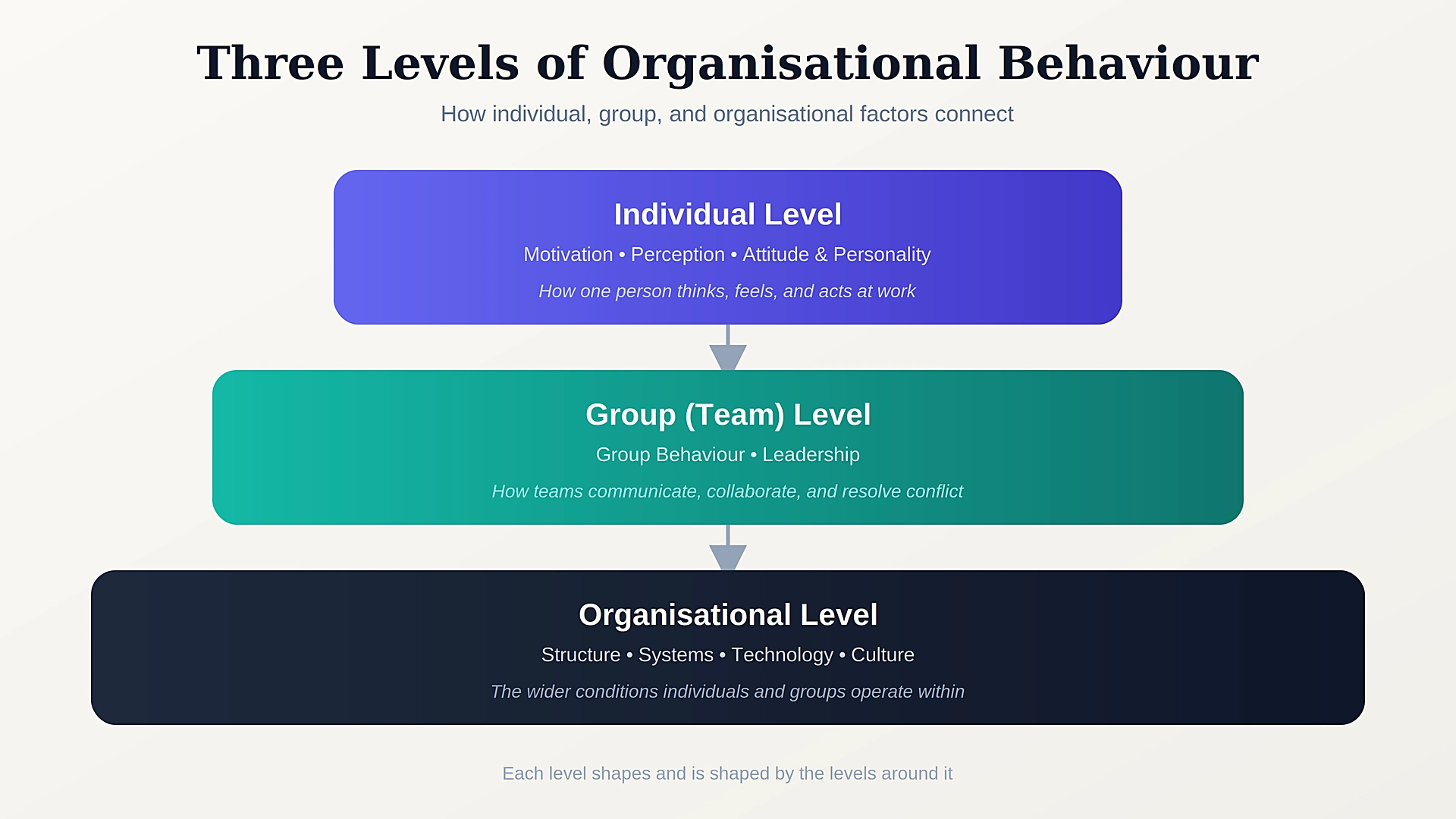
Organisational behaviour works at three connected levels:
- Individual: How one employee thinks, feels, and works.
- Group: How people work together in a team, including how they communicate and support each other.
- Organisational: The company's rules, work culture, and way of doing things that affect everyone.
These levels are not separate. A demotivated employee (individual) can lower group morale (group). A weak structure (organisational) can make even strong individuals look unproductive. Seeing organisational behaviour as three connected layers, rather than a random list, makes it far easier to apply in real workplaces.
|
Category |
What It Covers |
Example Elements |
|---|---|---|
|
Individual Level |
How one person thinks, feels, and acts at work |
People, individual behaviour, motivation, perception, attitude and personality |
|
Group (Team) Level |
How teams work and communicate together |
Group behaviour, leadership |
|
Organisational Level |
How the whole company is set up and run |
Structure, systems, technology, culture |
Individual Level
The individual level looks at how one employee thinks, feels, and acts at work where employee behaviour starts, before it becomes visible in a team.
People First
People in organisational behaviour are the starting point. A company is only as strong as the people in it.
- What it means: No two employees bring the same background, skills, or way of thinking to a role.
- Why it matters: Businesses that ignore this apply a single management style to everyone, resulting in uneven results.
- Impact: Attention to individual differences improves hiring fit, employee relationships, and job satisfaction.
- Example: A new employee may have the right skills but lack confidence. Giving them a mentor instead of more training can help them settle in, stay with the company, and do better at work.
Individual Behaviour
Individual behaviour: How an employee makes decisions, works every day, and responds to feedback.
- Why it matters: Small daily actions can make a difference in the quality and consistency of work.
- Impact: Teams that admit mistakes and learn from them keep improving. Teams that avoid responsibility often make the same mistakes again.
- Example: A customer service employee learns from a difficult call and speaks more calmly the next time. When everyone improves this way, the whole team provides better customer service.
Motivation
Motivation in organisational behaviour explains what pushes people to work hard, even unobserved praise, salary, purpose, growth, or simply enjoying the work.
- Why it matters: It's one of the strongest predictors of employee engagement and output.
- Connection: Good leadership keeps employees motivated. Motivated employees are more likely to communicate well and work better as a team.
- Example: A sales employee who is regularly appreciated is more likely to stay motivated. If their hard work is ignored, they may start looking for another job.
Perception
Perception in organisational behaviour is about how employees read events at work two people can see the same meeting very differently.
- Why it matters: Perception, not just facts, drives how people react.
- Risk: The same situation can be understood differently by different people. which can slowly reduce trust.
- Example: If a company changes working hours without explaining the reason, some employees may feel they are not trusted, while others may see it as a positive change. A clear explanation helps everyone understand the decision.
Attitude and Personality
Attitude and personality affect how people deal with change, handle stress, and work with others. People with a positive attitude usually work better in teams, even when the project is challenging.
- Why it matters: How you behave at work often matters as much as, or even more than, your skills.
- Impact: A negative attitude from one employee can affect the mood of the whole team.
- Example: When deadlines are tight, employees who stay calm and focus on solutions help others do the same.
Group (Team) Level
The group level looks at how teams work together and individual behaviours combine here into patterns that support or undermine business goals.
Group Behaviour
Group behaviour covers teamwork, communication, and how conflicts get resolved within a team.
- Why it matters: Most jobs involve working with other people, so teamwork plays a big role in getting things done.
- Impact: When everyone knows how the team works, problems are easier to notice and fix before they affect deadlines.
- Example: A team that meets for a quick check-in each week notices a delayed campaign file early enough to fix it before launch.
Leadership
Leadership has a strong impact on how a team communicates and works together. Strong leaders encourage open communication, shared responsibility, and mutual respect, helping teams perform more effectively.
- Why it matters: A leader's behaviour influences how the whole team works together.
- Impact: Teams are more open when leaders listen to their concerns. If leaders dismiss feedback, employees may stop sharing it.
- Example: After recognizing a junior employee's contribution, the team leader notices more people taking part in discussions.
Organisational Level
The organisational level covers the whole company structure, systems, technology, and culture. These set the conditions individuals and groups operate within.
Structure
The way a company is organized whether it has few management levels, many levels, or a matrix structure affects how decisions are made and how information is shared.
- Why it matters: A good structure helps people communicate and work together more easily.
- Impact: Too many approval levels can slow work down, while very flat structures may leave employees unsure about who is responsible for what.
- Example: A company's marketing and sales teams rarely meet because they report to different managers. After they start holding regular planning meetings, they stay aligned on their goals and work better together.
Systems
These are the everyday processes a company uses to manage work, such as planning tasks, approving requests, tracking progress, and completing work.
- Why it matters: When processes are confusing, employees may not know who to contact or what to do next.
- Impact: Some people put off tasks or avoid them because the process takes too much time or feels difficult to follow.
- Example: A company requires several approvals for a small expense claim. Many employees stop submitting valid claims because the process is too time-consuming. After the approval steps are reduced, more employees submit claims correctly.
Technology
Whether employees are in the office or working remotely, technology plays a big part in how they communicate and finish their work.
- Why it matters: New technology is more likely to succeed when employees know how to use it.
- Impact: Without proper guidance, many employees continue using old methods or create their own ways of getting the work done.
- Example: A company introduces a new work platform and gives employees time to learn it before making the switch. As a result, the change is smoother and fewer people struggle with the new system.
Culture
Culture is built on shared values and everyday behaviours that guide how employees interact and make decisions, even when no written rules exist.
- Why it matters: Culture shapes almost every other element on this list.
- Impact: People are much more willing to share ideas or admit mistakes when they know they won't be judged for it. If every error leads to blame, most employees will simply keep quiet instead of speaking up.
- Example: During a team meeting the manager admitted to making a mistake and explained what they learned from it. Seeing that, newer employees felt more comfortable speaking up about their own mistakes instead of trying to hide them.
How These Elements Influence One Another
None of these elements work alone; they shape and reshape each other constantly.
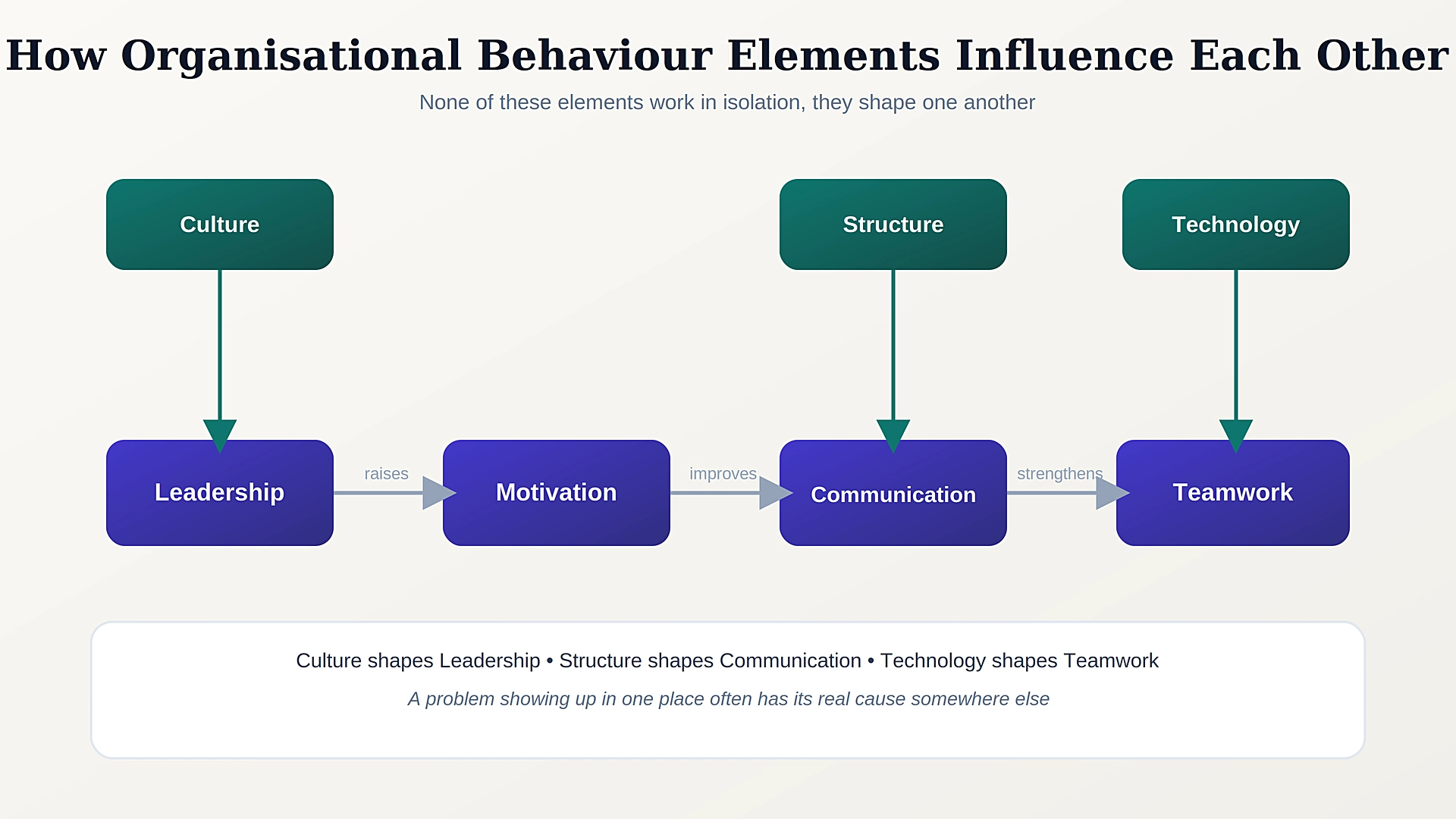
These elements do not operate on their own. A change in one area usually affects the others, so they keep influencing each other over time.
- Leadership and Motivation: A supportive manager can help an employee regain interest in their work, even when pay or benefits stay the same.
- Motivation and Communication: Employees who feel motivated are usually more willing to ask questions, share ideas, and join discussions.
- Communication and Teamwork: Open communication helps team members clear up confusion before it becomes a bigger problem, making day-to-day work easier.
- Culture and Leadership: Managers often reflect the culture of their workplace. The values a company encourages can influence the way they lead their teams and make decisions.
- Structure and Communication: The way a company is organized affects how information is shared. When roles and reporting lines are clear, employees know who to approach and where to pass information.
- Technology and Collaboration: The right tools can make it easier for people to work together. However, if employees are not given enough training or the rollout is poorly planned, those tools can end up slowing work instead.
Example: A company introduces new technology without first fixing old processes. Even with good intentions, the mismatch between tools and systems lowers morale and makes people resist change.
Problems rarely have just one cause, so fixes often need to work on multiple levels at once.
How the Key Elements of Organisational Behaviour Improve Business Performance
When these elements are managed well, improvements often start to appear within a few months.
- Higher productivity: When employees understand their responsibilities and have the right support, they spend less time figuring things out. For example, a warehouse team with clear daily goals and short morning meetings is likely to finish its work more efficiently than a team without a clear plan.
- Stronger teamwork: Good group behaviour and steady leadership resolve disagreements faster, without needing a manager to referee every time.
- Better decision-making: Employees who trust their leaders raise concerns early, before small issues become expensive mistakes.
- Employees are more engaged in their work: Employees are more likely to stay involved when they feel their ideas are heard and appreciated.
- Reduced turnover: People are less likely to leave their jobs when they feel supported and have reasons to stay.
- Healthier workplace culture: Trust, open communication, and appreciation become stronger over time when they are part of everyday work.
- Greater organisational success: All of the above build on each other; none require a full overhaul, just steady attention to individual, group, and organisational elements.
Common Workplace Problems Caused by Weak Organisational Behaviour
These problems build up slowly and rarely stay contained to one department.
- High staff turnover: caused by poor leadership or unclear expectations; employees quietly look elsewhere rather than raise the issue.
- Low morale: Unclear communication and a lack of recognition can reduce motivation. Over time, employees may lose interest if their efforts are rarely noticed.
- Team conflicts: Confusion about who is responsible for what can create unnecessary problems. Even when people get along, unclear roles can lead to misunderstandings and tension.
- Resistance to change: caused by new systems or technology introduced without support; employees resist the rollout rather than the change itself.
- Weak collaboration: caused by a culture that discourages open communication; once raising concerns feels unsafe, people stop doing it.
Most of these problems can be prevented once a business identifies which specific element is causing the friction.
Practical Ways to Improve Organisational Behaviour
Small, targeted changes make the biggest difference:
- Hold regular team meetings: Short, regular check-ins help identify and solve issues before they become conflicts.
- Give employees opportunities to share feedback: an anonymous suggestion form or regular one-on-ones help people feel heard.
- Recognize achievements consistently: a specific, timely mention of good work does more than an occasional generic thank you.
- Clearly assigned roles and responsibilities: help prevent confusion and minimize conflicts among team members.
- Provide leadership development: even basic training in feedback and conflict handling improves how a team communicates.
- Introduce new technology with proper training: give staff time, clear instructions, and someone to ask questions to.
These six areas cover the most common trouble spots across individual, group, and organisational levels, making them a useful starting point for organisational behaviour notes or team workshops. As managers take on greater responsibilities, developing strong Project Management Skills can also help them apply these practices more effectively while leading teams and improving workplace performance.
A Real-World Example of Organisational Behaviour in Action
The problem: A mid-sized retail company was seeing more warehouse employees leave their jobs. Many said pay was the reason, but the company later found that other workplace problems were causing people to leave.
The causes
- Different shift leaders gave different instructions, so employees were often unsure who to follow.
- The old scheduling system made mistakes, creating overlapping shifts. This left some employees confused about their hours, while others had to work extra shifts.
The improvements
- The company started short team meetings before each shift so everyone received the same information.
- Shift leaders were trained to communicate clearly and handle problems fairly.
- The company introduced a new scheduling system and trained employees to use it properly.
The outcome: Within four months, turnover dropped by nearly 30 percent, and staff surveys showed noticeably better morale. The employees themselves did not change. Instead, improvements in leadership at the group level and systems at the organisational level created better outcomes. Professionals looking to strengthen these workplace capabilities can explore SterlingNext Professional Training Courses to develop practical leadership and management skills.
Conclusion
Key Elements of Organisational Behaviour are not just business concepts they are part of everyday work. You can see them in how meetings are run, how people work together, and how new ideas are accepted. The real value of understanding these ideas is knowing that individuals, teams, and the organisation all affect one another. A problem that appears in one area may actually start somewhere else. Whether you're a manager, HR professional, or business owner, understanding these elements helps create a workplace where people feel heard, supported, and motivated. Even small improvements in how people work and communicate can make a positive difference across the whole organisation.
Get Certified With Industry Level Projects & Fast Track Your Career
Checkout Top 10 Highest Paying Jobs
Frequently Asked Questions
Common frameworks list people, structure, technology, the external environment, and behaviour patterns like motivation and leadership. Most businesses focus on individual behaviour, group dynamics, leadership, structure, and culture.
It is studied at three levels, The individual level focuses on personal attitudes, motivation and behaviour. The group level examines teamwork, communication, and leadership. The organisational level looks at structure, culture, systems, and processes that shape how people work together.
Organisational behaviour helps managers understand why people behave differently at work. This makes it easier to hire the right people, communicate clearly, solve problems fairly, keep employees motivated, and support teams when work becomes challenging.
Organizational behavior looks at why people act the way they do at work. Human resource management uses that understanding to make decisions about hiring, pay, workplace policies, and employee development.
Leaders have a big impact on how teams work together. Supportive leaders make it easier for employees to raise issues, while poor leadership can cause people to stop sharing ideas and lose interest in their work.
Poor organisational behaviour can lower employee morale, increase staff turnover, create communication problems, cause workplace conflicts, reduce teamwork, slow productivity, and make it harder to achieve organisational goals.
Yes. It is just as important for small businesses as it is for large organisations. Understanding motivation, communication, leadership, and workplace culture helps business owners build stronger teams, solve problems early, and create a positive work environment as the business grows.
You might see an employee become less motivated after missing out on recognition, a team having trouble with a new tool because no training was provided, or a manager creating a workplace where employees either speak up or stay quiet.
The main challenges are managing individual differences fairly, maintaining open communication across levels, adapting culture and systems as the company grows, and responding to change without losing morale or productivity.
Models help managers understand employee behaviour. They show how things like motivation, leadership, and teamwork affect the way people work, making it easier to solve workplace problems.