
Training Outcomes Within Your Budget!
We ensure quality, budget-alignment, and timely delivery by our expert instructors.
Table of Content
- ISO 9001 Documentation Requirements Explained
- Understanding ISO 9001 Documentation Requirements
- Understanding ISO 9001 Clauses at a Glance
- ISO 9001 Quality Policy and QMS Scope Requirements
- Document Control: Requirements and Procedure Under ISO 9001
- Records That Must Be Retained: Internal Audits and Corrective Actions
- ISO 9001 Clause 4.1: Context of Organization Documentation
- ISO 9001 2026 Revision: What's Changing for Documentation
- Going Digital: Electronic, AI, and Paperless Documentation Systems
- Best Practices for Maintaining ISO 9001 Documentation
- Conclusion
- Recommended Reads
Recent Blogs
ISO 22301 Clauses Explained
August 25th, 2026
ISO 13485 Medical Devices QMS
August 25th, 2026
Sprint Planning Best Practices: Template & Common Mistakes
August 24th, 2026
How to Write User Stories: Format, Examples & Acceptance Criteria
August 24th, 2026
Azure AZ-104 Exam Study Guide: Pass on First Attempt
August 24th, 2026
AWS SysOps Administrator Certification Guide
August 24th, 2026
Cloud Computing Salary Guide 2026: AWS, Azure & GCP
August 20th, 2026
CompTIA Cloud+ Certification: Complete Guide
August 20th, 2026
ISO 31000 vs ISO 27001
August 20th, 2026
CISM Certification Cost and Roadmap for Career Success
August 19th, 2026
CISSP Exam Format & Domains
August 19th, 2026
Closer Look at CISSP Requirements That Truly Matter Most
August 19th, 2026
CISSP Certification Path Steps For Aspiring Security Leaders
August 19th, 2026
CISSP Certification Benefits That Support Career Growth
August 19th, 2026
AWS DevOps Engineer Certification: Complete Guide
August 18th, 2026
ISO 9001 Documentation Requirements
Last updated on July 29th, 2026
- Share
-

-

-

-

-

 Sachin Kumar
ISO 9001 follows a simple approach to how your organization works, then keeps records to show that you follow those processes.
ISO 9001 Documentation Requirements Explained
Introduction
Whether you're setting up a new quality management system or getting ready for ISO 9001 certification, it's important to understand the ISO 9001 documentation requirements. Many organizations first focus on the Benefits of ISO 9001 Certification, but effective documentation is what helps the system work in practice. ISO 9001 does not ask you to create a lot of paperwork. It simply requires you to maintain the documents and records needed to run your processes consistently, demonstrate that you meet the standard, and continue improving over time. In this guide, you'll learn which documents are required, which are optional, and how to create a simple documentation system that works for both certification and day-to-day business.
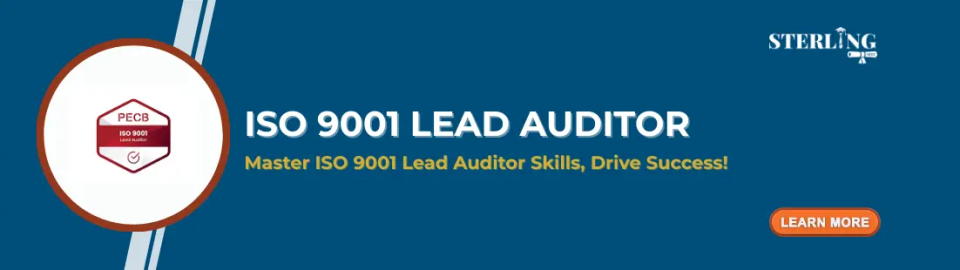
Understanding ISO 9001 Documentation Requirements
ISO 9001 follows a simple approach to how your organization works, then keeps records to show that you follow those processes. Unlike older versions of the standard, the current version does not require a fixed set of manuals. Instead, it allows each organization to decide what documents are needed to manage its processes effectively and consistently.
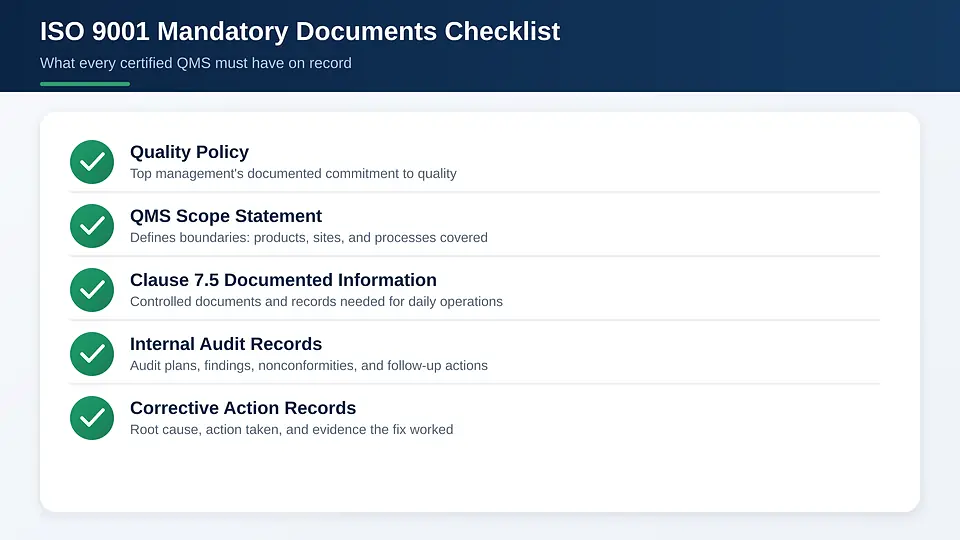
That said, some documents are non-negotiable, if you're working toward certification, your ISO 9001 mandatory documents checklist should include your quality policy, the scope of your QMS, documented information necessary for the effective operation of your processes, and specific records required by the standard.
Many beginners think "documented information" simply means paperwork, but that's not what ISO 9001 means. It includes any information your organization records and keeps, such as a Word document, spreadsheet, digital form, or cloud-based file. The format doesn't matter. What matters is that the information is accurate, kept up to date, and easy to find when it's needed.
Think of documentation as the memory of your quality management system. Without it, good practices live only in people's heads, and when someone leaves, that knowledge disappears with them.
During certification audits, auditors focus less on the amount of documentation and more on whether documented information accurately reflects how the organization operates and is consistently followed.
Understanding ISO 9001 Clauses at a Glance
Before looking at the documents required by ISO 9001, it's useful to understand how the standard is organized. It is divided into different clauses, with each one covering a specific part of a Quality Management System (QMS), from planning and leadership to daily operations and improvement. Some clauses require documented information, while others focus on the actions your organization needs to take. Together, they help your organization deliver consistent quality and keep improving its processes.
The table below provides a simple overview of the main operational clauses.
|
ISO 9001 Clause |
Purpose |
Documentation Required? |
|---|---|---|
|
Clause 4 – Context of the Organization |
Understand your organization, identify interested parties, and define the QMS scope. |
Yes |
|
Clause 5 – Leadership |
Establish quality policy, leadership responsibilities, and customer focus. |
Yes |
|
Clause 6 – Planning |
Address risks, opportunities, and quality objectives. |
Some documented information |
|
Clause 7 – Support |
Manage resources, competence, awareness, communication, and documented information. |
Yes |
|
Clause 8 – Operation |
Plan, control, produce, and deliver products or services. |
Yes |
|
Clause 9 – Performance Evaluation |
Monitor performance through audits, measurement, and management reviews. |
Yes |
|
Clause 10 – Improvement |
Handle nonconformities, corrective actions, and continual improvement. |
Yes |
Although every clause supports an effective QMS, two clauses receive the most attention because they directly influence ISO 9001 documentation requirements: Clause 4.1 and Clause 7.5.
Why Are Clause 7.5 and Clause 4.1 Important?
Some ISO 9001 clauses are especially important because they help build a strong Quality Management System (QMS). Clause 4.1 focuses on understanding the organization's business, including the internal and external factors that can affect its goals. Clause 7.5 explains how to create, update, and control documents and records. Together, these clauses help organizations run their processes consistently and make it easier to meet ISO 9001 requirements.
ISO 9001 Quality Policy and QMS Scope Requirements
Two documents form the foundation of any quality management system: your quality policy and your scope statement.
Quality Policy
Meeting ISO 9001 quality policy requirements means writing a policy that reflects your organization's actual purpose and direction, not a generic statement copied from a template. Your policy should:
- Fit the purpose and context of your organization
- Provide a framework for setting quality objectives
- Include a commitment to meeting requirements and continual improvement
- Be communicated, understood, and applied across the organization
Top management owns this policy, and it must be available as documented information, usually shared internally or included in a quality manual.
The second part of ISO 9001 quality policy requirements to keep in mind is accessibility: your policy isn't just for auditors. Employees should be able to explain what it means for their daily work.
QMS Scope
Alongside the policy, ISO 9001 QMS scope requirements ask you to define the boundaries of your quality management system, which products, services, sites, and processes are covered, and which requirements don't apply, with justification.
Defining the scope correctly from the beginning makes everything easier later. If the scope is too broad, you'll have to show that all those areas meet ISO 9001 requirements. If it's too narrow, you may leave out important processes that customers expect to be included.
Document Control: Requirements and Procedure Under ISO 9001
Once your key documents are in place, you need a system to manage them, this is where ISO 9001 document control requirements come in, closely tied to what the standard calls ISO 9001 Clause 7.5 documented information, one of the most detail-heavy parts of the standard.
What Clause 7.5 Covers
ISO 9001 Clause 7.5, documented information, sets out how organizations should create, update, and control the records and documents that their QMS depends on. It groups documentation into two categories:
- Documents: These explain what should be done. Examples include quality policies, procedures, work instructions, and forms.
- Records: These show what was actually done. Examples include inspection reports, training records, completed checklists, and test results.
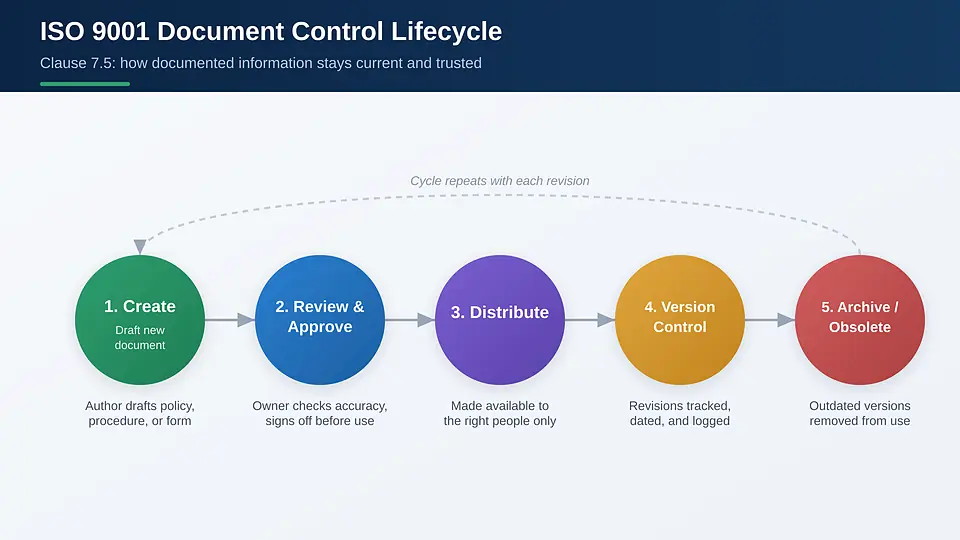
Clause 7.5 doesn't dictate a format. It does require consistent version control, so no one works from outdated instructions.
Building Your Document Control Procedure
A solid ISO 9001 document control procedure typically covers:
- How documents are created, reviewed, and approved before use
- How changes and revisions are identified and tracked
- How outdated versions are removed from circulation
- Who has access to which documents, and how that access is protected
- How documents are stored, backed up, and retrieved when needed
Many teams write a short, dedicated ISO 9001 document control procedure as a standalone document, so new employees know how to request changes or find the latest version.
Getting ISO 9001 document control requirements right doesn't mean more paperwork; it means a system where people can trust that what they're looking at is current and approved.
Records That Must Be Retained: Internal Audits and Corrective Actions
Some documents and records are required by ISO 9001. The standard clearly states which records you must keep as evidence, but it does not tell you how long to keep them. Each organization decides the retention period based on legal, customer, and business needs. During that time, records should be easy to read, stored safely, and simple to find whenever they are needed.
Internal Audit Records
ISO 9001 internal audit records usually include audit schedules, audit plans, checklists, findings, nonconformities, and the actions taken to fix them. Auditors look for records that show internal audits are carried out regularly and that the organization is checking its processes and making improvements over time, not just preparing for the certification audit.
Professionals responsible for planning and conducting these audits often strengthen their practical auditing skills through an ISO 9001 Lead Auditor Training Program, which covers audit planning, evidence collection, reporting, and compliance with ISO 9001 requirements.
Corrective Action Records
ISO 9001 corrective action records usually include details of the problem, its root cause, the action taken to fix it, who was responsible, the completion date, and evidence that the problem was resolved. Keeping these records shows that the organization investigates issues, fixes them, and takes steps to prevent them from happening again.
Together, these examples show what solid ISO 9001 documentation requirements look like in practice: a QMS that isn't just good intentions on paper, but one that's actively used, tested, and improved.
ISO 9001 Clause 4.1: Context of Organization Documentation
Clause 4.1 asks organizations to identify internal and external issues relevant to their purpose and direction, market conditions, regulatory changes, technological changes, and other factors that may affect the organization.
That surprises beginners. This raises a common question: does ISO 9001 Clause 4.1 context of organization documentation actually matter if it isn't mandatory? In practice, yes. Auditors will ask how you determined your context, and "we discussed it once" rarely holds up as evidence.
Many organizations choose to document their Clause 4.1 business context, even though ISO 9001 does not require a specific format. They may use a short summary, a SWOT analysis, or management review notes. Writing it down makes it easier to keep the information consistent and show it during an audit, instead of relying on memory.
Think of Clause 4.1 as the "why" behind your QMS. Everything else policy, scope, risk assessments should trace back to the issues identified here.
ISO 9001 2026 Revision: What's Changing for Documentation
ISO 9001 is not updated very often. The current version was released in 2015, but a new version, ISO 9001:2026, is expected to be published around September 2026. Organizations will then have about three years (until around September 2029) to move from the 2015 version to the new one.
If you're preparing your Quality Management System (QMS) documents, there's no need to worry. The upcoming version of ISO 9001 is expected to make only small changes, not completely replace the current requirements. Most of the documentation you create today will still be useful and continue to meet the standard.
What Is Changing?
More focus on quality culture and ethics
The updated standard is expected to encourage organizations to build a stronger culture of quality and promote ethical behavior. This means your quality policy and leadership-related documents may need to show how management supports these values.
Climate change should be considered
Organizations are already expected to check whether climate change affects their business when identifying external issues under Clause 4.1. If it is relevant, it should be included in your documented context. If your current documentation does not mention this, it is worth reviewing now.
More guidance for understanding the standard
The 2026 version is expected to include additional guidance in Annex A. This guidance is not mandatory, but it can make it easier to understand the requirements and prepare better documentation.
Most documentation stays the same
The main clauses of ISO 9001 (Clauses 4 to 10) are expected to stay mostly the same. This means that if your organization already follows the current standard, you'll likely only need to update some documents instead of creating a whole new documentation system from the beginning.
Simple ISO 9001 2026 Transition Checklist
To prepare for the new version, you can:
- Review your Clause 4.1 documentation and check whether climate change is relevant to your organization.
- Update your quality policy, if needed, to reflect quality culture and ethical behavior.
- Keep a record of any document changes so updates are easier after the final standard is released.
- Check for any new terms or guidance added in Annex A and update internal documents where necessary.
- Review your documentation during regular internal audits instead of waiting until the last minute.
Should You Wait Before Creating New Documents?
No. You should continue to create and update documents in accordance with ISO 9001:2015. This version will remain valid during the transition period, so there is no reason to delay your documentation.
Once ISO 9001:2026 is officially published, you can update your documents as part of your regular surveillance or recertification audit. If your current documents already meet the requirements of Clause 7.5 and the existing ISO 9001 documentation requirements, you will likely only need to make a few small changes during the transition.
Going Digital: Electronic, AI, and Paperless Documentation Systems
ISO 9001 doesn't require any specific technology; it works whether records live on paper or online. Still, most organizations are moving away from filing cabinets.
Electronic Document Management
Many organizations use an electronic document management system for ISO 9001 to simplify version control, approvals, document retrieval, and access permissions.
AI and Automation
Modern document management tools do more than just store files. Some use AI to remind you when a document needs to be reviewed, keep track of different versions, and help create draft procedures. Your team can then review, edit, and approve these drafts. AI saves time by handling routine tasks, but people still make all the important decisions and give final approval.
Going Paperless
Many organizations choose to store all their ISO 9001 documents, such as policies, procedures, and records, in digital systems instead of using paper. This is called a paperless documentation system. It is not required by ISO 9001, but it makes audits easier because auditors can quickly find and check documents. Whether you use digital files or paper records, the main goal is to keep your documents accurate, up to date, and easy to find.
Best Practices for Maintaining ISO 9001 Documentation
Creating documents is only the first step. To keep your quality management system effective, organizations that invest in continuous learning are often better prepared to maintain compliance, adapt to changing requirements, and continuously improve their quality management systems. SterlingNext Learning Solutions supports professionals with practical training across quality management, project management, cybersecurity, cloud computing, and other in-demand fields.
Some recommended practices include:
Review Documents Regularly
Business processes, customer needs, and regulations can change over time. Review your documents regularly to make sure your policies, procedures, and work instructions are still correct, up to date, and useful. This helps everyone follow the latest requirements and work the right way.
Maintain Version Control
Every approved document should show its version number, the date it was updated, and who approved it. This helps employees know which version is the most up to date and prevents employees from using old documents. It also helps organizations meet ISO 9001 document control requirements.
Train Employees on Document Use
Documents are useful only if employees know where to find them and how to use them. Regular training helps staff understand the approved procedures and follow the latest version of each document in their daily work.
Protect and Back Up Documents
Organizations should keep their documents safe, whether they are stored on a computer or on paper, making regular backups helps prevent files from being lost. Only authorized people should be allowed to view or update documents. This keeps the information correct and reliable.
Periodically Remove Obsolete Documents
When a new procedure form or work instruction is approved, the old version should no longer be used. This helps everyone follow the latest information and keeps the quality management system accurate and up to date.
By following these best practices, organizations can keep their documents accurate, organized, and up to date, this also supports continuous improvement and makes certification audits easier to complete.
Conclusion
Good ISO 9001 documentation requirements are not about piles of paperwork, they are about keeping the right documents and making them easy to find, update, and use. Start with the basics of your quality policy, the scope of your quality system, and records like internal audits and corrective actions. These show how your organization handles quality and solves problems. Then choose a simple way to organize files, a small team may use a shared folder, while a larger one may use software. The key is using the latest version. As your organization changes, update the documents too. Good organization makes changes easier.
Get Certified With Industry Level Projects & Fast Track Your Career
Checkout Top 10 Highest Paying Jobs
Frequently Asked Questions
ISO 9001 requires businesses to keep important documents, such as the quality policy and system scope, along with records like audit and corrective action reports. These documents show that the organization follows its quality management system.
ISO 9001 requires documented information, such as a quality policy and QMS scope, and records, including internal audits, corrective actions, management reviews, and monitoring activities, where applicable.
No. Since the 2015 update, ISO 9001 does not require a separate quality manual. Many organizations still use one for convenience, but you can also meet the rules with separate policies, procedures, and records.
Some documents are optional, like a quality manual, work instructions, and an organizational chart, ISO 9001 does not require them, but many organizations use them to keep work clear and consistent.
It's the section of ISO 9001 that explains how organizations should create, update, approve, and control documents and records, so the right people always have access to accurate, current versions.
ISO 9001 does not set a fixed time for keeping documents and records. Your organization decides based on legal rules, customer agreements, and business needs. Keep records safe, easy to find, and available for as long as they are needed.
No. ISO 9001 is technology-neutral so that paper-based systems can meet its requirements. However, digital tools make version control, approvals, and audits significantly faster and easier to manage as your business grows.
Yes. Small businesses can follow ISO 9001 by using tools like Microsoft Word, Google Docs, or shared folders, they do not need costly software. The main thing is to keep documents clear, updated, and easy for employees to find.
More organizations are adopting cloud-based document management systems to store, manage, and control their documented information more efficiently. AI-assisted document control, and paperless documentation to improve efficiency, simplify audits, and maintain better version control while still meeting ISO 9001 requirements.
Begin with a gap analysis against the Clause 7.5 requirements. Prioritize your quality policy and scope statement first, then build out records for audits and corrective actions before your certification audit.