
Training Outcomes Within Your Budget!
We ensure quality, budget-alignment, and timely delivery by our expert instructors.
Table of Content
- ISO 27001 Risk Assessment Process Explained Step by Step
- What Is ISO 27001 Risk Assessment Process?
- Understanding ISO 27001 Clause 6.1.2
- ISO 27001 Risk Assessment Methodology
- How to Perform ISO 27001 Risk Assessment: Step by Step
- ISO 27001 Risk Assessment Checklist
- A Simple ISO 27001 Risk Assessment Example
- Third-Party and Ongoing Risk Assessment
- What Happens After Risk Assessment?
- Common ISO 27001 Risk Assessment Mistakes to Avoid
- Conclusion
- Recommended Reads
Recent Blogs
Sprint Planning Best Practices: Template & Common Mistakes
August 22nd, 2026
How to Write User Stories: Format, Examples & Acceptance Criteria
August 22nd, 2026
Azure AZ-104 Exam Study Guide: Pass on First Attempt
August 21st, 2026
AWS SysOps Administrator Certification Guide
August 20th, 2026
Cloud Computing Salary Guide 2026: AWS, Azure & GCP
August 20th, 2026
CompTIA Cloud+ Certification: Complete Guide
August 20th, 2026
ISO 31000 vs ISO 27001
August 20th, 2026
CISM Certification Cost and Roadmap for Career Success
August 19th, 2026
CISSP Exam Format & Domains
August 19th, 2026
Closer Look at CISSP Requirements That Truly Matter Most
August 19th, 2026
CISSP Certification Path Steps For Aspiring Security Leaders
August 19th, 2026
CISSP Certification Benefits That Support Career Growth
August 19th, 2026
AWS DevOps Engineer Certification: Complete Guide
August 18th, 2026
AWS Developer Certification: Study Guide & Exam Tips
August 18th, 2026
ISO 22000 Documentation Requirements
August 18th, 2026
ISO 27001 Risk Assessment Process
Last updated on July 30th, 2026
- Share
-

-

-

-

-

 Sachin Kumar
An ISO 27001 risk assessment involves identifying information security risks, evaluating them, and deciding how to manage them. It could assess the likelihood and damage of each threat, prioritize what to fix first, and protect your company's data.
ISO 27001 Risk Assessment Process Explained Step by Step
Introduction
Every organization handles valuable information, from customer records and financial data to internal communications, and every asset carries some level of risk. The ISO 27001 risk assessment process helps identify what could go wrong, assess how likely it is to happen, and evaluate the potential impact so organizations can focus on the most important security risks. As a core requirement of the ISO 27001 ISMS Standard, it provides the foundation for building an effective Information Security Management System and making informed risk management decisions. This guide explains each step with practical examples in simple, easy-to-follow language.
What Is ISO 27001 Risk Assessment Process?
An ISO 27001 risk assessment involves identifying information security risks, evaluating them, and deciding how to manage them. It could assess the likelihood and damage of each threat, prioritize what to fix first, and protect your company's data. Every business stores information: customer names, passwords, and financial records. Risk assessment is simply the structured way of asking what could hurt that information and how badly.
Think of it like checking your home before you leave. You make sure the doors are locked, the windows are closed, and everything is safe. In the same way, a company checks its data to find anything that could cause a problem.
Why It Matters
Without a risk assessment, companies are mostly guessing where to allocate security spending. That can lead to wasting money on the wrong problems. Recent breach data shows what's at stake: the average data breach now costs organizations millions of dollars, and healthcare breaches in particular often run even higher due to the sensitivity of the data involved. A risk assessment helps you see which risks are the most serious, so you can fix the most important issues first, before they turn into an expensive incident.
Who Is Responsible for ISO 27001 Risk Assessment?
One person usually leads ISO 27001 risk assessment, typically an information security manager, but they don't do it alone. People from IT, HR, and other teams help out too, since risks hide in many corners of a business, not just in computers.
Understanding ISO 27001 Clause 6.1.2
Every rule in ISO 27001 comes from somewhere. The rule on risk assessment is set out in clause 6.1.2. Don't let the number scare you; it simply means your company must have a clear, repeatable way to find and assess risks.
This requirement is based on the official ISO/IEC 27001:2022 standard, and companies often also refer to ISO/IEC 27005 for additional guidance.
ISO 27001 vs ISO 27005
These two often get confused, but they do different jobs. ISO 27001 is a certifiable standard; it tells you what you must do, including conducting a risk assessment. ISO 27005 is a companion guide that explains how to perform risk assessment effectively, with more detail on methods and techniques. You can't get certified against ISO 27005 alone; you need ISO 27001 as well. Many organizations use 27005 as a practical playbook while building the risk process 27001 requires.
What Clause 6.1.2 Asks For
In plain terms, it wants you to:
- Write down how you'll assess risks (your method)
- Use the same scoring system every time
- Assign someone to "own" each risk
- Decide what level of risk you're okay with living with
ISO 27001 Risk Acceptance Criteria
This means deciding how much risk your company is willing to accept. Every business is different. For example, a small bakery may accept more risk than a bank. Setting these rules early makes it easier to decide which risks to fix first and helps avoid disagreements later.
ISO 27001 Risk Assessment Methodology
There's no single "right" way to do this. ISO 27001 lets you choose your own method, as long as you use it consistently. This is called your ISO 27001 risk assessment methodology.
Asset-Based vs Scenario-Based Risk Assessment ISO 27001
Two simple ways to do this:
- Asset-based: You list out things you own, like laptops, servers, or customer databases, and think about what could go wrong with each one.
- Scenario-based: Instead of listing things, you imagine situations, like "what if someone clicks a phishing email?" and follow the story from there.
Many companies use a mix of both. Picking the right approach usually depends on your company's size and complexity.
Likelihood and Impact Risk Assessment ISO 27001
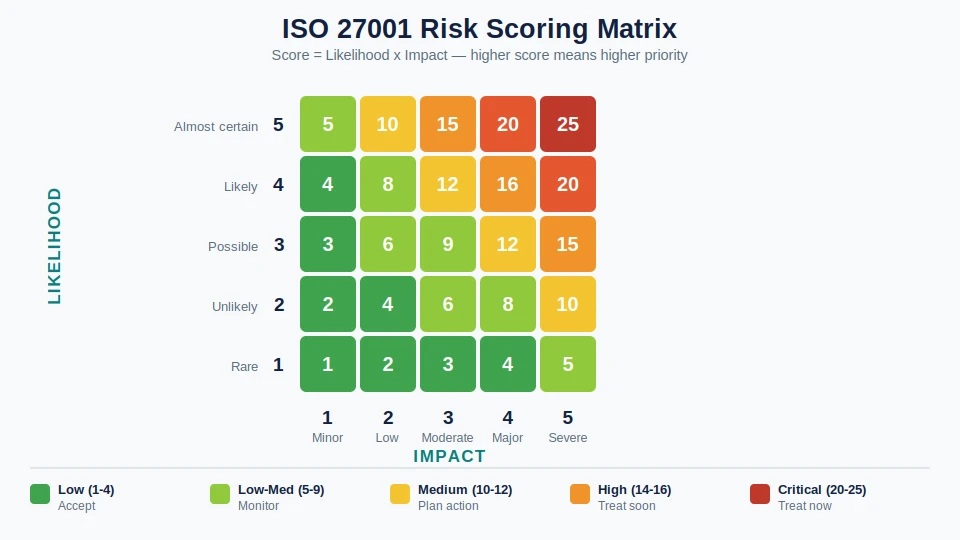
For every risk you find, ask two easy questions: How likely is this to happen? And how bad would it be if it did? This simple ISO 27001 likelihood-and-impact risk assessment approach is really the heart of the whole process.
ISO 27001 Risk Scoring Methodology
Most teams rate the likelihood of a risk and the potential damage it could cause on a scale of 1 to 5. They then multiply the two numbers to get a risk score. Using the same method each time helps everyone judge risks similarly.
How to Perform ISO 27001 Risk Assessment: Step by Step
Here's how to perform an ISO 27001 risk assessment in small, easy steps anyone can follow, even on their first try. For a deeper understanding of how these activities fit into an Information Security Management System (ISMS), you can explore our ISO 27001 Learning Program.
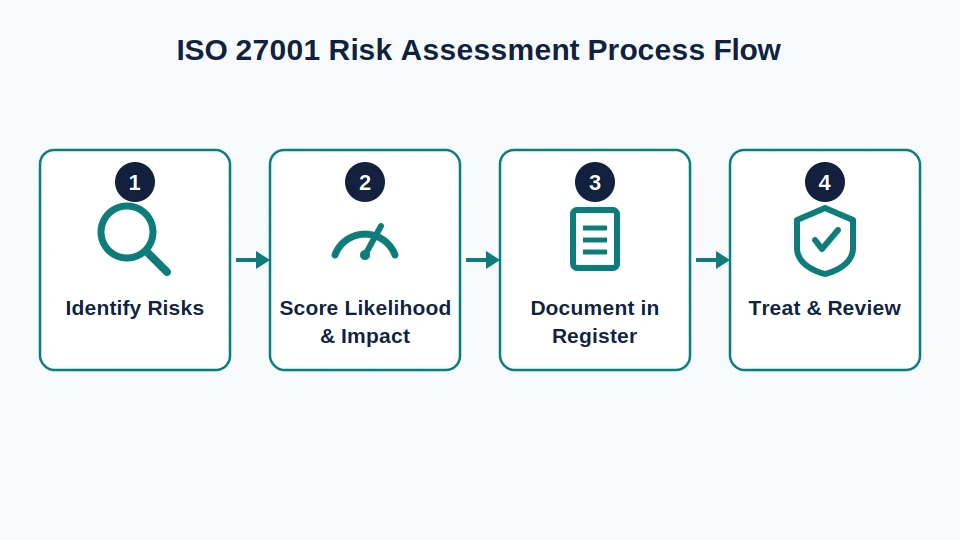
Step 1: Risk Identification and Evaluation ISO 27001
Start with a list. What data or systems matter most? Then ask what could threaten them: weak passwords, old software, an untrained employee clicking the wrong link. This first stage of risk identification and evaluation ISO 27001 is really just brainstorming, but with a clear focus.
Step 2: Score and Prioritize
Now give each risk a likelihood score and an impact score, multiply them. The higher the number, the more urgent it is. This tells you exactly what to fix first, instead of guessing.
Step 3: Write It All Down
Every risk assessment should be written down. Record each risk, how serious it is, and who is responsible for dealing with it. Meeting the ISO 27001 risk assessment documentation requirements means that every risk, score, owner, and decision must be documented in writing, not just in someone's head. Most companies do this in a spreadsheet.
Using an ISO 27001 Risk Register Template
Many people use an ISO 27001 risk register template to keep track of their findings. It works like a simple table where you list each risk, the asset it could affect, how likely it is to happen, its impact, the overall risk score, and the planned treatment. Here's an example of a completed risk register.
|
Risk |
Likelihood (1–5) |
Impact (1–5) |
Score |
Owner |
Treatment |
|---|---|---|---|---|---|
|
No MFA on customer login |
4 |
5 |
20 |
IT Manager |
Reduce: add MFA |
|
Untrained staff/phishing |
3 |
4 |
12 |
HR Lead |
Reduce: training |
|
Vendor data-sharing gap |
2 |
4 |
8 |
Procurement |
Transfer: contract clause |
Treatment" is just the action you take once a risk has been scored. ISO 27001 gives you four options: reduce it (add a control, like MFA or training, to make it less likely or less damaging), accept it (the risk is small enough to live with), avoid it (stop doing the thing that causes the risk entirely), or transfer it (shift the responsibility to someone else, like an insurer or a vendor through a contract). Every risk in your register should end up tagged with one of these four, so nothing is left unresolved.
ISO 27001 Risk Assessment Checklist
Here's a simple ISO 27001 risk assessment checklist to keep you on track:
- Decide on your scoring method before you start
- List out your important assets or scenarios
- Write down possible threats for each one
- Score every risk by likelihood and impact
- Compare each score to your risk acceptance criteria
- Give each risk an owner (a person responsible)
- Record everything in your risk register
- Get management to review and approve the results
Keeping this ISO 27001 risk assessment checklist nearby makes the whole ISO 27001 risk assessment process feel much less overwhelming, especially the first time you do it. If you'd like to learn how these steps are applied in a real-world implementation, SterlingNext ISO Training provides practical guidance on risk assessment, documentation, and ISMS implementation.
A Simple ISO 27001 Risk Assessment Example
The easiest way to understand the process is by walking through a simple ISO 27001 risk assessment example.
A Practical Scenario
Here's a hypothetical example: Imagine a small company that stores customer data in the cloud. They realize employees only need a password to log in, with no extra security. That creates a risk. They decide it's quite likely to happen (4 out of 5) and that the impact would be very serious if customer data were exposed (5 out of 5). Since the score is high, they treat it as a priority. To reduce the risk, they add two-factor authentication. This example shows how a risk assessment helps you decide what to fix first, rather than just filling out documents.
Third-Party and Ongoing Risk Assessment
Risk doesn't stop at your office door, and it doesn't stop after one review either.
ISO 27001 Third-Party Risk Assessment
Sometimes the weak link isn't you; it's a vendor or partner you work with. An ISO 27001 third-party risk assessment checks how safely your suppliers handle your data. Auditors often specifically ask whether an ISO 27001 third-party risk assessment has been done for key vendors, so it's not something to skip.
ISO 27001 Continuous Risk Monitoring
New security risks appear all the time. Hackers find new ways to attack, software can develop new flaws, and regulations can change. That's why you should review your risks regularly, not just once a year. This matters more than it might seem: organizations that walk into their first certification audit without an established, ongoing risk program often have to reschedule the second stage because their evidence isn't complete. Reviewing risks continuously, not just annually, helps you spot new problems before they become serious and keeps you audit-ready year-round.
What Happens After Risk Assessment?
Once risks are found and scored, there's one more phase. You build an ISO 27001 risk treatment plan, basically a to-do list for fixing the risks. You'll choose from a few ISO 27001 risk treatment options, such as reducing the risk, avoiding it, passing it to someone else (e.g., insurance), or simply accepting it if it's small enough.
These fixes are then matched against the ISO 27001 Annex A 93 controls mapping, a big list of possible security controls to choose from. Finally, everything gets recorded in the ISO 27001 Statement of Applicability 2022, a document auditors always want to see.
Together, the ISO 27001 risk treatment plan, the ISO 27001 Annex A 93 controls mapping, and the ISO 27001 Statement of Applicability 2022 turn your risk findings into real, trackable action.
It's worth taking this phase seriously: across industries, the most common ISO 27001 audit findings stem from weak or inconsistent risk assessment methodologies, not esoteric technical gaps. Getting the methodology right the first time saves you from repeat findings later.
Common ISO 27001 Risk Assessment Mistakes to Avoid
Even experienced teams trip up on the same handful of things. Watching for these early saves a lot of rework later.
- No documented methodology. Jumping straight into scoring risks without writing down your scales first. Auditors flag this immediately because it means no two assessments can be compared.
- The same person owns every risk. Assigning all risks to "IT" or the CISO may seem efficient, but auditors challenge it, since one person can't realistically fix everything and it hides who's actually accountable.
- Treating it as a one-time exercise. Doing a risk assessment once for certification and never touching it again. Risks change as your systems, vendors, and threats change; they need to be reviewed regularly, not just before an audit.
- Copy-pasted, generic risks. Using a template's risk list without adapting it to your actual environment. Auditors can tell when a risk register doesn't reflect the business it's meant to protect.
- No link between risks and controls. Identifying risks and choosing Annex A controls separately, without a clear trail showing which control addresses which risk. That gap is one of the most common findings in real audits.
Avoiding these five is often the difference between a smooth audit and a list of corrective actions.
Conclusion
The ISO 27001 risk assessment process is easier than it sounds. Take it one step at a time: identify the risks, assess their likelihood, measure their impact, write everything down, and decide how to reduce them. Whether you're doing a risk assessment for the first time or updating an existing one, the goal is always the same: understand your biggest risks and deal with the most important ones first. By following a simple and consistent process, risk assessment becomes a regular part of running your business. It helps you meet ISO 27001 requirements while better protecting your information and systems.
Recommended Reads
Get Certified With Industry Level Projects & Fast Track Your Career
Checkout Top 10 Highest Paying Jobs
Frequently Asked Questions
It means identifying potential threats to your company's data, assessing the severity of each threat, scoring them, and deciding which risks to fix first based on priority.
Start small. List your key data or systems, think about what could go wrong with each one, score every risk you find, and write it all down clearly in a simple table.
It's the specific rule stating that your company must have a clear, repeatable, documented way to find and score risks, rather than doing so randomly or differently each time someone reviews them.
Yes. ISO 27001 requires you to use the same risk-scoring method every time. This helps ensure the results remain consistent, no matter who performs the assessment. That's why it's important to document your risk assessment method so everyone follows the same process.
Asset-based assessment focuses on the specific assets your company owns, such as servers or databases. Scenario-based assessment, in contrast, imagines specific situations, such as a hacking attempt, and traces what could realistically happen next.
Usually, senior management makes this call, often working closely with the information security team, and bases the decision on how much risk the business can realistically handle without disrupting operations.
It's not strictly required by law, but it's strongly recommended anyway, since keeping organized, clear documentation is exactly what ISO 27001 expects from every certified organization during audits.
Most companies review their risks at least once a year. However, checking them more often is even better because new risks can appear at any time. Regular reviews help you find and fix problems before they become more serious.
Because your vendors and partners often have access to your company's data too. If their security is weak, that vulnerability effectively becomes your problem, potentially exposing your data through no direct fault of yours.
You move into the treatment phase, choosing how to handle each identified risk, then documenting everything carefully in your Statement of Applicability, which auditors will review closely during certification.