
Training Outcomes Within Your Budget!
We ensure quality, budget-alignment, and timely delivery by our expert instructors.
Table of Content
- PMP Exam Changes 2026 Key Updates and Preparation Guide
- Official PMP Exam Changes 2026
- PMP Domain Weightings 2026
- PMP Exam Format and Question Types
- PMBOK 8 and the Examination Content Outline
- PMP Business Environment Domain Changes
- AI and Sustainability
- Old vs New PMP Exam 2026
- PMP Exam 2026 Eligibility Requirements
- PMP Exam Difficulty and Scoring
- How to Prepare for the July 2026 PMP Exam
- PMP Exam Preparation Checklist 2026
- Conclusion
Recent Blogs
Cloud Computing Salary Guide 2026: AWS, Azure & GCP
August 18th, 2026
CompTIA Cloud+ Certification: Complete Guide
August 18th, 2026
AWS DevOps Engineer Certification: Complete Guide
August 18th, 2026
AWS Developer Certification: Study Guide & Exam Tips
August 18th, 2026
ISO 22000 Documentation Requirements
August 18th, 2026
ISO 31000 vs ISO 27001
August 18th, 2026
ISO 22000 vs HACCP
August 17th, 2026
CISSP Book Insights to Keep Your Exam Preparation on Track
August 14th, 2026
Benefits of ISO 14001 Certification
August 14th, 2026
CISM Certification Cost and Roadmap for Career Success
August 12th, 2026
ISO 20000 IT Service Management
August 10th, 2026
What is ISO Lead Auditor Certification?
August 10th, 2026
ISO Auditor Roles and Responsibilities
August 10th, 2026
Why Choosing PMI RMP Certification Can Benefit Your Career
August 10th, 2026
What to Know Before the Lean Six Sigma Green Belt Exam
August 10th, 2026
PMP Exam July 2026: What's Changed and How to Prepare
Last updated on August 17th, 2026
- Share
-

-

-

-

-

 Sachin Kumar
This guide explains the main exam changes, what remains the same, and how to prepare using the 2026 PMP Examination Content Outline and a clear study plan.
PMP Exam Changes 2026 Key Updates and Preparation Guide
The PMP exam changes 2026 include an updated Examination Content Outline, changes to the domain weightings, and more case-based and graphic questions. The exam now focuses more on delivering value, governance, AI-based decisions, and sustainability. Questions also test how project management concepts are used in real situations.
Understanding PMP Certification is a useful starting point because it explains the basic concepts before the updated exam structure is studied. This guide explains the main exam changes, what remains the same, and how to prepare using the 2026 PMP Examination Content Outline and a clear study plan.
Official PMP Exam Changes 2026
PMI’s 2026 update changes the exam structure, the focus of each domain, and the types of questions included. The official Examination Content Outline explains what needs to be studied and how the updated exam tests project management knowledge.
Why PMI Updated the PMP Exam
PMI updated the PMP exam to match current project management practices, project managers now work with remote teams, hybrid methods, new technologies, sustainability needs, and changing business goals.
- The exam now places greater emphasis on business value and strategic alignment.
- The Business Environment receives significantly more coverage.
- Scenario-based and graphic-based questions test practical decision-making.
- Candidates must show good judgment, adapt to changes, and understand stakeholder needs.
Official Changes at a Glance
The updated exam follows the 2026 PMP Examination Content Outline, which explains the exam domains, tasks, enablers, question formats, and eligibility information . The PMBOK Guide Eighth Edition can also help with preparation. However, the Examination Content Outline should be used to understand the exam domains, tasks, enablers, eligibility requirements, and question types.
|
Change area |
What changed in July 2026 |
Why it matters |
|---|---|---|
|
Examination blueprint |
PMI released a revised 2026 Examination Content Outline. |
Candidates should study the current outline instead of relying only on older preparation books. |
|
Domain weighting |
People: 33%, Process: 41%, Business Environment: 26%. |
The business environment now requires much more study time than before. |
|
Question formats |
The exam includes case/scenario and graphic-based questions, along with multiple-choice and interactive formats. |
Candidates need to interpret information and apply judgment, not only recall definitions. |
|
Exam duration |
180 questions must be completed in 240 minutes. |
Time management and timed practice remain important. |
|
Project context |
AI, sustainability, governance, value delivery, and adaptability receive greater attention. |
Candidates should understand how project decisions affect the wider organization. |
|
Eligibility window |
Qualifying experience may be counted from the last 10 years. |
Some candidates can use older project experience that previously fell outside the window. |
The PMP certification itself remains the same globally recognized credential. The significant change is the exam blueprint and the way candidates are expected to demonstrate their knowledge.
PMP Domain Weightings 2026
The updated exam follows the 2026 Examination Content Outline. The PMBOK Guide Eighth Edition can also help with preparation. The Examination Content Outline explains the exam domains, tasks, requirements, and question types.
|
Domain |
Previous exam |
July 2026 exam |
Study implication |
|---|---|---|---|
|
People |
42% |
33% |
Continue studying leadership, communication, conflict, teams, stakeholders, and collaboration. |
|
Process |
50% |
41% |
Process remains the largest domain and should receive the highest overall study allocation. |
|
Business Environment |
8% |
26% |
Give substantially more attention to governance, compliance, organizational change, strategy, risk, and business alignment. |
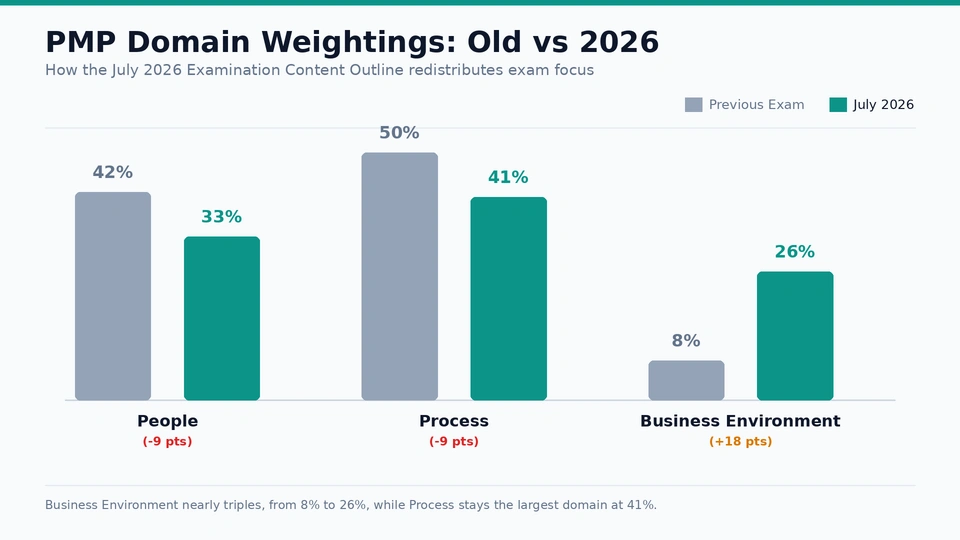
The new weighting does not mean candidates can ignore People or Process. Process is still the largest domain at 41%, while People continues to test important leadership and stakeholder skills.
However, the increase in the Business Environment is significant. Candidates who prepare only through project schedules, cost calculations, and process definitions may leave a major part of the exam uncovered.
What the Weighting Means for Study Time
A practical allocation could look like this:
- Process: 40% of study time.
- People: 30% of study time.
- Business Environment: 30% of study time.
- Mixed-domain practice: included every week.
The exact percentages are not a PMI-mandated study formula. They are a practical way to reflect the official exam blueprint while preserving enough time for all three domains.
PMP Exam Format and Question Types
The PMP exam format 2026 includes regular, case-based, scenario-based, and graphic-based questions; candidates should understand these question types and practice solving them within the given time.
PMP Exam Format 2026
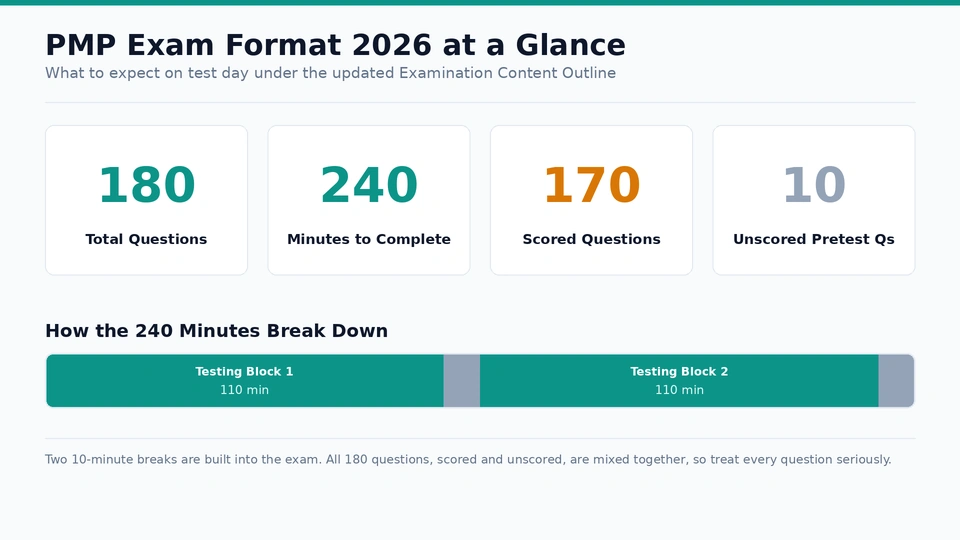
The PMP exam format 2026 includes:
- The exam has 180 questions.
- Out of 180 questions, 170 are scored, the remaining 10 do not affect the final score.
- Exam takers get 240 minutes to complete the exam.
- There are 2 breaks during the test of 10-minute
- Questions from all domains may appear in any order.
The 10 pretest questions do not affect the candidate’s score and are used to evaluate questions for possible future exams. Candidates do not know which questions are unscored, so every question should be treated seriously.
PMP Exam Question Types 2026
The PMP exam question types 2026 may include:
- One answer must be selected
- more than one answer may be correct
- Questions that require matching items.
- Questions answered by clicking the correct area on the screen.
- Pull-down-list questions.
- Drag-and-drop or similar interactive items.
- Case or scenario questions.
- Graphic-based questions involving charts, graphs, diagrams, or images.
Some interactive formats may depend on the delivery method. Candidates should review the latest PMI and Pearson VUE instructions before scheduling the examination.
PMP Scenario-Based Questions 2026
PMP scenario-based questions 2026 may describe a project challenge before asking what the project manager should do next, first, or best.
A scenario may involve:
- A stakeholder disagreement.
- A change in organizational strategy.
- A risk that has become an issue.
- An agile team facing delivery problems.
- A predictive project experiencing a scope or schedule change.
- A hybrid project requiring a decision about governance or communication.
The best answer is usually the option that addresses the underlying cause, follows the appropriate Process, involves the right stakeholders, and protects project or organizational value.
PMP Graphic-Based Questions 2026
PMP graphic-based questions 2026 require candidates to interpret visual information.
- A burndown or burnup chart.
- A workflow or process diagram.
- A dependency map.
- A risk or stakeholder matrix.
- A trend graph.
- A project-performance chart.
The test is not artistic interpretation. The skill is translating the visual information into a project-management decision.
When practicing, ask:
- 1. What does the graphic show?
- 2. What has changed?
- 3. What caused the change?
- 4. What should the project manager do next?
- 5. What action is needed from the stakeholder or governance team?
PMBOK 8 and the Examination Content Outline
The Examination Content Outline shows what the PMP exam covers. PMBOK Guide Eighth Edition helps explain the main principles and practices related to those topics. The Examination Content Outline should be used as the main study guide, while PMBOK 8 can be used for extra learning.
|
Resource |
Main Purpose |
How to Use It |
|---|---|---|
|
Examination Content Outline |
Defines the exam domains, tasks, enablers, question formats, and eligibility information. |
Use it as the main study checklist. |
|
PMBOK Guide Eighth Edition |
Explains project management concepts and principles. |
Use it to understand the reasoning behind the tasks. |
|
Practice Questions |
Test application and decision-making skills. |
Use them to find knowledge gaps and improve timing. |
PMI examination guidance Provides current scheduling and exam-delivery information. Review it before booking and taking the exam.
The PMP exam task changes 2026 are more important than memorizing the title of a particular guide. Candidates should read each task and ask how it would appear in a real project environment.
For example, a task may require the candidate to:
- Make project decisions based on business goals.
- Manage changes in business priorities.
- Explain project value and impact to stakeholders.
- Follow governance and compliance requirements.
- Change the project approach when needed.
This means the exam rewards applied reasoning more than isolated definition recall.
PMP Business Environment Domain Changes
The PMP Business Environment domain is an important part of the 2026 exam. It covers 26% of the exam. Candidates need to understand how projects support business goals, follow rules, manage changes, respond to external factors, and deliver long-term value.
Business Value and Benefits Delivery
Project decisions should support the expected results and benefits, a project can be completed successfully but still fail if it does not provide the value the organization needs.
How to Study Business Environment
Study this domain using scenarios about governance, compliance, strategy changes, organizational changes, risk, sustainability, stakeholder needs, and changes in business conditions.
AI and Sustainability
AI and sustainability are important topics in the 2026 exam, candidates should understand how they affect governance, risk, stakeholders, resources, compliance, ethics, and long-term business value.
AI in PMP Exam 2026
AI in PMP exam 2026 content should be approached as a project-management issue, not as a programming subject.
Artificial intelligence is not a separate domain in the exam. Candidates should instead understand the project implications of using AI tools, including:
- Data quality and reliability.
- Privacy and security.
- 180 total questions.
- 170 scored questions.
- 10 unscored pretest questions.
- 240 minutes of examination time.
- Two 10-minute breaks.
- s and ethical concerns.
- Human oversight.
- Stakeholder acceptance.
- Accuracy of AI-generated information.
- Impact on project decisions.
- Organizational policies and governance.
- Business value and measurable outcomes.
There is no need to study how to code an AI system. The more relevant question is whether a project manager can evaluate the risks and benefits of using AI responsibly.
Sustainability in PMP Exam 2026
Sustainability in PMP exam 2026 content may appear within decisions involving cost, schedule, resources, procurement, quality, risk, and long-term value.
A project manager may need to consider:
- Environmental impact.
- Social effects on communities or employees.
- Responsible procurement.
- Resource efficiency.
- Long-term operating costs.
- Regulatory expectations.
- Stakeholder priorities.
- The relationship between short-term delivery and long-term benefits.
Sustainability should not be studied only through definitions. Instead, study it through scenarios where the project manager must balance different priorities.
PMP Agile vs Predictive 2026
PMP Agile vs Predictive 2026 preparation should focus on choosing the right delivery approach for the situation.
A predictive approach may be appropriate when requirements, scope, regulations, and deliverables are stable. An agile approach may be more suitable when requirements are uncertain and frequent feedback is valuable. A hybrid approach may be appropriate when some parts of the project require predictive planning while other parts benefit from iterative delivery.
Old vs New PMP Exam 2026
The old vs new PMP exam 2026 comparison can help candidates who started studying before July 2026. The PMP certification remains the same, but the exam now uses new domain weightings, question formats, and study topics, looking at both updated versions makes it easier to see what has changed and which areas may not be covered in older study materials. Reviewing the PMP exam changes 2026 helps identify which topics, question formats, and domain areas need more attention during preparation.
What Stayed the Same
The July 2026 update does not change the PMP credential or how it is recognized worldwide, exam takers must still meet PMI eligibility requirements, complete the application process, and pass the exam. The three main domains also remain the same: People, Process, and Business Environment. Predictive, agile, and hybrid approaches are still part of the exam, along with topics such as leadership, communication, stakeholder engagement, planning, risk, quality, project delivery, and change management.
What Changed
|
Area |
Previous exam |
July 2026 exam |
|---|---|---|
|
People |
42% |
33% |
|
Process |
50% |
41% |
|
Business Environment |
8% |
26% |
|
Experience window |
Previous shorter window |
Qualifying experience within the last 10 years |
|
Question emphasis |
Situational and application-based |
More varied visual, case, scenario, and interactive formats |
|
Business focus |
Present but less heavily weighted |
Stronger emphasis on governance, strategy, value, and organizational change |
|
AI and sustainability |
Limited emphasis in older preparation materials |
More visible as project context and decision considerations |
|
Study method |
Domain knowledge plus situational practice |
Examination Content Outline mapping, mixed scenarios, visual interpretation, and timed practice |
PMP Exam 2026 Eligibility Requirements
The PMP exam 2026 eligibility requirements allow candidates to count qualifying project-management experience earned within the last 10 years before the application date.
Candidates also need 35 hours of project-management education or training unless they qualify for the relevant training waiver through an active CAPM certification.
|
Education background |
Required experience |
|---|---|
|
Secondary school diploma or equivalent |
60 months leading and directing projects |
|
Associate degree or equivalent |
48 months leading and directing projects |
|
Bachelor’s degree or equivalent |
36 months leading and directing projects |
|
GAC-accredited bachelor’s or postgraduate degree |
24 months leading and directing projects |
The experience should involve leading and directing projects in a professional setting. Candidates should not automatically count routine operational work, personal projects, academic assignments, or informal activities.
Before submitting an application, review PMI’s current eligibility instructions and record project dates, responsibilities, outcomes, and the number of months spent leading project work.
PMP Exam Difficulty and Scoring
PMP exam difficulty 2026 cannot be rated as harder or easier because PMI has not given an official difficulty score; the updated exam may be more challenging for candidates who depend mainly on memorization. Those who practice scenario-based questions and focus on making the right project decisions may find it easier to adjust to the new format.
PMP Exam Difficulty 2026
Has the difficulty of the PMP exam increased in 2026? PMI has not stated that the updated exam is harder or easier, and there is no official difficulty rating to confirm an increase.
However, the exam may feel more challenging for candidates who depend on:
- Memorizing definitions without understanding application.
- Studying only one delivery approach.
- Ignoring the Business Environment.
- Avoiding visual or interactive questions.
- Practicing questions without reviewing explanations.
- Using outdated materials without checking the current outline.
The most effective response is not to memorize more pages. It is to practice making decisions in realistic project situations.
PMP Exam Scoring System 2026
PMI does not specify a fixed percentage needed to pass, so there is no official score that guarantees a pass. PMP exam scoring system 2026 has 170 scored questions and 10 unscored questions.
Candidates should focus on:
- Answer every question on the exam.
- Divide the available time carefully across all questions.
- Pay attention to words such as “first,” “next,” “best,” and “most appropriate.”
- Remove answer choices that skip important steps such as stakeholder involvement, proper assessment, governance, or finding the root cause.
- Reviewing incorrect answers during practice.
Practice-test scores are useful for measuring readiness, but they should not be treated as an exact prediction of the official result.
How to Prepare for the July 2026 PMP Exam
A study plan should match the official exam outline and give enough time to each domain, regular practice and revision should also be part of the plan. Those who prepared for the old exam should check their study materials and update anything that is no longer relevant.
Step 1: Read the Current Outline
Start with the current Examination Content Outline, Mark the domains, tasks, enablers, and question types that need to be studied.
Do not choose a course only because it says “PMP 2026.” Check that it covers the July 2026 outline and the updated domain weightings.
Step 2: Allocate Study Time by Domain
Study time can be divided based on the three domains. Around 40% can go to Process, 30% to People, and 20% to Business Environment. It also helps to answer a mix of questions each week instead of studying one domain at a time.
Step 3: Use Updated Resources
Your PMP exam study materials 2026 should include:
- The current Examination Content Outline.
- Updated PMI guidance.
- A current PMP preparation course or book.
- Scenario-based practice questions.
- Graphic and interactive question practice.
- Timed mixed-domain examinations.
- A mistake log.
Older resources may still explain useful concepts, but they should be checked against the current outline. Current PMP Exam Preparation Training can be useful when study materials need to match the revised exam outline and updated question formats.
Step 4: Practice Decision-Making
For every practice question, identify:
- Understand the project setting.
- Identify the delivery method being used.
- Find the main issue in the situation.
- Note which stakeholder or team is involved.
- Connect the situation to the right domain and task.
- Choose the action that should be taken first.
- Check why the remaining options are less suitable.
Step 5: Complete Timed Practice
The real exam contains 180 questions and lasts 240 minutes. Include timed sessions in your study plan and practice using the same breaks you expect to use on test day.
PMP July 2026 Study Schedule
|
Week |
Main focus |
|---|---|
|
Weeks 1–2 |
Read the Examination Content Outline and review eligibility. |
|
Weeks 3–5 |
Study Process tasks, planning, delivery, quality, risk, procurement, and measurement. |
|
Weeks 6–7 |
Study People tasks, leadership, conflict, communication, teams, and stakeholders. |
|
Weeks 8–9 |
Study Business Environment, governance, compliance, strategy, change, and sustainability. |
|
Week 10 |
Practice agile, predictive, and hybrid scenarios. |
|
Week 11 |
Practice graphic-based, case-based, and interactive questions. |
|
Week 12 |
Complete timed simulations and review recurring mistakes. |
PMP Exam Preparation Checklist 2026
The PMP exam preparation checklist 2026 should cover more than reading and practice questions. Learners should verify eligibility, select current resources, study all three domains, practice every major question format, complete timed sessions, review mistakes, and confirm exam-day requirements before scheduling the test.
Use this PMP exam preparation checklist 2026 before scheduling or taking the exam:
Eligibility and Application Checklist
- Read the current Examination Content Outline.
- Confirm that your project experience falls within the 10-year window.
- Check that your education and project leadership experience meet the requirements.
- Complete the required training or confirm that it has already been completed.
Study Materials Checklist
- Use current PMP exam study materials for 2026.
- Match the study materials with new exam topics
- Practice scenario, graphic, agile, predictive, and hybrid questions.
Practice-Test Checklist
- Complete timed mixed-domain tests.
- Review incorrect answers.
- Note down mistakes by exam topic and review them regularly.
- Practice full mock exams within the time limit.
Exam-Day Checklist
- Check the latest PMI and Pearson VUE exam rules.
- Confirm the exam date, time, and appointment details.
- Check identification requirements.
- Plan your breaks and time-management strategy.
PMP preparation can also support broader skills such as planning, communication, risk management, and decision-making. SterlingNext Professional Learning Programs cover these areas across project management and other professional roles.
Conclusion
The PMP exam changes 2026 focus more on how project managers handle real situations. The exam now gives more importance to business value, governance, adaptability, visual questions, and practical decision-making. Study plans should follow the latest Examination Content Outline and use materials that match the revised exam. More time should also be given to the Business Environment domain because its weight has increased. Instead of only memorizing terms, preparation should include understanding why an answer works, comparing possible actions, and practicing how project decisions are made in realistic situations.
Get Certified With Industry Level Projects & Fast Track Your Career
Checkout Top 10 Highest Paying Jobs
Frequently Asked Questions
The 2026 PMP exam includes new domain weightings, more focus on Business Environment, and case or graphic-based questions. It has 180 questions in 240 minutes, topics may include AI, sustainability, governance, and business value, preparation should follow the latest Examination Content Outline.
The updated PMP exam became effective worldwide in July 2026. Anyone taking the exam after this change should prepare using the latest 2026 Examination Content Outline. It is also worth checking the appointment information in PMI and Pearson VUE to make sure the correct exam version is listed.
Older books and courses are still useful for learning basic project management concepts. However, some exam details may be outdated. They may not include the latest domain weightings, eligibility rules, question types, AI, sustainability, or Business Environment topics. It is better to use these materials along with the latest PMI resources and practice questions.
PMI has not stated that the new exam is harder for everyone. Difficulty can depend on how a person prepares. The revised exam may be more challenging for those who mainly memorize terms and definitions. More attention is now given to understanding situations, reading visuals, judging possible actions, and choosing suitable responses related to stakeholders, governance, business value, and project delivery.
The 2026 PMP exam is divided into three domains. People account for 33%, Process for 41%, and Business Environment for 26%. Process still has the largest share. However, the Business Environment has grown considerably compared with the previous 8% weighting. Preparation should therefore cover every domain while giving enough attention to governance, organizational needs, and business alignment.
No. AI does not have its own PMP exam domain. Instead, AI-related situations may be included within normal project scenarios. Preparation can include areas such as ethical use, risk, security, data quality, stakeholder impact, human review, governance, and business value. Programming knowledge or experience building AI systems is not required.
Sustainability can appear as part of normal project decisions rather than as a stand-alone topic. A question may connect it with procurement, resources, quality, risk, compliance, stakeholders, or long-term project value. The important part is understanding how different environmental, social, financial, and delivery needs can affect a project decision.
The exam has 180 questions and a total testing time of 240 minutes. Out of the 180 questions, 170 are scored and 10 are unscored pretest questions. These pretest questions are mixed with the others, so candidates cannot identify them during the exam. Two 10-minute breaks are also provided.
Start with the latest PMP Examination Content Outline. It explains the domains, tasks, exam weighting, eligibility details, and the types of questions that may appear. Reading it first makes it easier to choose suitable books, courses, and practice tests. A study schedule can then be created around the areas covered in the current outline.
PMP eligibility depends on education, project experience, and project management training. Experience must be within the last 10 years. Most candidates need 35 hours of project management education, unless they have a CAPM waiver. Required project experience ranges from 24 to 60 months, depending on the candidate’s highest education level achieved.