
Training Outcomes Within Your Budget!
We ensure quality, budget-alignment, and timely delivery by our expert instructors.
Recent Blogs
Cloud Computing Salary Guide 2026: AWS, Azure & GCP
August 18th, 2026
CompTIA Cloud+ Certification: Complete Guide
August 18th, 2026
AWS DevOps Engineer Certification: Complete Guide
August 18th, 2026
AWS Developer Certification: Study Guide & Exam Tips
August 18th, 2026
ISO 22000 Documentation Requirements
August 18th, 2026
ISO 31000 vs ISO 27001
August 18th, 2026
ISO 22000 vs HACCP
August 17th, 2026
PMP Exam July 2026: What's Changed and How to Prepare
August 17th, 2026
CISSP Book Insights to Keep Your Exam Preparation on Track
August 14th, 2026
Benefits of ISO 14001 Certification
August 14th, 2026
CISM Certification Cost and Roadmap for Career Success
August 12th, 2026
ISO 20000 IT Service Management
August 10th, 2026
What is ISO Lead Auditor Certification?
August 10th, 2026
ISO Auditor Roles and Responsibilities
August 10th, 2026
Why Choosing PMI RMP Certification Can Benefit Your Career
August 10th, 2026
Project Cycle Management Essentials for Successful Delivery
Last updated on August 10th, 2026
- Share
-

-

-

-

-

 Sachin Kumar
Projects often run into trouble because expectations are not clear; risks are not spotted early enough, or progress isn't tracked the right way. Using a structured project cycle management approach helps lower these risks by keeping everyone on the same page.
Project Cycle Management Fundamentals Every Manager Needs
Introduction
Delivering a successful project requires more than meeting deadlines. It requires planning with purpose, managing resources carefully, tracking progress consistently, and reviewing results honestly. Many projects fail not because teams lack skills, but because they lack structure. This is where project cycle management becomes valuable.
Project cycle management gives organizations a clear path from the beginning of a project to its completion. Whether in a corporate setting or nonprofit environment, this approach supports better decisions and stronger results. In today’s business environment, professionals are expected to deliver measurable outcomes. Using a structured system like project cycle management helps teams stay focused, organized, and accountable throughout the entire process.
What Is Project Cycle Management?
Many professionals ask, what is project cycle management in practical terms? It is a structured system used to plan, carry out, and check a project through specific, manageable stages. It goes beyond just checking off daily tasks; it focuses on looking after the entire life of a project in a logical and highly organized way.
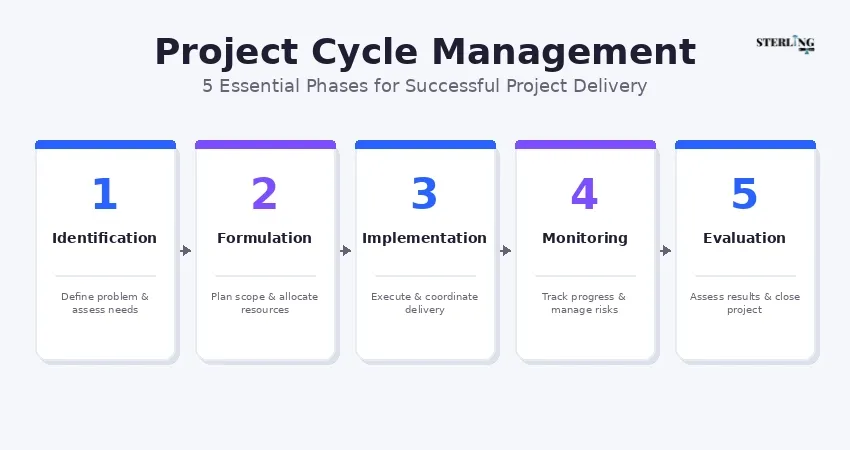
The project cycle management framework outlines the essential phases that every project should move through to ensure high quality:
- Identification: Figuring out the main need or the problem that needs to be solved.
- Formulation: Creating a detailed plan and the logic behind how it will work.
- Implementation: Doing the actual work and managing the people and tools involved.
- Monitoring: Checking progress against the plan as it happens to stay on track.
- Evaluation: Looking at the final results and the impact, the project actually made.
- Closure: Formally finishing the job and writing down everything for the records.
Unlike older methods that often treat a project like a one-time event that just ends, project cycle management works like a continuous loop. The lessons you learn from one project are used to help plan the next one. This makes the system very practical and helpful for growth over the long term.
For anyone looking into project cycle management for beginners, it is best to think of it as a strategic roadmap. It clears up any confusion and makes sure that teams keep making steady progress toward their goals.
Why Project Cycle Management Matters
Projects often run into trouble because expectations are not clear; risks are not spotted early enough, or progress isn't tracked the right way. Using a structured project cycle management approach helps lower these risks by keeping everyone on the same page.
When you use this method:
- Roles and responsibilities are defined, so people know what they need to do.
- Risks are talked about and planned for before they turn into actual problems.
- Progress is checked and measured on a regular basis.
- The final results are reviewed honestly to see what really happened.
This system answers the question of how project cycle management improves project success by bringing discipline to the team. It forces you to plan before you jump into action and reflect once the work is finished. In fast-moving workplaces, that balance is often the secret to getting things done right.
Project Cycle Management vs Project Management
It is very common for professionals to ask about the real differences between project cycle management vs project management. Even though they both aim to get things done, they look at the work through different lenses.
- Project Management: It focuses on getting specific tasks finished on time and within a set budget. It is hands-on and deals with daily coordination, making detailed schedules, and keeping a close eye on costs to make sure everything stays on track today.
- Project Cycle Management: This takes a much wider look at the whole picture. While it still cares about planning and doing the work, it puts a lot more weight on talking to stakeholders, doing deep evaluations, and looking at the long-term impact. This project cycle management approach ensures that a project isn't just a one-off task, but a step that helps the organization reach its bigger, long-term goals.
Both of these methods are necessary if you want your organization to run well. However, PCM offers a better setup for staying accountable and helping the team learn. By building feedback loops into the system, organizations can make sure that every project helps them get better and smarter for the next one.
Project Life Cycle vs Project Cycle Management
A project life cycle is basically just a timeline. It simply outlines the project moves through from start to finish. It is a straight path that ends once the job is done.
Project cycle management takes that timeline and turns it into a loop. It adds things like regular checks and final reviews to make sure you are always learning. Instead of just finishing a task and moving on, this project cycle management approach uses what you learned to make the next project better.
The PCM Process Explained
The PCM process follows a series of logical steps designed to keep the project on track.
Identification
The first step in project cycle management begins with a fundamental question: What is the actual need?
- Strategic Alignment: Teams must conduct an honest analysis to confirm that the problem being addressed is real and fits within the organization's priorities.
- Project Cycle Management in NGOs: In a nonprofit context, this phase usually involves direct community engagement. Tools like surveys and interviews help define actual needs rather than relying on assumptions.
- Corporate Settings: In business, identification often involves analyzing market trends, customer feedback, or internal performance data.
Formulation
Formulation is the process of turning an initial concept into a comprehensive plan. This stage is dedicated to defining the project for everyone who is on the same page.
Key elements defined during this phase include:
- Clear project objectives and expected results.
- Detailed lists of activities and timelines.
- Budget requirements and resource allocation.
- Defined roles and individual responsibilities.
- Risk management plans and performance indicators.
Implementation
- Communication: Maintaining clear reporting lines and providing regular updates is essential to prevent confusion.
- PCM Tools and Techniques: Using the right tools during this stage helps maintain control over the project. This includes maintaining work schedules, tracking budgets, and keeping a live risk log.
Monitoring
Monitoring happens while the work is being done. Its job is to watch progress and catch any gaps between the plan and what is happening as soon as possible.
- Are we hitting our deadlines?
- Are we spending more than we planned?
- Are there new problems we didn't see coming?
- Are the people involved happy with the work so far?
In project cycle management in NGOs, staying on top of monitoring is also about being open and honest with donors and local leaders about how the money and time are being used.
Evaluation
Evaluation is the process of taking a step back to assess how the project performed well. It’s not just about what you finished, but whether the work actually made a long-term difference.
- Did we actually reach our original goals?
- Did we use our money and resources wisely?
- What specific problems slowed us down?
- What did we do really well that we should do again?
The project cycle management framework gets better every time you do this because it turns your experience into shared knowledge. If you skip this part, it makes it harder to plan the next time. An honest review makes every future project much stronger.
Closure
Closure is the formal way to end the project. It’s about more than just stopping the work; it’s about tying up all the loose ends so nothing is left hanging.
A proper closure includes:
- Closing out the budget and finishing all payments.
- Writing a final report on how everything went.
- Telling everyone involved that the project is officially done.
- Saying thank you and recognizing the hard work of the team.
A proper closure ensures that the project ends on a high note and provides a solid foundation for the next project in the cycle.
How to Implement Project Cycle Management
Many professionals ask how to implement project cycle management in their organization. The process does not need to be complicated. Organizations that want structured guidance on applying governance, risk, and performance principles often explore PMP® certification which explains practical frameworks for managing projects systematically from initiation to closure.
- 1. Train your team on the PCM structure.
- 2. Introduce a standard template for planning.
- 3. Define clear monitoring practices.
- 4. Schedule formal evaluation reviews.
- 5. Document lessons are learned.
Consistency is more important than complexity.
How to Apply Project Cycle Management Framework Step by Step
If you are wondering how to apply project cycle management framework step by step, follow this simple structure:
- Identify the need.
- Assess feasibility.
- Create a detailed plan.
- Assign responsibilities.
- Monitor progress weekly or monthly.
- Conduct mid-term and final evaluations.
- Document lessons clearly.
Repeating this process builds discipline within the organization.
PCM Best Practices
- Clear Documentation: Keep your records simple and easy for anyone to read.
- Regular Risk Checks: Review potential problems often so you aren't caught off guard.
- Open Communication: Share progress updates honestly, even when things are difficult.
- Team Feedback: Listen to the people doing the work to find better ways of operating.
A vital part of PCM best practices is consistency. A structured system only works if the team follows it for every project. When these steps become a regular habit, the quality of your work will naturally improve.
Project Cycle Management Examples
Project Cycle Management Example – Corporate Setting
Think about a large retail business that needs to fix its delivery network because customers are complaining about late orders. Using the PCM process, the company can fix this step by step.
- Identification: The company looks at data and finds that slow shipping is hurting sales and making customers unhappy.
- Formulation: A team is kept together to plan the fix. They select new software, set a budget, and plan training for the staff.
- Implementation: The team installs new technology at various warehouses and stores.
- Monitoring: Managers check weekly reports to see if shipping times are actually getting faster.
- Evaluation: After three months, the company reviews the data and sees that customer satisfaction has gone up.
- Closure: The team writes a final report to show what worked and what didn't so they can do even better next time.
This project cycle management example shows that having a clear structure helps a business get real, measurable results.
Expanded Project Cycle Management Example – Nonprofit Setting
- Identification: The group notices that very few people in the area are recycled, and local trash levels are too high.
- Formulation: They create a plan to hold community workshops and hand out free recycling bins.
- Implementation: The group runs the classes and gives out the bins to the neighbors.
- Monitoring: Every month, track participation and how much recycling is being collected.
- Evaluation: Six months later, they review the overall numbers and see a big jump in recycling across the community.
- Closure: The group shares these results with the public and their donors to show the impact of their work and build trust.
This second project cycle management example proves that PCM is just as useful for community projects as it is for big business, ensuring everyone stays accountable.
PCM Tools and Techniques in Daily Practice
Effective PCM tools and techniques do not need to be complex.
Practical tools include:
- Clear written work plans
- Risk lists updated monthly
- Budget tracking sheets
- Simple performance scorecards
These tools keep projects visible and measurable. When teams use these tools consistently, decision-making becomes easier and more informed.
Long-Term Benefits of Project Cycle Management
Organizations that adopt project cycle management see long-term benefits:
- Better resource planning
- Stronger stakeholder trust
- Improved team coordination
- More reliable results
- Clear accountability
Over time, this structured approach becomes part of the organization’s culture.
Conclusion
Project cycle management provided the structure. By following a clear path, using simple tools, and applying lessons from one project to the next, any organization can perform better and lower their risks.
Whether you are working in a corporate office or in a nonprofit setting, PCM creates a clear line from the first day. Explore project and program management to get a better handle on how these practical systems and governance styles work in the real world.
Recommended Reads
Get Certified With Industry Level Projects & Fast Track Your Career
Checkout Top 10 Highest Paying Jobs
Frequently Asked Questions
It is a structured method for planning, implementing, monitoring, and evaluating projects in defined stages.
The PCM process includes identification, formulation, implementation, monitoring, evaluation, and closure.
It improves success by adding structure, reducing risks, and encouraging learning.
Project management focuses on execution, while PCM includes evaluation and continuous improvement.
The life cycle describes stages. PCM adds structured monitoring and learning.
Clear planning, regular monitoring, and documentation of lessons.
Start with training, templates, monitoring routines, and formal evaluation reviews.
Work plans, risk logs, budget tracking sheets, and performance indicators.
Yes, project cycle management in NGOs ensures accountability and measurable impact.
Yes, project cycle management for beginners can be applied using simple templates and step-by-step guidance.