
Training Outcomes Within Your Budget!
We ensure quality, budget-alignment, and timely delivery by our expert instructors.
Table of Content
- Essential CCNA certification benefits you should know
- What Is CCNA Certification?
- Who Is CCNA Certification For?
- Is CCNA Still Relevant in the AI Era?
- CCNA Certification Benefits for Career Growth
- CCNA Certification Benefits for Organizations
- Skills Learned in CCNA Certification
- Pros and Cons of CCNA Certification
- Conclusion
- Recommended Reads
Recent Blogs
Cloud Computing Salary Guide 2026: AWS, Azure & GCP
August 18th, 2026
CompTIA Cloud+ Certification: Complete Guide
August 18th, 2026
AWS DevOps Engineer Certification: Complete Guide
August 18th, 2026
AWS Developer Certification: Study Guide & Exam Tips
August 18th, 2026
ISO 22000 Documentation Requirements
August 18th, 2026
ISO 31000 vs ISO 27001
August 18th, 2026
ISO 22000 vs HACCP
August 17th, 2026
PMP Exam July 2026: What's Changed and How to Prepare
August 17th, 2026
CISSP Book Insights to Keep Your Exam Preparation on Track
August 14th, 2026
Benefits of ISO 14001 Certification
August 14th, 2026
CISM Certification Cost and Roadmap for Career Success
August 12th, 2026
ISO 20000 IT Service Management
August 10th, 2026
What is ISO Lead Auditor Certification?
August 10th, 2026
ISO Auditor Roles and Responsibilities
August 10th, 2026
Why Choosing PMI RMP Certification Can Benefit Your Career
August 10th, 2026
CCNA Certification Benefits
Last updated on July 30th, 2026
- Share
-

-

-

-

-

 Sachin Kumar
In this guide, we will walk through what CCNA actually is, who it suits, why it still matters today, and how it can shape your career growth and earning potential.
Essential CCNA certification benefits you should know
Introduction
If you have ever browsed IT job listings, you have probably noticed one credential showing up again and again: CCNA. Whether you are just starting out or already working in tech, understanding the real CCNA Certification Benefits can help you decide if this Cisco credential is worth your time. In this guide, we will walk through what CCNA actually is, who it suits, why it still matters today, and how it can shape your career growth and earning potential. A CCNA vs CCNP Comparison can also help you clearly understand the difference between entry-level and advanced networking certifications.
What Is CCNA Certification?
CCNA stands for Cisco Certified Network Associate. It is an entry-to-associate-level certification from Cisco, one of the biggest names in networking hardware and software. A CCNA Certification Guide helps you understand that the exam assesses your knowledge of fundamental networking topics, including IP addressing, routing, switching, network security, and automation.
Think of it as proof that you understand how data moves between computers, routers, and servers. You don't need a networking degree to take the exam, but you do need to study the topics Cisco outlines in its exam blueprint.
Many people compare it to a driver's license for network engineers. It doesn't make you an expert overnight, but it shows employers you know the rules of the road well enough to be trusted behind the wheel.
Who Is CCNA Certification For?
CCNA certification isn't only for people who already work in networking. It fits a wider group than most people expect.
- Helpdesk and support staff who want to move into a more technical role. In fact, the benefits of CCNA certification for helpdesk technicians are significant, as it provides a structured way to learn networking concepts they encounter only in bits and pieces on the job.
- Recent graduates are looking for a credential that proves practical skill, not just classroom theory.
- Career changers from unrelated fields seeking a recognized starting point in IT.
- Working IT professionals in system administration or cybersecurity who want to round out their networking knowledge.
If you enjoy problem-solving, working with technology, and understanding how systems interact, CCNA provides a solid foundation to start developing that expertise.
Is CCNA Still Relevant in the AI Era?
With so much talk about automation and artificial intelligence, some people wonder if a networking certification like CCNA still holds value. The short answer is yes, and here is why.
AI tools depend on networks to move data quickly and securely. Someone still has to design, configure, and troubleshoot that infrastructure, and that is exactly what CCNA teaches. The certification has also evolved. Recent versions of the exam include topics like network automation and programmability, which shows that the future of CCNA certification is closely tied to where the industry is actually heading, not stuck in the past.
Beyond automation, the value of Cisco certifications in IT industry conversations keeps coming up because networks are the backbone of cloud computing, remote work, and connected devices. As more businesses depend on stable, secure networks, people who understand how to build and maintain them stay relevant, regardless of which new technology trend appears next.
CCNA Certification Benefits for Career Growth
This is where the CCNA certification benefits really start to show, especially when combined with structured learning through a CCNA Career Training Program, which helps learners build practical, job-ready networking skills. Here's a quick look at the six practical categories we'll cover, followed by a closer explanation of each, including the specific skills, job titles, and outcomes.
- 1. Networking foundation: CCNA teaches the core basics of networking from day one, like how devices connect and communicate.
- 2. Career growth: It helps you get better job opportunities, improve your resume, and perform better in interviews.
- 3. Salary: With CCNA skills, you can access a wider range of job salaries and improve your chances of earning more over time.
- 4. Real-world skills: You learn practical skills, such as setting up networks and fixing common issues, used in real jobs.
- 5. Industry recognition: Many companies value CCNA because it demonstrates your understanding of networking basics.
- 6. Beginner-friendly and long-term useful: It is easy to start with CCNA, and the skills remain useful even as technology grows.
|
Benefit |
How It Helps Your Career |
|---|---|
|
Strong networking foundation |
Learn core networking concepts like routing, switching, and IP addressing. |
|
Better job opportunities |
Qualify for entry-level networking and IT support roles. |
|
Higher salary potential |
Increase earning potential as you gain experience and skills. |
|
Practical networking skills |
Learn real-world configuration, troubleshooting, and security tasks. |
|
Industry recognition |
Earn a globally recognized Cisco certification trusted by employers. |
|
Long-term career growth |
Build a strong foundation for advanced certifications like CCNP and CCIE. |
1. Strong Foundation in Networking
CCNA builds core networking knowledge, including:
- IP addressing and subnetting
- Routing and switching
- Network security basics
- VLANs and wireless fundamentals
These are essential skills that form the base for advanced IT roles, and they're a big part of why the certification carries weight even years into a networking career.
2. Career Growth Benefits and Job Opportunities
Passing the CCNA exam signals to employers that you understand core networking concepts without needing months of hand-holding. This is the heart of CCNA certification for career growth, since it often opens doors to roles that were previously out of reach, including:
|
Job Role |
What You'll Do |
|---|---|
|
Network Technician |
Install and maintain network devices |
|
IT Support Engineer |
Troubleshoot network and connectivity issues |
|
NOC Technician |
Monitor enterprise networks |
|
Junior Network Administrator |
Configure and manage routers and switches |
|
Helpdesk Support |
Provide technical support and basic networking assistance |
- It strengthens your resume, especially if you're new to networking.
- It builds a strong foundation for advanced networking certifications such as CCNP and CCIE, helping you develop deeper skills and qualify for higher-level networking roles as your experience grows.
- It can help you move from helpdesk or general IT support into networking roles.
- Hands-on practice alongside CCNA improves your chances of landing a networking job.
3. Higher Salary Potential
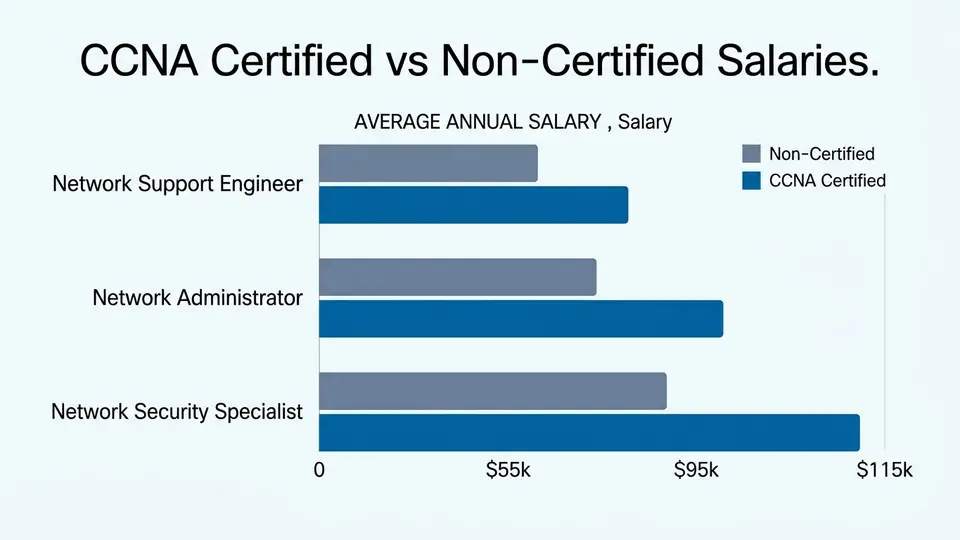
Money is often the biggest driver behind certifying. The CCNA certification salary increase percentage isn't fixed because it depends on your location, job role, experience, and employer. However, certified professionals often earn more than uncertified peers in similar positions. Realistic CCNA salary expectations should also factor in job title and location, as city-based roles usually pay more than roles in smaller markets. Some of the highest-paying jobs with CCNA include network engineer, network security specialist, and systems administrator, especially when combined with a few years of hands-on experience.
- Certified professionals often qualify for roles with wider pay bands than non-certified applicants in the same department.
- The certification can strengthen your position during salary negotiations by providing a recognized credential that demonstrates your networking skills.
- Pay growth often continues as you combine CCNA with specialized certifications in areas such as security or wireless networking.
4. Real-World Networking Skills
Beyond the resume boost, the skills learned in CCNA certification are genuinely useful day to day. Key hands-on skills covered include:
- Network configuration and troubleshooting
- Routing protocols like OSPF
- Network security fundamentals
- Automation and programmability basics
These skills learned in CCNA certification apply directly to real troubleshooting scenarios, not just exam questions. This practical grounding is part of why the value of Cisco certifications in IT industry hiring decisions remains high; managers know the material maps to actual job tasks.
- You learn to read and interpret network diagrams, which speeds up troubleshooting on the job.
- You build a habit of methodical problem-solving, since the exam rewards structured thinking over guesswork.
- You learn how to use command-line tools, which are basic tools networking teams use every day to check and fix networks.
5. Industry Demand, Recognition, and Value
Cisco equipment runs a large share of enterprise networks worldwide, so a Cisco-backed credential tends to carry weight beyond any single company or region. Demand for CCNA-certified professionals stays strong, especially for networking and infrastructure roles, and many employers prefer CCNA over CompTIA Network+ because it is more hands-on and vendor-specific.
- Recruiters often use CCNA as a quick filter when screening resumes for networking or support roles.
- It is recognized across industries, from healthcare and finance to retail and telecom, not just tech-specific companies.
- It pairs well with other credentials, such as CompTIA or cloud certifications, to build a more rounded profile.
- Cisco is a global networking leader, so the credential validates practical, job-ready skills wherever you apply.
6. Beginner Accessibility and Long-Term Relevance
Even if you have no IT background, CCNA is achievable, and it tends to hold its relevance well as technology evolves.
- Many people wonder whether they can start without prior IT experience, and the answer is yes; it's often the first real step into a networking career.
- For beginners specifically, it's a worthwhile starting point because the material is structured and the exam blueprint tells you exactly what to study.
- Even as AI reshapes parts of IT, this certification remains relevant, since networks power AI systems in the first place.
- The road ahead for CCNA remains strong thanks to continued demand in cloud computing, cybersecurity, and enterprise networking.
- The fundamentals you learn transfer across employers, so you're not locked into one company's specific systems, and they form a solid foundation for more advanced certifications later.
CCNA Certification Benefits for Organizations
It isn't just individuals who benefit. Companies also benefit from having CCNA-certified staff on their teams.
- Fewer network outages. Certified staff is trained to follow structured troubleshooting procedures, reducing downtime.
- Lower training costs. New hires with CCNA already understand shared terminology and concepts, so onboarding takes less time.
- Consistent standards. When multiple team members hold the same certification, they tend to configure and document networks in similar, predictable ways.
- Better vendor relationships. Since Cisco equipment is common in enterprise networks, having certified staff makes it easier to get the most out of that hardware and Cisco's support resources.
- Stronger security posture. Certified staff is more likely to follow best practices in access control and network segmentation, thereby reducing the risk of preventable breaches.
- Smoother audits and compliance checks. Standardized configurations and documentation habits make it easier to demonstrate compliance during security or vendor audits.
- Better internal promotion pipelines. Organizations can identify and develop talent from within, moving certified helpdesk or support staff into network roles rather than hiring each time externally.
- Improved client and stakeholder confidence. For IT service providers and consultancies, having CCNA-certified staff on record can reassure clients about the quality of support they're receiving.
For hiring managers reviewing resumes, a CCNA credential is a quick way to filter candidates who have at least a baseline of verified knowledge, which saves time during recruitment. Taken together, these organizational advantages are a big reason companies often list CCNA as a preferred or required qualification in networking and IT support job postings, rather than treating it as a nice-to-have. In some cases, structured preparation paths, such as SterlingNext CCNA Certification Programs, are used to align learning with the skills expected for these roles.
Skills Learned in CCNA Certification
The CCNA exam covers a lot of ground, but the skills you walk away with fall into a few practical categories that show up in almost every networking job.
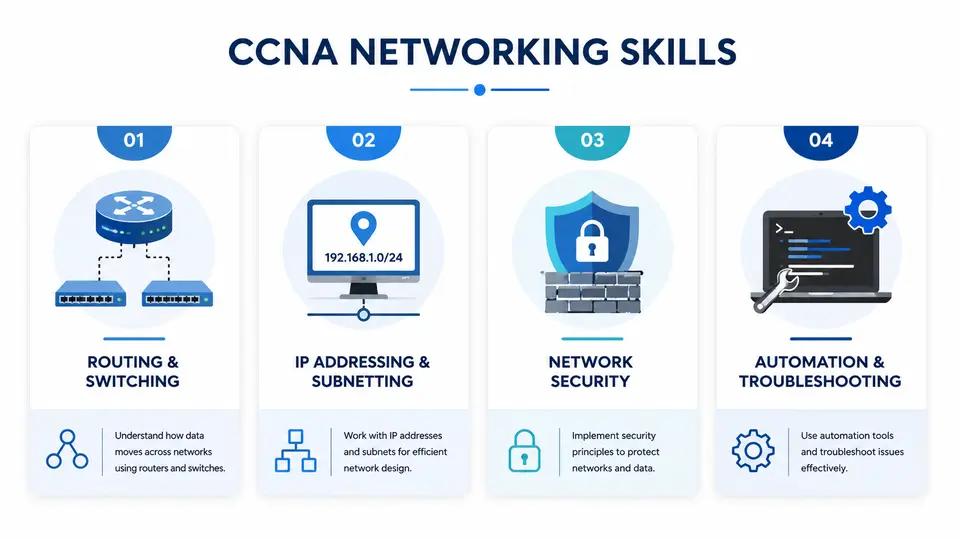
Networking fundamentals
- Learning how IP addresses and subnetting work, which is the base of all networking.
- Understanding how routers and switches send data between devices.
- Learning how a network is built so you can find and fix problems later.
Hands-on configuration
- Setting up VLANs to segment and organize networks.
- Configuring routing protocols like OSPF.
- Securing networks with access control lists and port security.
- Working with the same commands and tasks used in real networking jobs.
Structured troubleshooting
- Solving problems step by step instead of guessing.
- Using tools such as ping and traceroute to check where the network problem is happening.
- Following a clear process to understand what is causing the problem.
Automation and programmability basics
- Understanding how APIs and scripting are starting to reshape network management
- Not a deep dive, but enough exposure to see where the field is heading
Altogether, the skills learned in CCNA certification give you a working knowledge of how networks are built, secured, and maintained, which is exactly what employers expect from someone stepping into a support or junior networking role.
Pros and Cons of CCNA Certification
No certification is perfect for everyone, so it's worth weighing the pros and cons honestly before you commit your time and money.
Pros
- Widely recognized by employers across industries, not just telecom or networking firms.
- Builds a strong technical foundation you can use even if you later specialize elsewhere.
- Opens entry points into helpdesk, support, and junior network roles.
- Can lead to higher-paying, more specialized positions over time.
- Costs far less than a formal degree while still carrying real weight with employers.
- Gives you a clear, structured study path instead of having to guess what to learn.
- Works well alongside other entry-level certifications to strengthen your overall profile.
Cons
- You need to study properly for several months to clear the exam
- There are exam fees and renewal costs you need to pay over time
- CCNA alone is not enough. You still need real practice using labs or real networking work.
- Cisco updates the exam periodically, so material can shift and require re-learning.
- It focuses heavily on Cisco-specific tools and terminology, which may not fully transfer to networks built on other vendors' equipment.
- Without renewal or continuing education credits, the certification can lapse and need to be retaken.
- On its own, it may not be enough to land senior or highly specialized roles, which usually require additional certifications or years of experience.
Conclusion
Choosing a certification depends on what you want to do in your career, so CCNA may not be the right choice for everyone. However, if you want to work in networking, IT support, or network administration, it is a good place to start. CCNA Certification Benefits include helping you learn practical networking skills that many employers value. As technology continues to grow with cloud computing and automation, CCNA remains a useful certification. Take time to understand the concepts, practice in hands-on labs whenever possible, and view the certification as the first step toward building a successful and long-term career in IT.
Recommended Reads
Get Certified With Industry Level Projects & Fast Track Your Career
Checkout Top 10 Highest Paying Jobs
Frequently Asked Questions
CCNA gives you a clear and organized way to show your networking skills. It is a well-known certification that helps you get better job opportunities, improve your resume, and build strong basic networking knowledge for your future.
Yes. Networking skills remain necessary across almost every industry, since businesses rely on stable connectivity for daily operations, cloud services, and remote work.
For most beginners, yes. CCNA teaches basic networking in a simple step-by-step way and is trusted by many employers. It can help you get noticed when applying for entry-level IT jobs.
Yes, it is possible, especially for beginner jobs like support roles. But if you also practice hands-on skills or do an internship, your chances of getting a job become much better.
Common beginner jobs include network technician, helpdesk support, junior network administrator, and IT support engineer. These roles help you start learning real networking work.
Yes, though it will take more study time. Many successful candidates start with no formal IT background and use structured courses or labs to catch up.
No certification can guarantee a job. What CCNA does is make your application more competitive and demonstrate to employers that you have verified baseline knowledge.
Many employers prefer CCNA because it teaches strong networking basics using Cisco systems. It is especially useful in companies that use Cisco equipment, which is common in medium and large businesses.
It shows that you know how to handle basic networking tasks like routing, switching, and fixing network problems. This gives employers confidence that you can do everyday network support work.
Your salary depends on your job, location, and experience. However, CCNA can help you earn more, especially when you combine the certification with practical networking experience.