
Training Outcomes Within Your Budget!
We ensure quality, budget-alignment, and timely delivery by our expert instructors.
Table of Content
- CISSP Domains And Cybersecurity Career Paths
- What Are CISSP Domains?
- How Certification Knowledge Connects To Job Roles
- Cybersecurity Jobs Requiring CISSP: A Career Path Overview
- What Jobs Can You Get With A CISSP?
- Domain Focus Areas By Security Role
- Which CISSP Domains Are Best For Security Architect Roles
- Security Architect Requirements And Modern Architecture Approaches
- CISSP Security Operations Roles And Incident Response
- CISSP Software Development Security Roles And Governance
- Conclusion
Recent Blogs
ISO 31000 Risk Assessment Process
August 27th, 2026
Top Tech Certifications Driving IT Infrastructure Modernization
August 27th, 2026
Kanban vs Scrum: Which Agile Framework to Choose?
August 27th, 2026
Azure AZ-104 Exam Study Guide: Pass on First Attempt
August 27th, 2026
ISO 22301 Clauses Explained
August 27th, 2026
ISO 13485 Medical Devices QMS
August 27th, 2026
Sprint Planning Best Practices: Template & Common Mistakes
August 27th, 2026
How to Write User Stories: Format, Examples & Acceptance Criteria
August 27th, 2026
AWS SysOps Administrator Certification Guide
August 24th, 2026
Cloud Computing Salary Guide 2026: AWS, Azure & GCP
August 20th, 2026
CompTIA Cloud+ Certification: Complete Guide
August 20th, 2026
ISO 31000 vs ISO 27001
August 20th, 2026
CISM Certification Cost and Roadmap for Career Success
August 19th, 2026
CISSP Exam Format & Domains
August 19th, 2026
Closer Look at CISSP Requirements That Truly Matter Most
August 19th, 2026
How CISSP Domains Fit Into Real Cybersecurity Job Paths
Last updated on August 10th, 2026
- Share
-

-

-

-

-

 Sachin Kumar
In this article, you'll learn what each domain covers in simple language and how it connects to real job tasks, what employers look for, and career growth.
CISSP Domains And Cybersecurity Career Paths
Introduction
If you're thinking about a career in cybersecurity, you've probably heard about CISSP. But what does it actually mean, and how is it useful in a real job? Learning the CISSP Domains helps you understand the main skills cybersecurity professionals use every day, not just what you need to pass the exam. It also gives you a clear idea of the Cybersecurity Leadership Career Path, showing how each domain helps you build the knowledge needed for higher-level security roles. In this article, you'll learn what each domain covers in simple language and how it connects to real job tasks, what employers look for, and career growth.

What Are CISSP Domains?
CISSP, which stands for Certified Information Systems Security Professional, is a globally recognized certification for experienced cybersecurity professionals. It's built around eight core knowledge areas, often called domains, covering the full scope of information security.
Each domain focuses on a different area of cybersecurity expertise, such as risk management, network security, or software security, so candidates learn to view security from every angle rather than just one narrow skill.
Here's a quick look at the eight domains:
|
Domain |
Core Focus Area |
|---|---|
|
Managing Security and Risk |
Governance, compliance, and policy |
|
Asset Security |
Classifying and protecting data assets |
|
Security Architecture and Engineering |
Designing secure systems and infrastructure |
|
Communication and Network Security |
Protecting data as it moves across networks |
|
Identity and Access Control |
Controlling who can access what |
|
Security Assessment and Testing |
Auditing and validating security controls |
|
Security Operations |
Monitoring, detection, and incident response |
|
Software Development Security |
Building security into the coding process |
Why This Structure Matters
These domains cover different parts of cybersecurity because real jobs involve many types of tasks. For example, a security professional might check who has access to company systems in the morning and investigate a security alert later in the day. The CISSP domains match these everyday responsibilities and provide a common way to understand and measure cybersecurity skills across different roles.
For beginners, think of the domains as building blocks that together form a complete picture of how organizations protect their data and systems.
How Certification Knowledge Connects To Job Roles
One of the most useful aspects of the CISSP framework is that it doesn't remain theoretical. Mapping CISSP domains to security roles helps job seekers understand exactly where their strengths fit within a security team.
For example, if you enjoy creating rules and planning how security should be managed, you may like the Security and Risk Management domain because it matches governance-related jobs. If you prefer hands-on technical work and problem-solving, the Security Architecture and Engineering domain may be a better fit for hands-on cybersecurity roles.
How Employers Use This Mapping
In job interviews, employers usually ask questions about the CISSP domain that is most important for the role instead of testing you on every cybersecurity topic.
- A compliance officer role may focus heavily on risk and governance domains
- A network security job may focus more on Communication and Network Security.
- A software development job may focus more on Software Development Security.
This makes it easier for employers to find the right candidate and helps professionals learn the skills they need for the job they want in the future.
Cybersecurity Jobs Requiring CISSP: A Career Path Overview
Many companies, especially large businesses and government organizations, prefer candidates to have the CISSP certification when hiring for cybersecurity jobs. These roles usually come with more responsibility and involve making important security decisions.
This isn't limited to one type of role either. From engineering positions to leadership roles, the certification shows up across the board because it demonstrates a broad, verified body of knowledge.
Common Reasons Employers Ask For It
- It shows that the candidate understands how cybersecurity works in large organizations.
- It proves the candidate has real work experience because CISSP requires several years of experience.
- It helps companies train new employees faster because CISSP-certified professionals already understand common security terms and practices.
A Typical CISSP Career Path
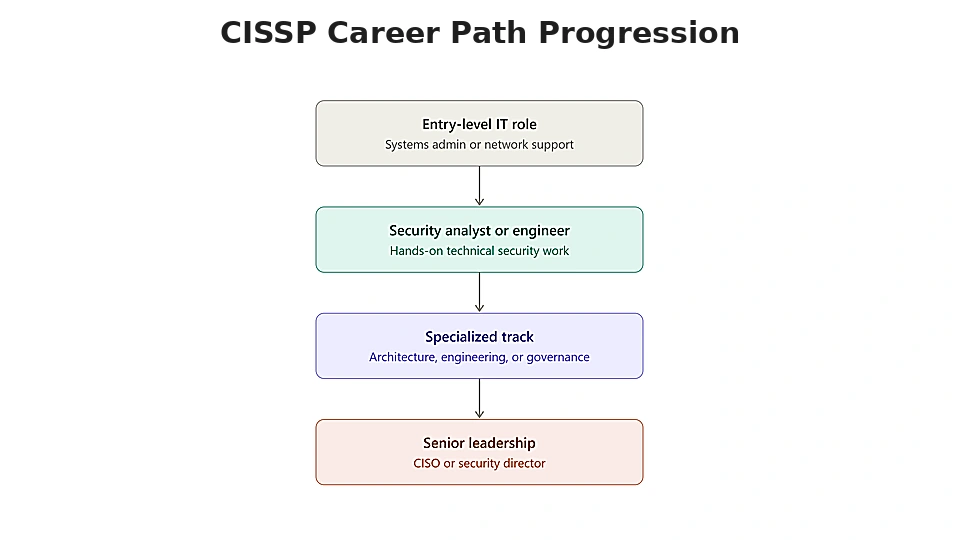
Many professionals start their CISSP career journey in IT roles like system administration or network support. These positions build experience with systems and networks, helping them transition into cybersecurity roles such as security engineer, security architect, or governance specialist.
After working in cybersecurity for a few years, you may be ready for senior or leadership roles. In these positions, you help keep an organization's systems safe and guide security decisions. To prepare for these opportunities, many professionals join CISSP Certification Training to study the eight CISSP domains and get ready for the certification exam.
What Jobs Can You Get With A CISSP?
This is one of the most common questions from people considering the certification. The honest answer is: quite a lot, because the certification is respected across multiple specialties rather than tied to a single job title.
Here are some roles commonly held by CISSP holders:
- Security Analyst
- Security Engineer
- Security Architect
- Security Manager
- Chief Information Security Officer (CISO)
- IT Auditor
- Security Consultant
As you compare different cybersecurity roles, SterlingNext Career-Focused Training provides information on certification programs that align with a variety of professional career paths.
What Changes Between These Roles
While the job titles differ, most of these roles share a few things in common:
- They require an understanding of multiple domains, not just one
- They involve some level of risk-based decision-making
- They often include communication with non-technical stakeholders
A Security Analyst focuses more on monitoring systems and responding to security issues. A Security Manager spends more time planning security policies and managing teams. CISSP does not limit you to one career path. Instead, it prepares you for technical, management, and consulting roles.
Domain Focus Areas By Security Role
Not every CISSP domain is important for every job. The domains you need depend on the cybersecurity role you want. Learning the right domains helps you prepare for the job and perform better in interviews.
|
Security Role |
Primary Domains |
Typical Focus |
|---|---|---|
|
Security Manager |
Security and Risk Management |
Policy, budgeting, and team coordination |
|
Security Engineer |
Security Architecture and Engineering, Network Security |
Building and maintaining technical controls |
|
Security Architect |
Architecture and Engineering, Identity and Access Management |
Designing systems that scale securely |
|
SOC Analyst |
Security Operations |
Monitoring, alert triage, and threat detection |
CISSP Domains For Security Managers
For this role, the most important CISSP domains are governance, risk management, and working with people. Security managers spend more time creating security policies, planning budgets, and working with different teams than doing technical tasks.
CISSP Domains For Security Engineers
In this role, the main focus is on system design, network security, and building secure systems. Security engineers create and manage the security tools and controls that protect an organization's computers, networks, and data.
Which CISSP Domains Are Best For Security Architect Roles
Many people ask this when planning their cybersecurity career. Security architects need strong knowledge of system design and engineering. They also need to understand identity management and network security to build secure and reliable systems.
CISSP Domains For SOC Analysts
For this role, the main focus is on monitoring and daily security tasks. Security analysts watch for suspicious activity, investigate security alerts, and report real threats. These skills are an important part of their everyday work.
Security Architect Requirements And Modern Architecture Approaches
The role of a security architect has changed over time. Today, it's not enough to secure only the network. Security architects also need to protect cloud systems, distributed environments, and user access across different platforms.
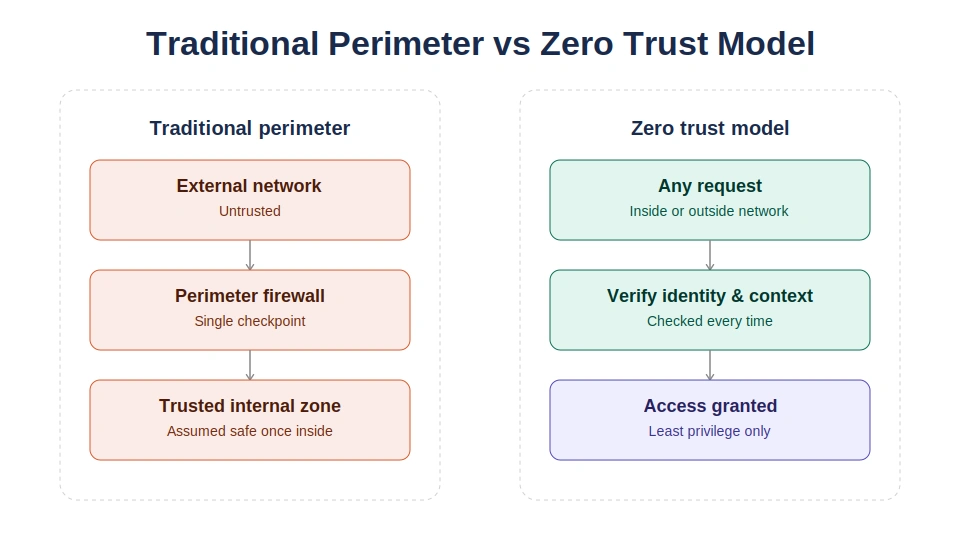
Zero Trust Security Architecture
One big change is the use of Zero Trust security. Instead of automatically trusting people or devices inside the network, Zero Trust checks and verifies every user and device before giving access.
This approach has become a standard expectation in architecture-focused interviews because it reflects how modern organizations operate.
Enterprise Identity And Access Management
Alongside zero trust, enterprise identity and access management has become a core skill area for architects. Making sure the right people have the right access is central to reducing risk across large organizations.
Strong architects understand how these identity systems integrate with everything from cloud applications to on-site infrastructure, ensuring consistent controls wherever data lives.
CISSP Security Operations Roles And Incident Response
Not every security career is about designing systems. Many professionals spend their careers keeping systems running safely, day to day.
What Falls Under Operations
These positions typically involve monitoring, investigating, and responding to threats in real time. This is often the entry point for many cybersecurity careers, since it offers hands-on exposure to real incidents.
Responding When Things Go Wrong
Incident response is a key part of this role. When a security problem happens, such as a phishing attack or a data breach, the team works quickly to find the problem, stop it from spreading, and reduce the damage.
Typical tasks include:
- Monitor security alerts and system logs for suspicious activity.
- Investigate security incidents to understand what happened and how serious they are.
- Record what was learned from each incident to improve security in the future.
Security Infrastructure Engineering Support
Operations teams don't work in isolation. This kind of engineering support ensures that the tools, servers, and monitoring systems teams rely on remain healthy and properly configured.
CISSP Software Development Security Roles And Governance
Security isn't only about networks and operations; it also touches how software itself gets built.
Where Development Meets Security
These positions focus on making sure applications are built with security in mind from the first line of code, rather than patched after the fact.
Software Development Security Practices
Developers can improve software security by writing better code, checking it constantly, and looking for weaknesses. When problems are found early, fixing them usually takes less time and effort.
Governance, Risk, And Design Principles
Security governance and risk management help create the rules that development teams follow, they make sure security decisions match the organization's goals, risks, and compliance needs.
Security design principles also play an important role by helping teams build safer systems from the start, practices like giving users only the access they need and using multiple layers of protection help reduce security risks.
Conclusion
CISSP is not only about passing an exam. It can also help you understand the skills required for different cybersecurity careers. Each CISSP domain covers a specific part of security and relates to the work professionals do in real jobs. For example, if you like investigating risks and finding security issues, a role in security analysis may interest you. If you enjoy creating rules and making decisions, cybersecurity policy or management could be a better fit. Those who like working with technology may enjoy designing and protecting secure systems. Learning about these domains can help you choose a career direction, plan your studies, and develop skills that support your growth in cybersecurity.
Get Certified With Industry Level Projects & Fast Track Your Career
Checkout Top 10 Highest Paying Jobs
Frequently Asked Questions
The CISSP certification is built around eight knowledge areas that cover key parts of cybersecurity, including security operations, risk management, and software security; these domains help professionals understand how security practices are applied across different areas of an organization.
Different cybersecurity roles focus on different CISSP domains. While professionals need to know all eight areas for the certification, their daily work usually depends more on a few specific domains.
CISSP is useful for people in technical, management, and governance roles. It helps professionals understand security concepts, manage risks, and make better security decisions. You do not need to spend every day writing code or configuring firewalls to benefit from CISSP.
Most people spend around three to six months preparing, studying a few hours a week alongside full-time work. It really depends on your existing experience with the domains, how much time you can realistically commit, and how comfortable you already are with exam-style questions.
CISSP requires relevant work experience, so it suits professionals with some background in IT or security. Complete beginners are usually better served by starting with entry-level certifications, then working toward the CISSP once they've gained hands-on experience.
Employers use it as a simple way to confirm that a candidate understands key security concepts across different areas. A CISSP certification shows hiring managers that the professional has knowledge of multiple cybersecurity domains.
Employers can use it to quickly check whether a candidate has strong knowledge of different security areas. A CISSP certification shows that the professional understands essential concepts across various cybersecurity domains.
CISSP supports career growth into senior and leadership positions, it covers governance, technical knowledge, and security operations, helping professionals show they can handle wider security responsibilities beyond individual tasks.
Real incident experience helps develop practical skills that books alone cannot provide. The lessons learned from handling security issues can later support growth into engineering positions or management roles.
Zero trust and identity management aren't separate topics, they live inside specific CISSP domains. That's why professionals with strong domain fundamentals tend to design and support these modern frameworks more effectively than those without.