
Training Outcomes Within Your Budget!
We ensure quality, budget-alignment, and timely delivery by our expert instructors.
Table of Content
Recent Blogs
Adobe Premiere Pro System Requirements
July 31st, 2026
PMP Exam Format and Syllabus Explained
July 31st, 2026
How CISSP Certification Impacts Long Term IT Career Paths
July 31st, 2026
Why Choosing PMI RMP Certification Can Benefit Your Career
July 31st, 2026
How to Unhide a Post on Facebook
July 31st, 2026
PMI Certification Choices for Focused Career Growth Path
July 31st, 2026
Types of Charts in Excel
July 31st, 2026
Smart Path to CompTIA Security+ Certification Mastery
July 31st, 2026
CISM vs CISSP Which One Fits Better in Your Career Journey
July 31st, 2026
Android vs iOS: Key Differences
July 31st, 2026
What is PowerPoint?
July 31st, 2026
CCSP vs CISSP Know What Works Best for Your Career Future
July 31st, 2026
Security+ VS CISSP Which Certification Is Better
July 31st, 2026
Common Networking Concepts You Must Know For Network
July 31st, 2026
What is PMP Certification Complete Beginner Guide
July 31st, 2026
CISA Certification Career Path
Last updated on July 30th, 2026
- Share
-

-

-

-

-

 Sachin Kumar
Benefits of CISA Certification, such as better career opportunities, industry recognition, and higher earning potential. This guide explains what the certification is, the requirements to earn it, the exam format, costs, timeline, career opportunities, and whether it's the right choice for your professional goals all in simple, beginner-friendly language.
CISA Certification Career Path for Audit, Risk, and Information Security Roles
If you're exploring careers in IT audit, risk, or compliance, you've likely come across the CISA certification, CISA Career Path is one of the most respected routes into information systems auditing and can lead to opportunities in audit, governance, and security teams. Before deciding whether to pursue it, many professionals also look into the Benefits of CISA Certification, such as better career opportunities, industry recognition, and higher earning potential. This guide explains what the certification is, the requirements to earn it, the exam format, costs, timeline, career opportunities, and whether it's the right choice for your professional goals all in simple, beginner-friendly language.
What Is the CISA Certification?
CISA stands for Certified Information Systems Auditor, a globally recognized credential from ISACA, a professional association focused on IT governance and cybersecurity. It's built for people who assess, control, and monitor an organization's information systems.
Here's where beginners often get tripped up: a U.S. government agency, the Cybersecurity and Infrastructure Security Agency, also uses the acronym CISA. That agency runs the CISA cyber career pathways tool, a resource for exploring cybersecurity work roles under the NICE Framework. It's useful for mapping a cyber career, but unrelated to the ISACA exam this article covers.
Why does the ISACA certification matter? Auditors who understand both business operations and IT systems are in high demand, employers need people who can:
- Spot weaknesses in IT controls before they cause damage.
- Confirm systems meet regulatory and policy standards.
- Translate technical risk into a language that leadership understands.
That mix of skills is what hiring managers look for when filling audit and risk positions.
CISA Prerequisites: What You Need Before You Start
Before diving into exam prep, it's important to understand whether you're ready to pursue this certification. The good news is that CISA has no hard academic prerequisites, but understanding the background that helps will save you time and frustration.
Educational Background
ISACA does not require a specific degree to sit for the CISA exam. Candidates from IT, computer science, accounting, finance, business, and management backgrounds all pursue the credential. What matters more than your degree is your comfort with IT systems and audit or control concepts.
Recommended Prior Knowledge
While not mandatory, candidates tend to do better with some exposure to the following:
- Basic IT concepts: A basic understanding of how computers, networks, databases, and software work.
- Audit basics: Knowing the purpose of audits.
- Risk management: Understanding how businesses identify problems, evaluate risks, and reduce potential issues.
- Governance frameworks: Some familiarity with frameworks like ISACA COBIT, ITIL, or International Organization for Standardization ISO 27001 can be helpful, but you don't need to be an expert before starting.
If you're entirely new to IT or audit, spending a few weeks on introductory materials before jumping into CISA study will pay off significantly.
Work Experience Requirement
To get the full CISA certification, you need five years of work experience in IT auditing, security, risk, or related fields. However, and this is important, you do NOT need to have this experience completed before sitting the exam. You can pass the exam first and then fulfill the experience requirement within ten years of passing. Certain educational substitutions can also reduce the experience requirement by up to two years.
This flexibility is one reason the CISA certification path appeals to professionals still early in their careers.
Before planning your certification journey, review the complete CISA eligibility requirements to understand ISACA's experience requirements and certification process.
CISA Certification Requirements and How the Process Works
Before earning the credential, you'll need to meet ISACA's CISA certification requirements. They're straightforward, but skipping a step can delay things.
The Three Core Requirements
- Pass the exam: Complete a four-hour test with 150 questions covering topics such as IT auditing, governance, technology systems, and security.
- Gain the required experience: Most candidates need five years of relevant work experience in IT auditing, controls, or security, in some cases, education or other qualifications can reduce this requirement.
- Apply for certification: Submit your application, agree to ISACA's professional ethics rules, and commit to continuing education to keep your certification active.
You Don't Need Everything Lined Up First
Many beginners are surprised to learn that you don't need all of the required work experience before taking the exam. Many candidates choose to pass the exam first and then gain the necessary experience later within the time period allowed by ISACA. This makes the CISA certification path more flexible than many people expect, especially for professionals who are still building their experience while studying. For working professionals, this can be one of the fastest ways to progress through the CISA certification path without putting their careers on hold.
CISA Exam Structure: What the Test Actually Looks Like
Understanding the exam format before you study helps you prepare smarter.
Format and Duration
|
Detail |
Information |
|---|---|
|
Number of Questions |
150 multiple-choice questions |
|
Duration |
4 hours |
|
Delivery |
Computer-based, at Pearson VUE testing centers |
|
Passing Score |
450 out of 800 |
|
Language Options |
Available in multiple languages |
The Five Job Practice Domains
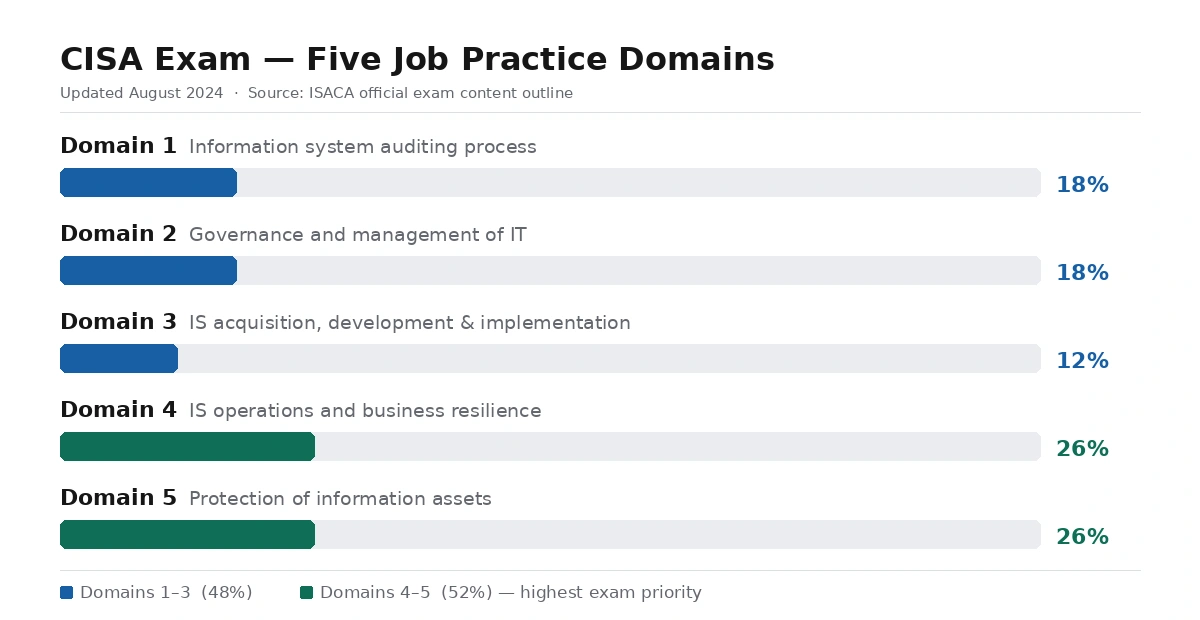
The exam is organized around five domains, each weighted differently:
|
Domain |
Topic Area |
Approximate Weight |
|---|---|---|
|
Domain 1 |
Information System Auditing Process |
18% |
|
Domain 2 |
Governance and Management of IT |
18% |
|
Domain 3 |
Information Systems Acquisition, Development and Implementation |
12% |
|
Domain 4 |
Managing IT Operations and Business Continuity |
26% |
|
Domain 5 |
Protection of Information Assets |
26% |
Domain 5, Protection of Information Assets, carries the most weight. Domain 2, Governance and Management of IT, trips up the most candidates who underestimate how much governance knowledge the exam tests.
Question Style Judgment Over Memorization
The CISA exam is not just about root-learning facts and definitions. Most questions are based on real-world situations and ask what an auditor should do in a specific scenario. In many cases, more than one answer may seem correct, but you must choose the best answer from an auditor's point of view. Because of this, candidates with hands-on audit or risk management experience often find the exam easier than those who rely only on studying books and notes.
How Long Does It Take to Complete CISA Preparation?
One of the most common questions beginners ask is how long it takes to earn the CISA certification. If you already have the required work experience, the biggest step is passing the exam. Most candidates spend about three to six months preparing for it. After passing, the application and approval process usually takes a few more weeks. As a result, many professionals complete the entire certification process in about six months to one year.
For how long to study for CISA specifically, most candidates put in 100 to 150 hours over two to four months. A simple approach:
- Work through the Review Manual, domain by domain.
- Take practice questions after each domain.
- Focus on weaker domains based on practice scores.
- Complete two full-length practice exams before the real one.
Studying a little at a time over several months is usually more effective than trying to learn everything at the last minute. That's because the CISA exam focuses on real-world decision-making, not just memorizing facts. Candidates who follow a structured CISA Exam Study Plan often find it easier to stay organized, cover all exam topics, monitor their progress, and improve weaker areas before exam day.
How Hard Is the Exam, and How Does It Compare to Other Credentials?
Is CISA difficult to pass? The exam is considered moderately challenging, but it is achievable with proper preparation. While ISACA does not officially publish pass rates, many estimates suggest that about half of candidates pass the exam. The challenge is not that the topics are impossible to learn, but that the exam focuses on applying knowledge and making good decisions in real-world situations rather than simply remembering facts and definitions.
Common mistakes include:
- Ignoring the governance and management domain, assuming it is less important than technical topics.
- Treating CISA as a technical exam when it is primarily an audit and risk-focused exam.
- Skipping practice tests, which can lead to poor time management during the actual exam.
With a study plan and realistic expectations, the exam is manageable.
CISA Certification Cost
Understanding the CISA certification cost is essential before starting your certification journey. While the exam fee is the largest expense, there are several other costs to consider when planning your budget.
1. CISA Exam Registration Fee
The main cost of earning CISA is the exam registration fee, which varies based on whether you are an ISACA member:
- ISACA Members: Pay a lower, discounted exam fee.
- Non-Members: Pay a higher exam fee.
Since exam fees can change over time, it's a good idea to check the latest pricing before registering.
2. Study Materials and Exam Preparation
Most people use study materials to help them prepare for the CISA exam. Common options include:
- CISA study books
- Practice tests
- Online courses
- Live training classes
- Boot camps and workshops
- Study groups
The cost depends on the study method you choose. Learning on your own with books and practice tests is usually cheaper, while full training programs and boot camps can be much more expensive.
3. Certification Maintenance Costs
Getting the CISA certification is not a one-time process. To keep it active, you'll need to pay a yearly maintenance fee and continue learning through professional education activities, this helps CISA holders stay current with changes in technology, auditing, risk, and cybersecurity. When budgeting for CISA, remember to account for both the exam costs and the ongoing costs of maintaining the certification.
4. Total Cost Considerations
The CISA exam fee is only one part of the cost. You may also need to pay for study materials, training, and practice tests, after you earn the certification, there are yearly fees to keep it active. Knowing these costs ahead of time can help you plan better.
Is the CISA Certification Worth the Cost?
Although earning a CISA certification requires a financial commitment, many professionals consider it a valuable investment because it can:
For a more natural, beginner-friendly style:
- Builds trust and professional credibility in the industry.
- Can help increase earning potential and salary opportunities.
- Opens pathways to senior audit, risk management, and leadership roles.
- Strengthens knowledge of IT governance, risk, and compliance practices.
- Supports long-term career growth in auditing, cybersecurity, and IT risk management fields.
Benefits of the CISA Certification
The CISA Certification Course offers strong career and professional advantages, especially for roles in IT audit, risk, and compliance.
- Better job opportunities: CISA is accepted by employers in banking, finance, IT, insurance, and consulting. It helps you qualify for roles in many industries.
- Higher salary potential: Certified professionals often earn more because companies value proven skills in audit, risk, and control.
- Strong credibility and trust: it shows that you understand how to assess, control, and secure business systems, which is important for senior-level roles.
- Career flexibility: as well. Since it is not limited to one technology or tool, you can move across different industries and departments without losing relevance.
- foundation for advanced certifications: like CISM, CRISC, and CGEIT, helping you grow into leadership roles in governance and risk management.
CISA Career Path and Job Opportunities in IT Audit
Once certified, a wide range of roles open up across banking, insurance, healthcare, technology, and government, since nearly every organization now runs on digital systems that need auditing.
Typical Entry-Level Roles to Target
CISA can help you get jobs like IT Auditor, Risk Analyst, and Compliance Analyst, you check systems and help find problems. With time and experience, you can become a manager or even a director who leads teams and makes important decisions.
What People Say About the Career Path for CISA
Most Reddit discussions about CISA say it is useful for getting IT audit and risk jobs. However, it is not enough alone. People get better results when they already have IT, security, or finance experience. The certification helps more in moving up or getting interviews than starting from zero.
CISA Job Roles and Responsibilities Explained
Many people ask about the career path network engineer to CISO. CISA alone won't get you there. Most network engineers also need CISM, hands on security leadership, and management experience since CISO is a business role not just a technical one.
Typical Day-to-Day Work
- Checking IT systems and controls
- Finding security gaps and risks
- Making sure rules and policies are followed
- Writing reports for managers
- Suggesting fixes and improvements
- Working with IT and business teams
CISA Salary and Career Growth Over Time
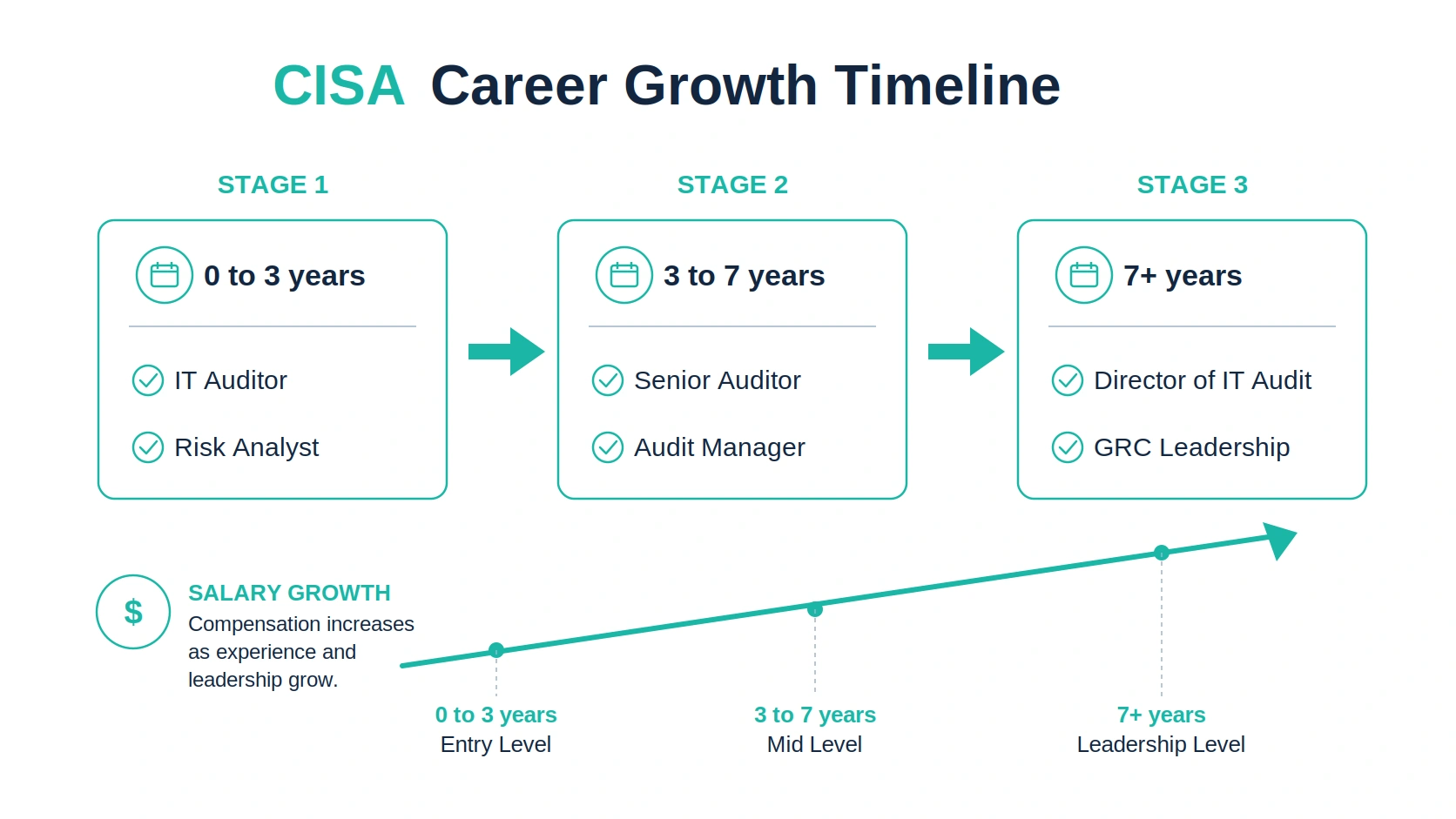
One of the biggest motivators for the CISA Career Path is naturally CISA salary and career growth. Figures vary by country and experience, but certified professionals in the U.S. generally earn well above non-certified peers, with senior managers and directors earning significantly more in regulated industries like banking and insurance. Many professionals also rely on SterlingNext Professional Training Programs to support their progression in this field.
How progression tends to look:
- 0–3 years: Risk Analyst or IT Auditor, learning and doing basic audits.
- 3–7 years: Audit Manager or Senior Auditor, handling bigger audits and teams.
- 7+ years: Director or GRC leader, managing strategy, teams, and decisions
Is CISA worth it for career growth? Yes, Most people who want jobs in audit, risk, or compliance, CISA is worth it. It shows employers you know the basics of checking systems and managing risk. It can help you get better job opportunities, grow faster in your career, and sometimes earn more over time.
CISA vs CISM, and Other Common Comparisons
A common confusion in the CISA career path is choosing between CISA and CISM. Both are ISACA certifications but have different purposes. CISA is focused on auditing and checking IT systems and controls, while CISM is focused on managing and leading security programs. If you like auditing, CISA is a better fit. If you want leadership in cybersecurity, CISM is more suitable. Many professionals eventually earn both for senior roles. For someone aiming to become a CISO, CISA alone is usually not enough. It is often combined with CISM and leadership experience, since CISO roles are more about strategy than auditing.
Not sure if you're eligible? Read our complete guide to CISA certification requirements before scheduling your exam.
Conclusion
The CISA career path is for people who want to work in IT audit, risk, and compliance roles. It mainly focuses on checking how well computer systems and controls are working and making sure they follow security and company rules. When you prepare for CISA, you learn about the exam pattern, who can apply, the cost, job roles you can get, salary expectations, and how it is different from CISM. It also helps you understand how IT audit and governance work in real companies.It takes time and regular practice to complete this certification because you also need some real work experience. But if you stay consistent, it can help you build a stable career and open up good job opportunities in IT audit and related areas.
Recommended Reads
Get Certified With Industry Level Projects & Fast Track Your Career
Checkout Top 10 Highest Paying Jobs
Frequently Asked Questions
People who want to work in IT audit,compliance, and risk it focuses on how organizations control their systems, manage risks, and maintain secure and reliable information systems.
There are no strict entry requirements to take the exam. However, the certification is awarded after passing the exam and completing 5 years of relevant work experience in IT audit, control, or security-related roles. Some experience waivers may apply.
The exam has 150-MCQs and lasts 4 hours, it covers five main areas like IT governance, security, and auditing. The questions are based on real situations and test how you make practical decisions.
The total cost depends on several factors, including the exam fee, optional ISACA membership, and preparation courses, overall expense varies based on how you choose to study and the resources you use.
Most candidates take around 6 months to a year to prepare and pass the exam, earning the certification also depends on completing the required work experience, which may take longer.
It is not very easy because it is more about using concepts in real audit situations than just memorizing theory. Having practical experience helps a lot. Many people are not able to pass in their first attempt.
Common starting roles include IT Auditor, IT Risk Analyst, and Compliance Analyst, with more experience, you can move into Senior Auditor, Audit Manager, or Director of IT Audit positions.
DISA is a diploma that focuses on information systems audit, mainly for accounting and audit professionals and CISA is more widely recognized worldwide, while DISA is more limited and specific to audit-related jobs.
Most candidates study for about 2 to 4 months regular, practicing and understanding each domain step by step is more effective than last-minute studying.
Neither is universally harder. CISA suits people with an IT background while CIA suits those from finance or accounting. Whichever aligns less with your experience will naturally feel more difficult.