
Training Outcomes Within Your Budget!
We ensure quality, budget-alignment, and timely delivery by our expert instructors.
Table of Content
- ISO 45001 Benefits That Improve Workplace Health and Safety
- What Is ISO 45001 and Why Is It Important?
- What Is ISO 45001 Certification?
- Why Do Organizations Look for ISO 45001?
- Key ISO 45001 Benefits and Their Business Impact
- Who Benefits From ISO 45001 Certification?
- ISO 45001 Benefits Across Industries and Company Sizes
- Workplace Safety Before and After ISO 45001 Certification
- Common Myths and Facts About ISO 45001
- Is ISO 45001 Worth It?
- Conclusion
Recent Blogs
ISO 45001 Documentation Requirements
August 4th, 2026
Best Software Development Projects Guide for All Developers
August 4th, 2026
Communication in Project Management for Modern Workplaces
August 4th, 2026
Master Project Plan in Excel with Templates and Easy Steps
August 4th, 2026
How to Build a Requirement Traceability Matrix Effectively
August 4th, 2026
Complete Guide to Project Failure Causes and Prevention Tips
August 4th, 2026
Project Management Plans: The Complete Resource
August 4th, 2026
Key Project Report Writing Techniques You Should Use Today
August 4th, 2026
What Is the Project Management Life Cycle? 5 Phases Explained
August 4th, 2026
Understanding Project Management Career Path Completely
August 4th, 2026
Effective Agile Risk Management for Better Project Outcomes
August 4th, 2026
ISO 9001 Lead Auditor Interview Guide: Questions Hiring Managers Actually Ask
August 4th, 2026
What Every Project Coordinator Should Know About Their Role
August 4th, 2026
Top Digital Marketing Projects Every Marketer Should Know
August 4th, 2026
Agile vs Traditional Project Management Essential Breakdown
August 4th, 2026
Benefits of ISO 45001 Certification
Last updated on August 4th, 2026
- Share
-

-

-

-

-

 Sachin Kumar
It can be used by small businesses and large companies across different industries. By following the standard, organizations can make daily work safer and reduce avoidable interruptions.
ISO 45001 Benefits That Improve Workplace Health and Safety
Introduction
Workplace accidents can affect employees and businesses in many ways, someone may get hurt, work may be delayed, and the company may face extra costs or legal problems. The ISO 45001 benefits help businesses deal with these risks before they become bigger problems. The ISO 45001 Workplace Safety Standard gives companies a practical way to find hazards, improve safety, and involve workers in everyday safety decisions. It can be used by small businesses and large companies across different industries. By following the standard, organizations can make daily work safer and reduce avoidable interruptions.
What Is ISO 45001 and Why Is It Important?
ISO 45001 gives organizations a clear way to improve workplace health and safety, as defined by the International Organization for Standardization . It helps identify possible hazards, manage risks, and take practical steps to create safer working conditions. Professionals who want to learn about its basic requirements, structure, and safety principles can study them through ISO 45001 Foundation training. The standard is important because it replaces informal and reactive safety practices with a clear, documented, and consistent process.
Before ISO 45001, many organizations handled workplace safety through separate policies and by reviewing incidents after they happened. ISO 45001 takes a different approach by requiring organizations to identify and control hazards before work starts.
The importance of ISO 45001 certification becomes clear when an organization faces a serious workplace incident. A documented safety system shows that proper precautions were in place and safety risks were being managed. This can be important during investigations, audits, and legal proceedings.
Why this standard carries weight:
- It can be used by organizations of any size and in many different industries.
- It can work alongside other management systems, such as ISO 9001 for quality management.
- It requires active involvement from top management, rather than relying only on approval from a safety officer.
A regional food processing plant, for instance, might have relied for years on a single safety supervisor's judgment. The benefits of the health and safety management system ISO 45001 shift that responsibility into a shared, documented process that survives staff turnover and scales as the plant grows.
What Is ISO 45001 Certification?
ISO 45001 certification is formal recognition that an organization has a workplace health and safety management system that meets ISO 45001 requirements. An independent certification body checks the system to see whether workplace risks are identified, controlled, monitored, and improved through a clear and consistent process.
How the Certification Process Works
The certification process usually includes a review of safety policies, risk assessments, employee training, incident records, internal audits, and workplace safety practices, auditors may also speak with employees and managers to check whether safety procedures are clearly understood and followed during everyday work.
ISO 45001 certification is different from simply reading or applying parts of the standard. Implementation means putting the required health and safety processes in place, while certification involves an external assessment of those processes.
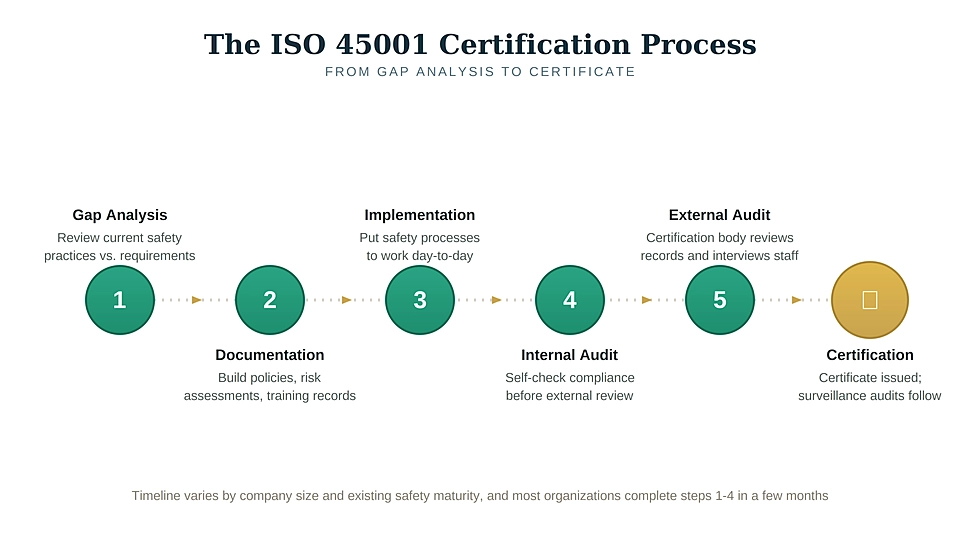
What ISO 45001 Certification Means
The certificate does not mean that workplace accidents will never happen instead, it shows that the organization follows a recognized system to reduce risks, involve employees, meet safety requirements, and improve workplace health and safety over time.
The benefits of ISO 45001 implementation become easier to see as organizations follow the system every day, making workplace safety more consistent and reducing preventable risks.
Why Do Organizations Look for ISO 45001?
Organizations choose ISO 45001 mainly to reduce workplace accidents, meet client or legal requirements, and protect their reputation, according to BSI, 79% of organizations said ISO 45001 helped them comply with regulations. The decision is often driven by legal needs, client expectations, and a real effort to prevent workplace injuries and harm.
This is important because a workplace accident can lead to more than just immediate expenses. It may also result in missed workdays, increased insurance costs, and lower employee morale.
Common reasons organizations seek certification:
- Client or tender requirements that mandate a certified supplier
- A history of incidents that management wants to prevent from repeating
- Pressure from insurers offering better terms to certified companies
The benefits of ISO 45001 certification for companies operating in supply chains are often tied directly to contract eligibility. A parts supplier to an automotive manufacturer, for example, may lose out on renewal contracts if a competitor holds certification and it does not. Beyond contracts, the benefits of ISO 45001 for organizations also show up internally, in clearer accountability when an incident occurs.
Key ISO 45001 Benefits and Their Business Impact
The key benefits and advantages of ISO 45001 come from spotting problems early, managing safety risks, and checking safety practices regularly. This reduces accidents, meets safety requirements, controls costs, and makes workplace safety easier to manage.
1. Reduces Workplace Accidents and Injuries
ISO 45001 encourages companies to spot safety problems before they cause accidents organizations typically see 30 to 50% fewer incidents within the first year through regular risk checks, equipment inspections, and safety measures that prevent injuries, damage, and disruptions at work.
2. Supports Health and Safety Compliance
The standard gives organizations a clear way to identify safety needs, assign responsibilities, and maintain important records, this makes it easier to prepare for inspections and show that workplace safety requirements are being properly handled.
3. Improves Hazard Reporting
Clear reporting procedures allow unsafe conditions, near misses, and workplace concerns to be raised early this gives organizations more time to investigate issues and introduce corrective action before serious harm occurs.
4. Strengthens Risk Management
A key benefit of implementing ISO 45001 is that organizations can make risk assessment a regular part of their daily operations, new equipment, workplace changes, contractors, and processes can be reviewed before they introduce additional hazards.
5. Reduces Operational Disruption
Few workplace incidents can reduce downtime, investigations, and disruptions to daily work, this helps organizations keep work running smoothly and avoid delays that could have been prevented.
6. Controls Incident-Related Costs
A workplace accident can bring several unexpected costs, such as medical bills, damaged equipment, time away from work, and compensation claims. When organizations take steps to deal with safety risks early, they can avoid many of these problems. This can also reduce work delays and help employees carry out their daily tasks without unnecessary interruptions.
7. Encourages Continual Improvement
Internal audits, management reviews, corrective actions, and employee feedback help organizations regularly review workplace safety, these activities also make it easier to update safety practices when working conditions or risks change.
Who Benefits From ISO 45001 Certification?
ISO 45001 helps employees, organizations, and businesses in different ways, employees can benefit from safer working conditions, organizations can improve workplace safety, and businesses can build trust while reducing disruptions to daily operations.
Benefits of ISO 45001 for Employees
The benefits of ISO 45001 for employees include safer working conditions, clear safety procedures, regular training, and a proper way to report hazards, employees can also take part in safety decisions, which can improve communication and build confidence at work.
Benefits of ISO 45001 for Organizations
The benefits of ISO 45001 for organizations include better risk control, clear responsibilities, improved recordkeeping, and more consistent safety practices, regular audits and reviews also help organizations find problems and improve workplace safety over time.
Benefits of ISO 45001 for Business
The benefits of ISO 45001 for business include fewer disruptions, greater customer trust, and better control of costs linked to workplace incidents, certification may also help with tenders and supplier approval when safety standards are part of the selection process.
Benefits of ISO 45001 for Small Business
ISO 45001 can help small businesses set clear safety responsibilities and follow the same safety steps as the company grows, simple system can replace informal safety habits with clear processes that are easy to follow without adding extra complexity.
ISO 45001 Benefits Across Industries and Company Sizes
The value of ISO 45001 depends on the type and size of the business different industries have different workplace hazards and safety needs. Customer and client expectations can also vary between industries.
Benefits for Large and Multi-Site Organizations
When a company has sites in different locations, keeping the same safety standards everywhere can be difficult. ISO 45001 gives each site a common way to handle training, responsibilities, inspections, and audits. This helps the company manage health and safety more easily across all its locations.
Benefits Across Manufacturing, Construction, and Logistics
In manufacturing, ISO 45001 helps companies spot machinery risks, check equipment regularly, and make the production floor safer for workers.
On construction sites, it helps teams carry out safety checks, manage contractor risks, prepare for emergencies, and control dangerous work.
For logistics companies, the standard can be useful for improving warehouse safety, checking vehicles, handling materials correctly, and making loading and unloading safer.
Workplace Safety Before and After ISO 45001 Certification
ISO 45001 helps organizations move from reacting to safety problems to preventing them, it allows organizations to identify hazards early, assign clear responsibilities, and regularly check safety performance.
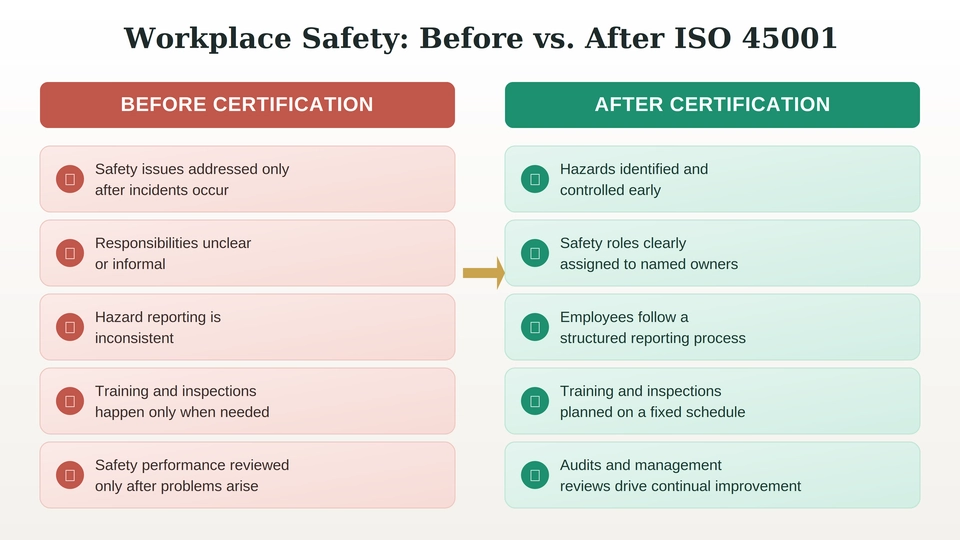
These changes help organizations manage workplace risks more consistently. The results develop over time as employees and management follow the system in daily operations.
Common Myths and Facts About ISO 45001
Several misconceptions keep organizations from pursuing certification. Separating myth from fact helps decision-makers evaluate the standard on its actual merits.
|
Myth |
Fact |
|---|---|
|
Only large companies need ISO 45001 |
The standard scales to any size, including small businesses with a handful of employees |
|
Certification is a one-time achievement |
It requires ongoing surveillance audits to remain valid |
|
It replaces local safety laws |
It works alongside regulations, not instead of them |
|
It only benefits management |
Employees gain formal reporting channels and safer daily conditions |
|
Implementation is too expensive for the return |
Reduced incidents and insurance costs often offset setup costs over time |
Organizations preparing for certification often start by requesting a benefits of ISO 45001 checklist from a consultant to confirm they have the required documentation in place. Many also look for the benefits of ISO 45001 PDF guide published by accredited standards organizations for more detail.
Is ISO 45001 Worth It?
For most organizations with physical workplace hazards, ISO 45001 is worth pursuing because implementation costs are generally smaller than the long-term cost of unmanaged risk.
Signs that certification is likely worth the investment:
- The organization has had repeated safety incidents or near-misses.
- Clients or tenders increasingly require proof of a certified safety system.
- Insurance costs are rising because of a history of workplace claims.
Organizations with low-hazard office environments may see a smaller return initially. However, the long term benefits of ISO 45001 certification are often more noticeable in manufacturing, construction, and logistics, where fewer incidents and better access to contracts can outweigh the cost of certification.
The value of ISO 45001 depends on an organization’s risks, size, and safety responsibilities. Readers comparing it with other professional standards may also come across SterlingNext Certification Training Programs while reviewing different learning and certification options.
Conclusion
The advantages of ISO 45001 go beyond getting a certificate, the standard helps businesses spot safety problems early and take action before they cause injuries. The standard can be used in a small workplace or a large company with hundreds of employees. It can help reduce accidents, make safety duties easier to understand, and build trust with customers and business partners. Businesses working toward certification can start with a basic checklist, ask employees for their input, and review safety practices from time to time. Safety should be part of the normal workday, not something people think about only when an inspection is coming.
Get Certified With Industry Level Projects & Fast Track Your Career
Checkout Top 10 Highest Paying Jobs
Frequently Asked Questions
ISO 45001 helps organizations spot workplace threats, control risks, and involve employees in safety discussions, it also encourages companies to improve their everyday safety practices, helping protect workers and reduce the risk of accidents.
ISO 45001 certification helps reduce workplace accidents, improves safety communication, and clarifies responsibilities, it also strengthens risk management and supports the creation of a safer workplace that employees, customers, and business partners can trust.
The time needed for ISO 45001 certification depends on the size of the company, how it operates, and the safety measures already in place, some companies may finish the process in a few months, while others may need more time to prepare.
During the audit, the auditor checks company records, looks at how safety procedures are followed at work, and talks with employees. The goal is to see whether the company follows ISO 45001 requirements and uses its safety system in day-to-day operations.
Yes, ISO 45001 may help companies avoid unnecessary downtime, fewer workplace accidents can mean fewer interruptions, less staff absence, and a smoother flow of daily work.
ISO 45001 may not lower insurance costs on its own, but when a company has fewer accidents and a good safety record, it may have a better chance of getting better insurance terms. Some insurers offer 5 to 15 percent lower premiums for certified organizations.
Yes, ISO 45001 certification can give companies an advantage when applying for tenders or becoming approved suppliers. It shows clients that the company takes workplace safety seriously and has proper safety practices in place.
Yes, ISO 45001 can also be useful for office-based businesses, it can help them deal with common workplace concerns such as poor ergonomics, stress, fire risks, electrical issues, and emergency situations.
Implementation means creating the safety system and using it in the workplace. Certification is the next step, where an independent auditor reviews the system to check that it follows ISO 45001 requirements.
Yes, companies need to renew their ISO 45001 certification. Regular audits take place during the certification period, followed by another full audit when the certificate is due for renewal.